Free Easter Resources: For Personal Devotion or Lesson Preparation

Here’s one for all you procrastinators. My hope is that this post will serve you, your family, and your church in making much of King Jesus this Easter.

The Gospel Project

The writers of The Gospel Project have provided a lesson on The Resurrection and Exaltation of King Jesus. Below are the PDF versions of this session in both Adult and Student Leader Guide and Personal Study Guide.

Gospel Centered Discipleship

Jonathan Dodson and Brad Watson have written an excellent free e-book titled Raised: Doubting the Resurrection. The authors write: “We wrote this book out of our love for skeptics and respect for the questions they help us ask. We also write as believers who oscillate in real belief in the resurrected Christ. We hope it proves to be an insightful, stirring reflection on the resurrection.” You can download it below.

Desiring God

Desiring God has provided eight biblical devotions to prepare for Easter. 

They have also provided definitions for some words of the season

  1. Holiday: From a combination of two Old English words, halig + daeg—holy day; day set apart for special religious observance.
  2. Lent: From an Old English word related to lengthen. It meant springtime, when the days are lengthening. Now we use it to refer to the days between Ash Wednesday and Easter.
  3. Ash Wednesday: In the Bible, ashes are a sign of mourning, an appropriate symbol as we think of our part in the death of our Lord.
  4. Maundy Thursday: The night when we look back to the Lord’s Last Supper gets its name from the Latin word mandatum—commandment, remembering Jesus’ words to the Apostles during the Last Supper, “A new commandment I give to you, that you love one another: just as I have loved you, you also are to love one another” (John 13:34).
  5. Good Friday: This worst day in history is also good because of the reconciliation that comes through the cross.

Tim Keller

A few years ago Tim Keller wrote an article for Relevant Magazine on the Resurrection. In the article Keller writes:

Jesus had risen, just as He told them He would. After a criminal does his time in jail and fully satisfies the sentence, the law has no more claim on him and he walks out free. Jesus Christ came to pay the penalty for our sins. That was an infinite sentence, but He must have satisfied it fully, because on Easter Sunday He walked out free. The resurrection was God’s way of stamping PAID IN FULL right across history so that nobody could miss it.

Keller also wrote an article titled The Resurrection and Christian Mission, in which he argues:

Christians move out into a violent world as agents of peace, into a broken world as agents of reconciliation, into a needy world as servants of the poor. We do so knowing that it is God’s will to eventually end all war and division, all poverty and injustice. The resurrection of Christ assures us that God will redeem not just souls but bodies, and will bring about a new heavens and new earth. As the risen Christ, he stands not just with us in our present time, but he waits at the end of history to heal and renew everything. That is his promise. Therefore, we will not fear.

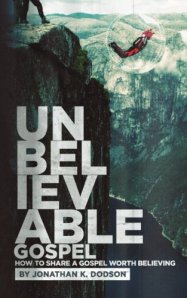
Unbelievable Gospel by Jonathan Dodson

Francis Schaeffer was once asked what he would say if he had an hour to share the gospel with someone. He responded by saying: “I will spend the first fifty-five minutes asking questions and finding out what is troubling their heart and mind, and then in the last five minutes will share something of the truth. (18-19)”

DodsonThis quote is refreshing to those of us who grew up in the age of canned gospel presentations. Many of us have been trained to put others in evangelistic headlocks and wait for them to tap out with a decision to follow Christ. This is why many readers will find Jonathan Dodson’s Unbelievable Gospel refreshing. Dodson does a good job of balancing gospel truth with patient proclamation.

According to Dodson, an “…evangelist isn’t someone who coughs up information about Jesus or proselytizes people…an evangelist is someone who communicates the gospel of Jesus with patience and wisdom. (18)” Like Schaeffer modeled, the work of an evangelist includes listening patiently in order to wisely show others why the gospel is actually worth believing.

“How is the gospel good news to those we evangelize? Evangelicals are proficient at rehearsing the information of the gospel but we often lack the ability to situate the gospel in the lives of others. (9)”

When we share the gospel with others do we wonder if they are able to perceive how the gospel is good news for them? What people need to know is not only what the gospel is, but also what the gospel does. We need to show how Jesus is better! Dodson suggest that using gospel metaphors at the prompting of the Holy Spirit is a more effective way to aim at the heart of the listener. In other words, use the gospel for how we share the gospel. Here are some examples:

  • To those searching for acceptance in all the wrong places, we can point them to perfect acceptance in the gospel of justification.
  • To those searching for fulfilling relationships, we can point them to profound, personal union with Christ.
  • To those who struggle with tolerance, we can show them the uniqueness of Christ in the gospel of redemption.
  • To those who fear disapproval or demand the applause of others, we can share the gospel of adoption, which offers an enduring approval and produces humble confidence.
  • To anyone longing for a new start, there is the hope of new creation.

Moreover, Dodson argues that Gospel theology should drive evangelistic methodology. People do not want to hear a memorized presentation, they want to know how the gospel is good news to them. So the gospel is not only the evangelistic message but also provides an evangelistic method. In other words, the gospel also informs how we share the good news.

  • Instead of preachy self-righteousness, we can point people to Christ’s righteousness, which is based on his performance not ours.
  • Instead of impersonal evangelism, we can share the hope of Jesus from our personal union with Christ.
  • Instead of being intolerant, we can lovingly tolerate the differences between religions while also communicating the unique redeeming work of Christ.
  • Instead of using right answers to gain approval or applause, we can share an enduring approval that comes through faith in the Father who adopts through the Son.
  • Instead of sharing a shallow gospel of information, we can communicate the deep transformative gospel of new creation.

The premise of this book is simple. Dodson observes that people often find the gospel unbelievable and reasons that two groups of Christians contribute to this unbelief.

  • The first group shares a gospel that is preachy, impersonal, intolerant, condescending, or shallow—mediocre news at best. We may mention who Jesus is, even what he has done, without lifting a finger to delve into the doubts and struggles people face.
  • The second group remains silent hoping their actions will remedy evangelistic concerns. The problem, however, is that the “good news” must be heard.

Dodson offers a better way. Using the concept of gospel metaphors, illustrated with real life stories, Dodson suggests that we listen to others in order to share a gospel worth believing. This concise book is a very welcome addition to the category of evangelism. Pick up your copy here.