C.S. Lewis the Poet

“All this flashy rhetoric about loving you.
I never had a selfless thought since I was born.
I am a mercenary and self-seeking through and through;
I want God, you, all friends, merely to serve my turn.
Peace, reassurance, pleasure, are the goals I seek,
I cannot crawl one inch outside my proper skin;
I talk of love – a scholar’s parrot may talk Greek –
But, self-imprisoned, always end where I begin.”

C.S. Lewis

This is one of the reasons I love to read Lewis, he is reflective, thoughtful, and brutally honest in his writing.

I remember the first time I read this poem, I was forced to think of own state of depravity in contrast to the riches of God’s grace shown to me in the Gospel.

A Thought on Personal Revelation.

In our society, the idea of ‘revelation’ as means of knowing truth is laughed at in most circles. “Ever since the enlightenment, there has been a decided tendency to presuppose the supremacy of a rational-empiricism” as foundational, and we are told to work from there to obtain knowledge.

Let me define some terms. Empiricism is ‘sense perception’, how you and I come to real world encounters. Much of human awareness comes through sense perception. Rationalism is the obtaining of knowledge through rational, logical processes (Mathematics, Deductive Logic).

While rational thought is necessary to ‘think of experience’, rational thought grows out of experience and is a limited and finite expression. This thought process focuses on the finite particulars of this world, or ‘only the things we can know from experience’. Well, what about God? While, I think we can know that God exists by using the processes of rational-empiricism I do not think this goes far enough. I believe that God is a personal God. It seems that way since He has decided to make Himself known to all creation (Rom. 1:19-20).  So if He does exist, how can one know Him personally?

As a Christian I believe that knowing God in a personal way is the only means to everlasting life. There is only one way to know God, Jesus put it like this in John 14;

“Let not your hearts be troubled. Believe in God; believe also in me. I am the way, and the truth, and the life. No one comes to the Father except through me. If you had known me, you would have known my Father also. From now on you do know him and have seen him.”

Therefore it stands that “if God is truly an ultimate, transcendent, supernatural Person, He could hardly be known personally or understood in any redemptive in-depth sense by mere finite empirical, rational, intuitive grounds alone”. This is why God chose to reveal himself to mankind, and revealed himself most fully in the life and work of Christ. This is the ‘personal revelation’ needed to know God most fully. Or should I put it this way, God’s revelation of himself is absolutely necessary to know Him in a personal way.

Think about it, if God were to reveal himself at all to persons, such as you and I, He could have hardly done it in any other fashion than as a person. So God does speak, and speaks to man cognitively in a personal way through revelation on a finite level.

Note: I am currently reading “The Word of the Cross“, by Lewis A. Drummond. Some of the quotes above are taken from this book.
An Argument from Numbers; The New Testament and Other Literature from Antiquity

Is the New Testament really reliable? This question seems to return to the secular ‘drawing board’ over and over. As Christians we believe that the Bible is the authoritative word of God, and is a faithful witness of the historical accounts of Jesus Christ. In fact, Christianity is rooted in history, and makes claims that can be historically investigated. While I am not going to deal with the whole scope of issues here in this blog, I do want to point out a couple of relevant facts about the New Testament.

The New Testament’s 5,366 Greek copies make it the best transmitted book in antiquity. Plato’s works survive in 7, of Homer we have 643 copies, Caesar’s Gallic Wars are found in 10, and finally Livy’s Roman History, 35 of 142 books survive in 20 copies (the oldest has the Book of Hebrews written on the back).

Think about it, the New Testament alone has 5,366 documents to compare for accuracy!

While some critical scholars would argue that ‘textual variants’ discount the Bible’s accuracy. It is quite clear that we have enough evidence to make educated and prayerful choices about the original text. Even if we were to make a mistake, no major doctrine would be at risk. In fact, if we were to get all the textual variants wrong, over 95 percent of the text would be without dispute.

What’s the point? The historical accuracy of the Bible is often scrutinized wrongly, against all the historical evidence that points to its accuracy. In comparison to the other books of antiquity, we have much more text to compare from a critical historical standpoint. Therefore we can have more confidence in the historical accuracy of the New Testament (in a literary sense) than we do in knowing that we have all of Plato’s works close to their original form.

The Bible is a faithful witness of the historical accounts of Jesus Christ. But knowing that His words have been accurately handed down is not enough. What’s more important is whether you believe that what he said was true. In fact, Your eternal destiny depends on it.

The Beauty of the Gospel

As Christians we hold that there is one true God. We also confess that He has made Himself known to all of creation, and made Himself known most fully in the life and work of His only son Jesus Christ. This is the essence of the Gospel. The Gospel is more than enough to keep us in astonishment over the loving kindness and mercy of God.

But, I fear that many times, more often than not, the Gospel has become commonplace for many Christians. We all have that tendency, once we become acquainted with something great, no matter what it is (the grand canyon, the beauty of the ocean, the sound of great music, and even the Gospel), it becomes mere commonplace.

While we were in Antigua recently Laura and I were talking to one of our tour guides and I made a comment along the lines of “your beaches are breathtaking”. He paused and agreed, but then he continued and said there are many natives who take it for granted, in fact, he had friends that had not visited their beaches in over 10 years.

Its good to remind ourselves of God’s grace. It’s also good to let others remind us. The video below does this.

The narrator is R.C. Sproul, David Crowder and Shane & Shane sing “To the Only God” in the background.

An Article in COLLIDE MAGAZINE!

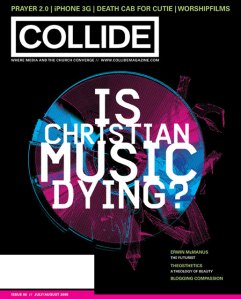
I recently submitted an article to COLLIDE MAGAZINE, and it is going to appear in the July/August issue. This issue should hit mailboxes on or around July 15. Below is a snapshot of the cover, so be on the lookout for it! I am very excited about this article! I have always loved to write, I see this as just another ministry opportunity.

The article is titled “Theosthetics: A Theology of Beauty” (It’s on the bottom right hand corner).

Exploring The Use of Mnemonic Devices, Part 3

Last week my Pastor made a comment on the use of ‘mnemonic devices’ in the Greek text of the New Testament, since then ‘the topic’ has been in the back of my mind. I mentioned in a previous post that my Greek professor Dr. Black had been helpful in this process, he came through again when he emailed me this link earlier today.

This link is an article written by Dr. Black “On the Reading of Poetry”, in the International Standard Version of the Bible. In the ISV, the translators have attempted to retain the poetic nature of the Greek text in the parts of scripture where the majority of scholars acknowledge that poetic structure exists.

This musing is thought provoking!


Exploring The Use of Mnemonic Devices, Part 2

I have been thinking about the use of mnemonic devices for the past few days, and how the beauty of ancient Greek (which often sings) is often lost in our English translations. My Greek professor from seminary gave me some guidance. Dr. Black serves on the ‘committee on translation’ for the International Standard Bible. The ISV is a project that is close to being finished. You might be thinking, ‘great…another Bible translation, thats all we need!’

Well, there are many reasons why I am excited about the ISV. In particular, while translating the Greek text these scholars have tried to retain the use of mnemonic devices in certain places. Let me give you a few examples;

Read this translation of Titus 1:12“Liars ever, men of Crete, savage brutes that live to eat”.

Do you see the difference? Even more interesting, check out how the translators have retained the hymn like nature of Philippians 2:6-11.

In God’s own form existed he,
And shared with God equality,
Deemed nothing needed grasping.
Instead, poured out in emptiness,
A servant’s form did he possess,
A mortal man becoming.
In human form he chose to be,
And lived in all humility,
Death on a cross obeying.
Now lifted up by God to heaven,
A name above all others given,
This matchless name possessing.
And so, when Jesus’ name is called, 
The knees of everyone will fall
Where’er they are residing.
Then every tongue in one accord,
Will say that Jesus Christ is Lord,
While God the Father praising.

Building a Theological Library

Before seminary I often found myself wanting to study a certain book of the Bible, or an issue of theology and not knowing where to look for reliable resources. There are thousands of books out there on Christian thought, and it is often overwhelming when it comes time to choose.

Over the past few years I have bookmarked a few places where you can find references from reliable sources. Here are a few, if I come accross any others in the future I will update this page.

I was talking with Derek Radney about recommending theological books to others and he made a good point, sometimes it can be hard for others to pick up on the theological slant that a writer may be coming from. While in seminary I have learned about different positions, slants, and writers who hold those views. So, while each of these references may hold different views concerning particular aspects of theology, none of which jeopardize orthodoxy, I recommend the following.

a. Dr. Daniel Akin: “Building a Theological Library”.

b. Desiring God: References concerning Bible Commentaries.

c. Denver Seminary: An Annotated Bibliography of the Old Testament and New Testament.

Lewis on The Holy Spirit

When we study theology, we often study theology in a systematic way. This is where we look at certain truths, certain doctrines of the faith on their own as revealed in the scripture. It seems to me that we hear much less about the Doctrine of the Holy Spirit than we do of God the Father, or Christ His son.

Now, we as Christians beleive that the eternal triune God reveals Himself to us as Father, Son, and Holy Spirit, with distinct personal attributes, but without division of nature, essence, or being. It’s when we look at these distinct personal attributes that we tend to shy away from the Holy Spirit.

I was reading C.S. Lewis over the weekend for pleasure, I enjoy reading Lewis (though I do not agree with him all the time). While reading Mere Christianity I read this quote and thought it was poignant,

“Do not be worried or surprised if you find Him rather vague or more ‘shadowy’ in your mind than the Father or the Son. I think there is a reason for this. In the Christian life you are not usually looking at Him. He is always acting through you.” (175-176)

This truth is often referenced as we talk of the Holy Spirit as “Paraclete”, the helper, teacher, comforter, defender, the “one called alongside.” The title expresses the variety of ministries the Spirit performs by coming alongside us as Christians.

I often look back at instances and realize that God was somehow working through, around, in front, behind, and in me. The providence of God is a mysterious truth!

For more, read what Jesus teaches in John 14-16.

Exploring The Use of Mnemonic Devices

“Judge not, that you be not judged. For with the judgment you pronounce you will be judged, and with the measure you use it will be measured to you.” (Matthew 7:1-2)

My pastor pointed something out to me in Matthew 7 earlier today. There are a couple words in the Greek text that are used very repetitively. I think he did this because he knew it would eat away at me until I studied it.

After he left I read it over a few times, and then a few more time out loud, and realized that the Greek text of Matthew 7 might provide an insight into the usage of mnemonic devices in teaching. The ancient Greek language often ‘sings’ much better than modern English, providing a good vehicle for transferable teaching. Imagine you hear the words of Jesus in the Greek text.

Greek

Μ κρίνετε, να μ κριθτε·, ν γρ κρίματι κρίνετε κριθήσεσθε, κα ν μέτρ μετρετε μετρηθήσεται μν.

Transliteration (How the Greek sounds in English)

Mh krinete, ina mh kriqhte:

en w gar krimati krinete kriqhsesqe,

kai en w metrw metreite metrhqhsetai,

umin!

Wooden Translation

Not judge, that (you) not be judged:

In what judgment you judge, you will be judged,

And in what measure you measure it will be measured,

to you!

Why does this matter? Well, I believe Jesus taught others in such a way that it could be put into practice. While Jesus might have spoken this in Aramaic, the (translated) Greek rendered here is very precise. In fact, one commentator argues that the didactic nature of Matthew’s writing style suggests that Matthew himself was an experienced teacher. In ancient teaching practices mnemonic devices were often used as a vehicle for ‘transferable teaching’. It’s one thing to learn an abstract idea, it’s another thing to put that idea into practice. When the teaching is easy to remember, its easier to recall in any given situation.

It’s possible that this passage was constructed this way for a reason. Read the transliteration again and try to place it into a tune, I know this sounds silly but make a song out of it. Now imagine that song becoming a ‘jingle’ that plays in your head every time you are about to pass a harsh unqualified condemnation on someone. Get the point? I am not saying that Jesus was singing the Sermon on the Mount. But there is something different about a teaching that ‘sings’! Have you ever noticed you capacity to remember songs?