Dietrich Bonhoeffer: To the Psychologist we are Sick, but to the Christian we are Sinful

I am re-reading David Powlison’s book Seeing with New Eyes for my doctoral cohort on pastoral counseling coming up at the end of January. This book has profoundly impacted how I view pastoral ministry.  Powlison has helped transform how I approach teaching, counseling, and countless other pastoral opportunities. In the first few pages Powlison cites a quote by Dietrich Bonhoeffer that exposes what makes for a deep understanding of human nature.

The most experienced psychologist or observer of human nature knows infinitely less of the human heart than the simplest Christian who lives beneath the Cross of Jesus. The greatest psychological insight, ability, and experience cannot grasp one thing: what sin is. Worldly wisdom knows what distress and weakness and failure are, but it does not know the godlessness of man. And so it also does not know that man is destroyed only by his sin and can be healed only by forgiveness. Only the Christian knows this. In the presence of a psychiatrist I can only be a sick man; in the presence of a Christian brother I can dare to be a sinner. The psychiatrist must first search mt heart and yet he never plumbs its ultimate depth. The Christian brother knows when I come to him: here is a sinner like myself, a godless man who wants to confess and yearn for God’s forgiveness. The psychiatrist views me as if there were no God. The brother views me as I am before the judging and merciful God in the Cross of Jesus Christ.

– From Dietrich Bonhoeffer’s Life Together in the chapter on “Confession and Communion”
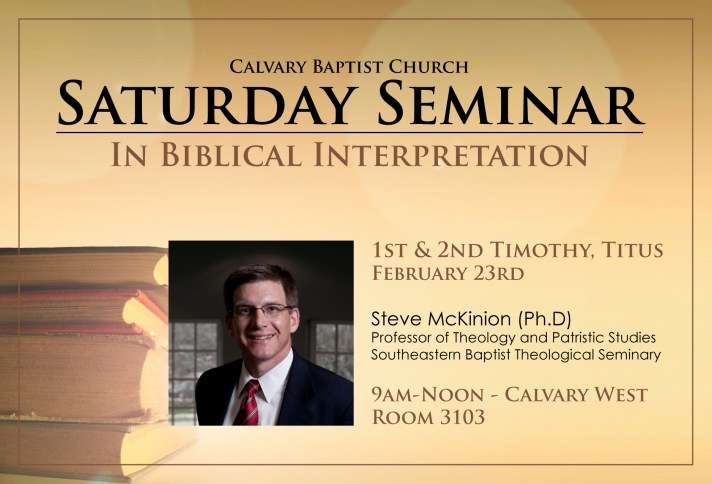
Saturday Seminar on 1st/2nd Timothy and Titus with Dr. Steve McKinion

Dr.McKinion

To sign up for this free training event please click on this link

On February 23rd we will have another Saturday Seminar in Biblical Interpretation on the 1st & 2nd Timothy and Titus with Dr. Steve McKinion fromSoutheastern Baptist Theological Seminary, where he serves as a Associate Professor of Theology and Patristic Studies. Here is a little background information on Dr. McKinion from his personal website.

He finished his BA at Mississippi College, his MA at the University of Mobile, and his PhD at the University of Aberdeen, Scotland, where he studied patristics with Iain Torrance. At age 27, after completing his PhD, he became a professor at Southeastern Baptist Theological Seminary, where he has taught since. He has also been a Visiting Professor at the University of Mobile, The Southern Baptist Theological Seminary, and Trinity Evangelical Divinity School. Steve has also helped lead several church launches, and is currently leading a new church startup in Raleigh called New Covenant Fellowship. Writing has been a big part of his life.  In addition to the articles, dictionary entries, and books he has in print, he is currently completing two major projects: the Isaiah volume in the Reformation Commentary on Scripture with IVP, and Invitation to Historical Theology with Kregel.

Dr. McKinion has already published the books Life and Practice in the Early Church, A Commentary on Isaiah 1-39 in the Ancient Christian Commentary on Scripture Series, and Words, Imagery, and the Mystery of Christ: A Reconstruction of Cyril of Alexandria’s Christology.

See his personal website at – http://www.stevemckinion.com/

To sign up for this free training event please click on this link

A Theological Reflection on Assurance and Perseverance: “How Do You Know That You Know?”

I thought about subtitling this post “how do you know that you know that you know in your heart of hearts that if you died tonight you would go to heaven“. I have actually heard the question of assurance posed that way by evangelists and pastors. Which is a ridiculous way to pose such an important and serious question. Assurance of salvation can be a very personal and emotional struggle for thoughtful followers of Christ. As a pastor, I often receive questions from people concerning their salvation. Questions like:

  • If I am a Christian, why don’t I feel like it sometimes?
  • If I am a Christian, why do I succumb to the same temptation over and over?
  • If I am a Christian, why does God feel so distant?
  • If I am a Christian, why do I wrestle with doubt?

Continue reading “A Theological Reflection on Assurance and Perseverance: “How Do You Know That You Know?””

Why We Need a Suffering Savior.

This morning Will Toburen ended his sermon with these moving words from John Piper, and I wanted to post them here.

Mass murder is why Jesus came into the world the way he did. What kind of Savior do we need when our hearts are shredded by brutal loss?

We need a suffering Savior. We need a Savior who has tasted the cup of horror we are being forced to drink.

And that is how he came. He knew what this world needed. Not a comedian. Not a sports hero. Not a movie star. Not a political genius. Not a doctor. Not even a pastor. The world needed what no mere man could be.

The world needed a suffering Sovereign. Mere suffering would not do. Mere sovereignty would not do. The one is not strong enough to save; the other is not weak enough to sympathize.

So he came as who he was: the compassionate King. The crushed Conqueror. The lamb-like Lion. The suffering Sovereign.

These words are from Piper’s blog post titled: How Does Jesus Come to Newtown?

Devotions in 2nd Peter

For the past few months I have been writing devotions on 2nd Peter for The Biblical Recorder, the North Carolina baptist newspaper. Each devotion is only 300 words and follows the outline of LifeWay’s Sunday school curriculum “Explore the Bible“. Perhaps you will find them helpful.

PDF of Devotions on 2nd Peter

Living with Truth (2 Peter 1:1-21)

More than 50 years ago Francis Schaeffer argued that the change in the concept of the way we come to knowledge and truth is the most crucial problem facing Christianity. The issue of truth is still important today. The cultural war on truth has a multifaceted and colored history. Like all cultural conversation, the dispute over truth has effects on each one of us, sometimes causing doubt, sometimes causing us to feel inadequate in our understanding of the faith.

The apostle is clear in 2 Peter 1:12-15 that it is good to be reminded of the truth, even if one is already firmly established in the faith. The presence of false teachers is something the church has always dealt with. The anchor of truth that holds believers from cultural sway often needs strengthening in the rough waters of this life.

So Peter reminds us of the truth of the gospel. He starts by arguing that our standing before God was accomplished by the righteousness of our Savior Jesus Christ. God’s grace in Jesus provides us with all the blessings pertaining to life and death. In response to the beauty of God’s grace on our behalf, giving us a transformed heart, he pleads with us to make every effort to live a life that honors God through the power of the Spirit.

See, the truth of the gospel is something we never move beyond. The truth of the gospel is something that we need to be reminded of often. Only the good news of Jesus Christ has the power to stir Christians to holiness. Therefore, let us be a people who prayerfully return to the Word of God, in reliance on the Spirit of God, to live as the people of God. The truth of the gospel will stand alone eternally, long after the smoke of our cultural wars have cleared.

Continue reading “Devotions in 2nd Peter”

The Christian Home as the Context of Discipleship

For the first time in its history, Western civilization is confronted with the need to define the meaning and purpose of the word family. We as Christians recognize that the family is not merely a sociological development, nor a product of human evolutionary progress, but God’s good design for human living–the family is most basic unit of human society, and for us as Christians the primary context of discipleship. Biblically speaking, the family is grounded upon the integrity of biblical marriage, as one man and one woman who are of like faith and both seeking to know and love God. This is lived out in front of our children. Moreover, the family is the context in which children are seen as gifts from God to be raised, educated, spiritually trained, and disciplined for their well-being. It is within these contexts that you and I, and our children, face the most intimate and consistent challenges of our faith.

Continue reading “The Christian Home as the Context of Discipleship”

How Do You Discern God’s Will?…

As a pastor one of the questions I receive most often is “what is God’s will for…”? This question is most often applied in personal situations and in the context of church life. How many of us have asked questions like:

  • What is God’s will for my life as it pertains to what school I will attend?
  • What is God’s will for my life as it pertains to what job I will take?
  • What is God’s will as it pertains to which mission trip I should take?
  • What is God’s will for our business as we make this big decision?
  • What is God’s will for our church as we head into the future?

The list could go on and on. So, how do you know if you are “doing God’s will?” Well, I think that we will be challenged in our conventional view of “discerning God’s will” when we take a quick look at the way Scripture talks about God’s will. Too often “God’s will” is primarily talked about in the context of secret personal plans or mystical church direction. But in the Bible we see a different context in which the language of God’s will is applied.

Continue reading “How Do You Discern God’s Will?…”

Pastoral Priorities and the Mission of the Local Church

Pastoral priorities are deeply imbedded in the matters of ministry philosophy and pastoral resolve. The question of priorities has been the substance of ecclesiological concern since the formative years of the early New Testament church. In the second chapter of Acts we find that the church was devoted to the apostles’ teaching and fellowship – the breaking of bread prayer.[1] As the church grew, the pastors came to realize that it was not right that they should give up preaching the word of God to serve tables.[2] In many ministry contexts it seems like the congregation expects the pastors to do the work both of pastor and of deacon. While serving tables is certainly not a bad thing, it possesses the potential to distract from the pastor’s primary focus and work. Prioritizing ministry focus can be one of the most effective ways that pastors can maintain personal health and ensure faithfulness to true effective gospel ministry. In the contemporary church setting, a congregation’s expectations of pastors can cause one to be exhaustingly busy and unfocused. By implication, this can lead to lack of clarity in the overall mission of the church. With so many programs, committees, and events, it is hard to prioritize what is most important to focus time and energy on.

Continue reading “Pastoral Priorities and the Mission of the Local Church”

Devotions on 1st Peter

For the past few months I have been writing devotions on 1st Peter for The Biblical Recorder, the North Carolina baptist newspaper. Each devotion is only 300 words and follows the outline of LifeWay’s Sunday school curriculum “Explore the Bible“. Perhaps you will find them helpful.

To download a PDF of the complete devotions on 1st Peter click here

Living with Lasting Hope (1 Peter 1:1-12)

The Apostle Peter penned First Peter to be circulated among God’s elect scattered throughout modern-day Turkey, an area that covered about 130,000 square miles. The purpose of the letter was to encourage the people of God in remaining faithful. We are reminded that Peter’s precious Savior Jesus Christ once charged him to feed the sheep. Here he does so very sweetly reminding them of the hope they have in the work of the triune God.

If there is anything that a troubled person needs, it is hope. And if there is anything that the promises of God in Christ offer, it is a hope that cannot be sabotaged. But sometimes Christians need to be reminded of this truth, especially when the cold dark clouds of suffering, distress and uncertainty block the horizon. Hope, according to Paul, calls believers to look beyond present circumstances towards an inheritance that is imperishable, undefiled and unfading.

This eternal hope has undeniable implications on how we face difficulty in the present life. There are many people around us who hold on to the empty philosophies of the world. Nevertheless, people continue to sacrifice their lives for these empty promises. Yet, for Christians we realize that Christ offered Himself as the ultimate sacrifice so that we could be brought to God, the only one in whom our deepest needs could be met.

We need to be reminded of the hope we have in Christ. May the Spirit stir up a longing for our true home with God, and for the inheritance we have in Christ. As Charles Spurgeon once wrote, “observe that the inheritance is kept for the saints, and the saints for the inheritance.” This is certainly a message that should circulate among believers as we are scattered as strangers in a fallen world, awaiting the glorious appearing of our Savior. Our hope is built on nothing less, than Jesus’ blood and righteousness.

Continue reading “Devotions on 1st Peter”

Sermon Video: “Until the Coming of the Lord…” (James 5:1-12)


Last Sunday I preached from James 5:1-12, and titled the sermon “Until the Coming of the Lord…”. I am thankful for Will Toburen‘s willingness to share the pulpit, and for his devotion to developing other preachers at Calvary.