In Honor of Will Toburen: The Transition to Summit Church in Durham, N.C.

Today marks the end of Will Toburen’s pastoral ministry at Calvary Baptist Church in Winston-Salem, N.C. However, Will’s legacy will continue at Calvary for many years to come. Will served as an Associate Pastor and Senior Associate Pastor at Calvary for well over a decade. He will now join the pastoral team at the Summit Church in Durham as the Executive Pastor for Discipleship Ministry. I’ve talked with the Summit’s pastor J.D. Greear recently and he, along with the rest of their team, is excited to welcome Will to their staff. What a great addition to an already stellar team!

photoWhen I came to Calvary as a seminary student in the Calvary School of Pastoral Leadership in 2006, Will along with Al Gilbert immediately pulled me in and began investing in my life. These two men have a very special place in my heart (and heart of hearts). They have both shaped my own life and ministry in ways they may never fully know. As for Will specifically, I view him as an older brother in the Christian life. A much wiser brother.

Will’s belief in me, his loving support, and his timely challenges have been formative and affirming – something that every Christian needs and few have the opportunity to receive. Not only has Will become a dear friend, he was part of our wedding ceremony, supported our adoption process, and always encouraged me to grow in ministry through preaching, teaching, and dozens of other ministry opportunities in the local church. Since I cannot be at Calvary for his last Sunday, or attend his going away fellowship, I would like to offer a few thoughts on Will here.

Will is a gifted preacher. I would put him up there with almost anyone. While Will is one of the best, he will never seek his own fame – he gladly points to the Father. I watched Will bring passion and humility to the pulpit for almost 7 years. First and foremost, Will always preached with Jesus as the center of his sermons. Will understands the gospel and works hard to apply the gospel through every text he preached. Will was also humbly honest from the pulpit. One of the things I valued dearly in his ministry was his willingness in admitting where he had failed and where he could work harder in his own personal life. Unlike some preachers who believe that one must always “have it together” to maintain strong leadership, he lead through repentance and humility.

While he was strong in the pulpit, he was so gentle with the people. Calvary loves Will. He grew up at Calvary. He was taught in Sunday School by many of the people who eventually sat under his preaching. I could always sense the mutual endearment when Will would visit some of those dear saints in the hospital or when he would stand by them as they slipped into eternity. I have watched Will weep with those who weep, hold congregants hands when they needed a pastors love, and celebrate the joys of life with many of the people. These are lessons I will treasure for the rest of my life. When I think of servant leadership – many of my lessons were learned under Will.

As a West Campus team we would meet once a week to pray, plan, and hold each other accountable. Each week Will would not only ask us hard questions, but he would also ask for our feedback on his life and ministry. He was always quick to go above and beyond to serve others. He rightly sought chances to grow and learn from others, even guys like me who were well under his ministry age. As I look back I can only conclude that Will wanted to be the most God honoring pastor that he could be. He wanted to preach the word with clarity and with Jesus as the hero. He also wanted to be sensitive to the Spirit when it came to his own life. And being open to allow others to speak into his sanctification process speaks volumes of his character and love for the church.

Strong in the pulpit, gentle in the hospital room. Always growing, and desiring others to grow. Like all of us Will has his faults, but he acknowledges them seeking to grow in the gospel. More importantly, Will loves Jesus, loves his family, and loves the church. I am grateful for our years of ministry together. I am also thankful for our friendship. I look forward to seeing what God has in store for this gentle giant of the faith.

I love you as a dear brother Will, and pray that God would continue to bless you as you begin this new chapter. Rock that sweater vest in your new ministry setting.

“Watch Me” featuring D.A. Carson


Using audio from Don Carson, this short video challenges us from the Bible how we must be sharing our lives, opening up the Bible and changing generations as we point them to Jesus.

(HT Tim Challies)

Free Easter Resources: For Personal Devotion or Lesson Preparation

Here’s one for all you procrastinators. My hope is that this post will serve you, your family, and your church in making much of King Jesus this Easter.

The Gospel Project

The writers of The Gospel Project have provided a lesson on The Resurrection and Exaltation of King Jesus. Below are the PDF versions of this session in both Adult and Student Leader Guide and Personal Study Guide.

Gospel Centered Discipleship

Jonathan Dodson and Brad Watson have written an excellent free e-book titled Raised: Doubting the Resurrection. The authors write: “We wrote this book out of our love for skeptics and respect for the questions they help us ask. We also write as believers who oscillate in real belief in the resurrected Christ. We hope it proves to be an insightful, stirring reflection on the resurrection.” You can download it below.

Desiring God

Desiring God has provided eight biblical devotions to prepare for Easter. 

They have also provided definitions for some words of the season

  1. Holiday: From a combination of two Old English words, halig + daeg—holy day; day set apart for special religious observance.
  2. Lent: From an Old English word related to lengthen. It meant springtime, when the days are lengthening. Now we use it to refer to the days between Ash Wednesday and Easter.
  3. Ash Wednesday: In the Bible, ashes are a sign of mourning, an appropriate symbol as we think of our part in the death of our Lord.
  4. Maundy Thursday: The night when we look back to the Lord’s Last Supper gets its name from the Latin word mandatum—commandment, remembering Jesus’ words to the Apostles during the Last Supper, “A new commandment I give to you, that you love one another: just as I have loved you, you also are to love one another” (John 13:34).
  5. Good Friday: This worst day in history is also good because of the reconciliation that comes through the cross.

Tim Keller

A few years ago Tim Keller wrote an article for Relevant Magazine on the Resurrection. In the article Keller writes:

Jesus had risen, just as He told them He would. After a criminal does his time in jail and fully satisfies the sentence, the law has no more claim on him and he walks out free. Jesus Christ came to pay the penalty for our sins. That was an infinite sentence, but He must have satisfied it fully, because on Easter Sunday He walked out free. The resurrection was God’s way of stamping PAID IN FULL right across history so that nobody could miss it.

Keller also wrote an article titled The Resurrection and Christian Mission, in which he argues:

Christians move out into a violent world as agents of peace, into a broken world as agents of reconciliation, into a needy world as servants of the poor. We do so knowing that it is God’s will to eventually end all war and division, all poverty and injustice. The resurrection of Christ assures us that God will redeem not just souls but bodies, and will bring about a new heavens and new earth. As the risen Christ, he stands not just with us in our present time, but he waits at the end of history to heal and renew everything. That is his promise. Therefore, we will not fear.

We the Priesthood of All Believers!

I doubt many people missed the election of the pope recently. It was a worldwide event. The papacy is one of the most enduring institutions in the world. Most Protestants have some vague idea concerning the function of the pope. Essentially, the pope has supreme spiritual authority over the Roman Catholic Church. He controls doctrine, and his decisions often impact societies and governments all over the world. Diversion from this doctrine and practice is one of the reasons for the Protestant reformation. And while Protestants may not affirm such powerful positions like the papacy by profession, many affirm such positions of power in practice – especially on the level of the local church.

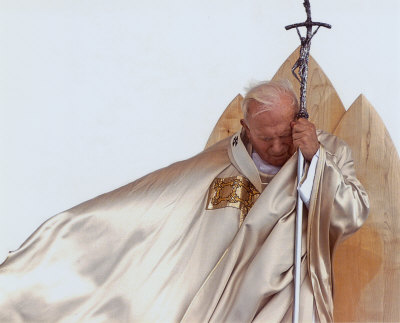
pope-john-paul-ii-1920-2005In the Middle-Ages priesthood was limited to, and regulated by, the clergy. One of the marks of the reformation was Martin Luther’s call for “the priesthood of all believers”. Timothy George has called this doctrine one of Luther’s greatest contributions to the Protestant Church. Luther argued that “all Christians are truly of the spiritual estate, and there is among them no difference except that of office (Open Letter to the Christian Nobility).” Luther was not arguing for leaderless anarchy in local churches (offices imply order), but was stressing the equal access and spiritual importance that each believer has with God through their grace given relationship in Jesus Christ.

The priesthood of all believers has been especially important to Baptist church life since it forms the basis for Congregationalism. I am a Baptist. As a Baptist I am partial to Congregationalism. In God’s Word, the people of God are referred to as “a holy priesthood”, “a royal priesthood”, and “a kingdom of priests” (1 Peter 2:5, 9; Revelation 1:6, 5:10). As a Baptist I believe that all true believers are priests and have equal access to God the Father through our high priest Jesus Christ (Read the book of Hebrews). Moreover, no one person or group should have supreme and unchecked spiritual authority within a local church as if they and they alone can hear from God.

There is not one person in the church, or group of persons in the church, that have a closer connection to God over and above their brothers and sisters in Christ. All believers have priestly access to the heavenly sanctuary and need no other mediator but Jesus Christ. Yet some Protestant churches, while professing to priesthood of all believers, ignore this precious doctrine in practice. And some Protestant leaders even parade their “unique” relationship with God, lording it over others in their church family.

Holding to the priesthood of all believers also implies that all “believer-priest church members are able and responsible to help the church find God’s direction for its life”[1]. While pastors may be set apart to lead through the teaching of the Word, and certain leaders may be set apart to make decisions, the entire congregation should humbly shoulder the responsibility of acting as the final court to recognize, respond, affirm, and even challenge the direction of its leaders if necessary. The church is the body of Christ, and Jesus Christ is the only head. The church should function as a body.

So why do some leaders take it upon themselves to wield supreme (and some times negligent) spiritual authority within local congregations? Why do some leaders over-spiritualize decisions in order to trump everyone else in their congregation? Why do some leaders talk as if they, and they alone, receive and impart special divine revelation to their people? I am not sure. There could be many reasons. I admit, I have implied this “power” before as a pastor, and repent. Implying papal-like authority is the easy way out when it comes to leadership. Its a way to avoid the often messy life of church community.

Most Protestant leaders would never bluntly admit any of these things. But, many leaders within Protestant churches communicate these ideas by implication. The saddest thing is that such papal attitudes within Protestant leadership ranks pronounces lower spiritual status of everyone else in the congregation. How did we arrive at Evangelical Catholicism within local church leadership? May we repent and seek to uphold the priesthood of all believers!


[1] John Hammett, Biblical Foundations for Baptist Churches, 46.

Jesus The Coming King!

I have been reading What Happens After I Die? by Michael Allen Rogers. My review of this book will be published at The Gospel Coalition website in the near future. I will not expound on the many benefits of this book here, but I do want to point you to a particular section that I found encouraging and challenging.

In his chapter titled The Final Heaven Inaugurated, Rogers expounds on the momentous event of Christ’s final return. He writes;

No eye on earth will miss this! All the splendor, honor, and authority presently belonging to Jesus as Lord will be supernaturally visible to the entire world. Christ will not display more glory than he already has, but finally all mankind will see what is true about him as he now is. Every eye will see him and every knee will bow to him…When he appears, the present dimension will be ripped away, and Christ will be manifest to all eyes throughout the earth (See Matt. 24:27).

He continues:

Tragically for many, that recognition of Jesus lordship will come too late. They will recognize him as Lord without adoring him by faith. But for those who greet him with settled faith, this hour means a transformation of everything. God’s great saving work will be concluded in us and all around us. Enemies of Christ will be banished entirely from his presence, and his loving subjects will step forward to be invested as knights and ladies of his eternal court, enfolded into the brightness of his kingly splendor (pg.130).

What a wonderful picture of what is to come for the children of God! What a terrible picture of what is to come for those who reject Christ’s kingship. Oh that we would long for those around us to intimately know and lovingly adore Jesus as their savior, king, and treasure!

Devotions in Jonah

These devotions were recently published as a series in The Biblical Recorder.

Jonah 1-2

Most likely you know the story of Jonah from Sunday School. The first few chapters describe Jonah’s call from God to go and cry out against the great and evil city of Nineveh. Instead of obeying God’s call, Jonah traveled downward in the opposite direction of Nineveh toward Tarshish and away from the presence of God.

While Jonah was on a ship full of pagan sailors headed for Tarshish, God hurled a great wind at the sea. The storm was so strong that the boat was close to breaking apart. The pagans called out to their gods and begged Jonah to call out to his God with the hope that He would save them from death.

It is revealed that Jonah’s disobedience had brought about this judgment of God in the form of a storm. Finally, the pagan sailors hurled Jonah into the sea and the storm stopped. While this story is already amazing it also points to something even more magnificent, namely, the gospel of Jesus Christ. If we read this story through the lens of Jesus we see that the saving of pagans through the sacrifice of Jonah points to the salvation of all nations through the death of Christ (1 John 2:2). Moreover, Jonah’s rescue from death points to the resurrection of Christ from the dead (Matthew 12:40). In a certain sense, Jesus is like Jonah in that He hurled himself into the storm of God’s wrath so that we could be brought in to safety.

Continue reading “Devotions in Jonah”

New Book: Orphan Justice by Johnny Carr

Congratulations to my friend Johnny Carr! On March 1st his book Orphan Justice will be released. In this valuable and needed book Carr calls the church to move from talking about orphan care to actually doing something about it. Here is Russell Moore‘s endorsement;

“No one has stood more at the forefront of the evangelical orphan care movement than Johnny Carr. He prophetically calls the church to care for orphans by combating racism, trafficking, poverty, and abortion.”

Orphan JusticeIn Orphan Justice Carr explores the orphan care and adoption movement in the U.S., and discusses the role of the church worldwide in meeting the needs of orphaned and vulnerable children. Moreover, Carr helps the reader understand the connections between social justice and biblically based orphan care. All this is done with an aim to provide the reader with practical steps to getting involved and making a difference today.

I highly recommend Orphan Justice to anyone interested in doing something about the global orphan crisis.

John Stott’s “The Living Church”

Stott’s The Living Church is a very good, concise, and introductory general ecclesiology. Reading this little volume gives one the feeling of sitting under a well-seasoned churchman as he talks about life within the church. A few insights were very helpful:

Stott notes that we must listen to the voices of the world in order to be able to “respond to them sensitively though without compromise” (12). The church should transform secular space, rejecting the sacred-secular divide. Later in the book Stott picks this idea back up by asking the question: Will Christians be able to influence the secular world so that the values and standards of the kingdom of God will permeate their communities? Stott rightly notes that Christians cannot be utopians. A point that modern Christians often leave out of the missional equation. He also charges that while Christians are spiritually and morally distinct, they are not to be separatists. Stott writes: “…the influence of Christians on society is intended by Jesus to be both negative (checking the spread of evil) and positive (promoting the spread of truth and goodness, and especially the gospel)” (133). The Living Church

Stott’s threefold common commitment for the local church is helpful – to the church, its mission, and its renewal (see pages 19-21). Moreover, his explanation of God’s vision for the church as a learning church, a caring church, a worshiping church, and a evangelizing church are good categorical marks (The second appendix of Mark Dever’s book 9 Marks of a Healthy Church titled “The Numerical Nineties and Beyond” has several lists that are similar.) Both of these explanations would be helpful for training church members and outlining the ministry of the church for potential church members.

Continue reading “John Stott’s “The Living Church””

The Gospel Project Experience: May 17-18

tgp-experience-banner

On May 17-18, LifeWay is hosting The Gospel Project Experience – a conference that will focus on the main events of the gospel. The purpose of The Gospel Project Experience is to walk participants through the entire gospel story (incarnation, life of Christ, death, resurrection, and second coming). J.D. GreearDavid NasserEd StetzerTrevin Wax and Ken Whitten will each speak on one of those five gospel themes. Matt Boswell will lead worship for the event.

For those who are currently using or considering LifeWay’s Gospel Project Bible study, there will be break-out sessions that help train and inform participants on how to get the most out of the Bible study. But even if you are not using The Gospel Project, you are invited to attend.

Prayerfully this event will be a time of refreshment, training, and inspiration focused on living out the implications of the gospel in your life, in your church family, and in your community.

The Gospel Project, led by General Editor Ed Stetzer and Managing Editor Trevin Wax, is designed to unify the entire church under a single Christ-centered curriculum. In every lesson that each age group studies, participants are immersed in the gospel story and ultimately challenged to live on mission for God. If you’re not sure what it is, I’d invite you to check it out when you have a moment. You can even sample four of the lessons for free.

Devotions in Amos

These devotions were recently published as a series in The Biblical Recorder.

Amos 1-3

The book of Amos opens with the prophet delivering a series of oracles proclaiming that no one can escape the consequences of their actions – not Israel (2:6-6:16) or Israel’s neighbors (1:2-2:5). In these first chapters we see a brutally honest portrait of universal justice coming from the omniscient and all-powerful God of the universe. Amos 4 is crystal clear; God is the sovereign King over all creation.

When the prophet unseals God’s indictment against the guilty, one might expect to see judgment visiting the foreign pagan nations. But Amos, as Professor Heath Thomas argues, looks past the whitewash to expose the decay of God’s people underneath. Contrary to all external appearances God’s people were guilty and “ripe” for God’s judgment. Amos proclaims that God’s people cannot do anything right (3:10).

But the good news is that God comes to Israel with both judgment for sin and promises of restoration. Prof. Thomas says God’s judgment is not to irradiate but to reconcile. In a very real sense Israel’s salvation is found through their judgment. As we look back from this side of the cross we read Amos and see very clearly that the judgment and restoration of God’s people anticipates the crucifixion and resurrection of Christ. Jesus fully consumed the judgment of God for our sin so that we could be restored back to God.

The demand for righteousness was fulfilled in Jesus who did everything right! Because of Jesus’ imputed righteousness Christians stand not under God’s wrath, but in the safe shadow of Jesus’ cross. The universal justice of God that we experience in Amos 1-4 is still a haunting reality today, and salvific escape is found only in Jesus Christ (Gal. 3:13–14; Rom. 3:9–31). Unless there is true repentance, no one can escape the judgment of God.

Continue reading “Devotions in Amos”