Saturday Seminar on Numbers and Deuteronomy with Dr. Heath Thomas

– Click Here to register for the Saturday Seminar –

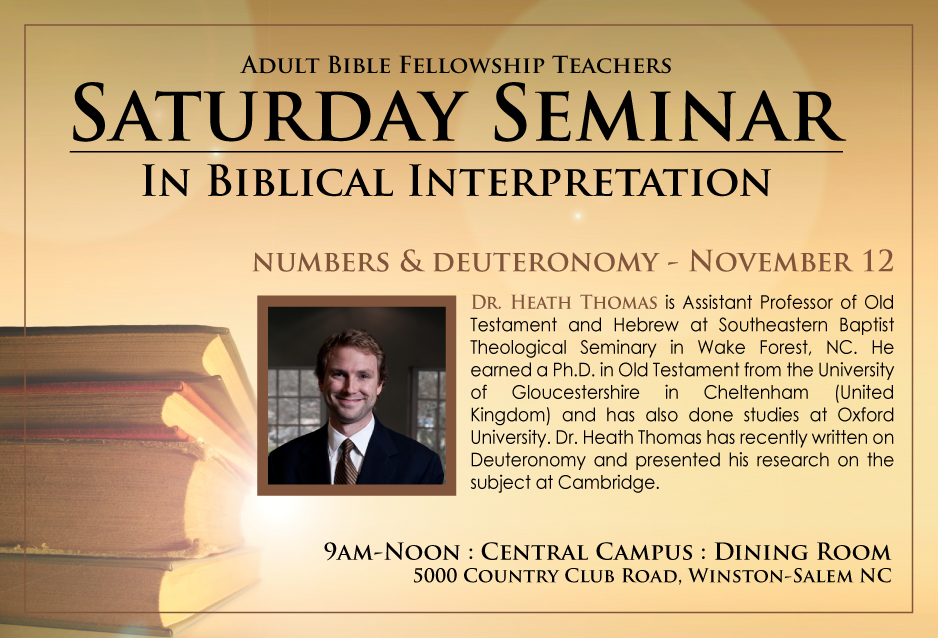
It’s time for another Saturday Seminar at Calvary! If you are a Bible Fellowship teacher, part of a Bible Fellowship teaching team, or just love to study the bible, you will not want to miss this training opportunity to learn from one of our Southeastern Baptist Theological  Seminary professors! Dr. Heath Thomas will be at Calvary on Saturday, November 12th from 9am-12noon. Dr. Thomas will be walking us through Numbers and Deuteronomy.

Dr. Heath Thomas is Assistant Professor of Old Testament and Hebrew at Southeastern Baptist Theological Seminary in Wake Forest, NC. He earned a Ph.D. in Old Testament from the University of Gloucestershire in Cheltenham (United Kingdom) and has also done studies at Oxford University.

– Click Here to register for the Saturday Seminar –

Is The Law Still Binding On The Christian?

Is the law still binding on the Christian? This is a question that many Christian’s ponder. And for good reason. In my studies I recently returned to a little book by John Stott titled Men Made New. This exposition of Romans 5-7 was first published in 1966 and is now out of print. I am not sure how I got a copy of it, but I am glad I did. In it Stott makes some helpful comments on this issue concerning the law of Moses.

He begins by stating that there are three possible attitudes to the law of God (attitudes that Tim Keller has popularized in the last few years). Attitudes represented first by the legalist, second by the libertine (or antinomian), and thirdly by the law-abiding believer. The first two represent the those who are not living in line with the gospel. The legalist is one who is in bondage to the law, one who imagines that their relationship to God depends on obedience. The libertine is one who rejects the law all together. But the law-abiding believer holds a proper balance, recognizing that while the law is not a means to salvation it should be delighted in as an expression of the will of God. Stott writes;

Is the law still binding on the Christian? The answer to that is “No!” and ‘Yes!’ ‘No’ in the sense that our acceptance before God does not depend on it. Christ in his death fully met the demands of the law, so we are delivered from it [as a means of salvation]. It no longer has any claims on us [to condemn us for sin]. It is no longer our lord. ‘Yes’ in the sense… we still serve… But the motive and means of our service have altered. Why do we serve? Not because the law is our master and we have to, but because Christ is our husband and we want to. Not because obedience to the law leads to salvation, but because salvation leads to obedience to the law. The law says, ‘Do this and you will live’. The gospel says, ‘You live, so do this.’ How do we serve? Not in oldness of letter, but in the newness of spirit. That is, not by obedience to an external code, but by surrender to an indwelling Spirit. (65-66)

This does not mean that the written law of God in the Holy Scriptures is not binding on us, but rather that we obey in a new motivation and in a new framework. Our motivation to obey is a response to God’s grace, and our framework is that we are accepted on the basis of Christ’s fulfilling the law, not ours. Now, undoubtedly this is a very simplistic answer and there are many nuances to this issue. But, in the spirit of simplicity and general attitude towards the law – I think we can learn much from this quote.

Theology Matters

People often imagine that it is possible to have a personal relationship with God apart from theology. In fact, some Christians assume that knowing doctrine and practical living are competing interests. The modern dichotomy between doctrine and life, theology and discipleship, knowing and doing, theory and practice has had disastrous consequences in the life of the church and its witness in the world.[1]

Theology matters. Theology matters because we need to know God. In fact, if you are a Christian, if you claim to know God – you are a theologian. Once you start to try to make sense of God, the Scriptures, and life, you are doing theology. So, all Christians are theologians in some sense or another. But as Graeme Goldsworthy points out, “some are more able theologians than others”.[2] The need is to be a good theologian, for your personal good, your evangelistic effectiveness[3], and your edification of others.[4]

Knowing God shapes the way we think and live. What you believe about God —what he is like, what he wants from you, affects every single part of your life. Theology matters because if we get it wrong its possible to build your life on a misconception of reality. That would be a tragedy. Theology matters because the Christian faith is not just a cultural tradition or an ethical code. Theology is not an abstract intellectual concept or an empty theory. Theology matters because God is real, and he has acted in our world, and his actions have meaning today and for all eternity.

The discipline of theology can never take the place of God himself, but we can’t know him and relate to him in the right way without theology. This is because theology, true biblical theology, tells us not only who God is, and what He has done, but also what it means to us. There’s nothing more precious than knowing the living God. Southern baptist theologian J. L. Dagg once wrote the following words:

 The study of religious truth ought to be undertaken…from a sense of duty, and with a view to the improvement of the heart.  When learned, it ought to be laid on the shelf, not as an object of speculation, but it should be deposited deep in the heart, where its sanctifying power ought to be felt.  To study theology, for the purpose of gratifying curiosity, or preparing for a profession, is an abuse and profanation of what ought to be regarded as most holy.[5]

Our goal is to know God, but that knowledge should be romantic, it should melt our hearts and lead to worship in response to who God is. Theology changes your life. Theology matters.

Continue reading “Theology Matters”

B.B. Warfield on the Centrality of the Gospel

There is a lot of talk right now, good talk, making sure that Christians understand that one never moves beyond the gospel after conversion. Princeton theologian B.B. Warfield once wrote a wonderfully clear statement on the centrality of the gospel for all of life:

There is nothing in us or done by us, at any stage of our earthly development, because of which we are acceptable to God. We must always be accepted for Christ’s sake, or we cannot ever be accepted at all…This is not true of us only when we believe. It is just as true after we have believed. It will continue to be true as long as we live. Our need of Christ does not cease with our believing; nor does the nature of our relation to Him or to God through Him ever alter, no matter what our attainments in Christian graces or our achievements in behavior may be. It is always on His “blood and righteousness” alone that we can rest.

“Miserable-Sinner Christianity in the Hands of the Rationalists”, The Works of Benjamin B. Warfield, vol. 7, 113ff.

In Honor of My Pastor: To Al Gilbert as he transitions to the North American Mission Board

This week at Calvary Baptist Church it was announced that our senior pastor, Al Gilbert, has accepted a position at the North American Mission Board under the leadership of Kevin Ezell. Al will begin his assignment with NAMB in mid-September as the Executive Director of Love Loud, the evangelism arm of the North American Mission Board. Essentially Al will help multiply ministries like our “Love Winston-Salem” initiative and our refugee ministry, and other mercy ministries to neglected neighbors throughout churches in North America. (Click here for the official announcement from NAMB)

North American Mission Board

It is bittersweet to see Al transition, but as I have told him already – for what its worth, I think it’s the right move. When I came to Calvary as a seminary student in the Calvary School of Pastoral Leadership, Pastor Al and Pastor Will Toburen immediately pulled me in and began investing in my life. These two men have a very special place in my own heart and in the heart of many in our church. They have both shaped my own life and ministry in ways they may never fully know. As for Pastor Al specifically, I view him as a “father figure” in the ministry. Al’s belief in me, his loving support, and his timely challenges have been formative and affirming – something that every young pastor needs and few have the opportunity to receive.

So I offer these thoughts in honor of my pastor and friend Al Gilbert, for what he has meant to me personally in the 5 years that I have been at Calvary. I also offer these thoughts to encourage him in this exciting, yet emotional time of transition.

First, as I reflect on our relationship over the past few years I am very appreciative of Al’s friendship. There have been times where I have come to him vulnerable about personal struggles, there have been many times where we have had good belly laughs, there have been times where we have had disagreements, times when we have shared fellowship over a meal, and there have been times when we have cried together. I can say that in all those situations I have always walked away knowing that Al loved me, cares for my soul, and wanted to see the best for me. Or as he has often joked, “God loves you, and I have a wonderful plan for your life.” Our relationship is something that I will treasure, and make every effort to continue.

Second, as Paul was to Timothy – Al has been to me and many of us young pastors through the years. Al has placed us in leadership positions, “platformed” us, and given us chances to grow into our ministry roles. For his belief in preparing the next generation I am deeply grateful. Personally, both Al and Will have walked with me through some important times in my own life. They both performed my wedding ceremony, lead my ordination service, and have become not only great mentors but great friends. As Al transitions it will be different not seeing him on a regular basis, but I look forward to how God is going to use him in the life of our convention.

Third, as for Al’s hobby as an amateur linguist – I smile. Al has invented at least one word that I know of – “supronomy” (You can ask him what it means, it’s a play off of one of J.I. Packer’s lines in a book.) It’s not officially recognized as an actual word yet, but many of us use it as if it was. We joke with Al about his love of words. But there is an important side of it also. There are some “ministry shaping” words that are imprinted on my mind because of Al – “panta ta ethnos”, “ethos” (If I can think of one just one more “e”…). I have taken Al’s quips, comments, and antidotes to heart, even when they are alliterated or corny. Sorry Al, I had to say it.

Forth, in his ministry at Calvary, Al has truly emphasized missions and multiplication in a way that has “lengthened and strengthened” us as a church. Under Al’s leadership and support our international mission efforts, our local mission efforts, our efforts to start new campuses have become part of the Calvary “DNA”. Many of us have heard Pastor Al’s benchmark sermon on God’s plan for proclaiming Christ to all peoples, a sermon that I once overheard Al Mohler recite “point for point” years after he heard it preached. The three points are simple, memorable, and provide a concise picture of Al’s love for seeing the people of God reach others for Jesus. The “ABC’s of the Great Commission” are – A is for “All peoples”, B is for “Blessing”, C is for “Church”. God has a heart for all peoples. We are blessed to be a blessing to others. Lastly, God has the church for his mission. I have lovingly picked on Al for making the points follow the “ABC” pattern, but at the heart of this memorable message is a love for God, and a passion for the church to be on mission – something that Al does not take lightly! Check out his chapter “The Big Picture of the Great Commission” in the book The Great Commission Resurgence. The point is this; I haven’t ever doubted Al’s passion for seeing the church on mission. I have often heard him pray, and teach us as a church to pray, “Lord, I will go anywhere, any time for your glory…and, if it’s not me, it would be a great honor if you would send my children.”

Lastly, Al is a true Southern Baptist statesman. He loves and believes in the Southern Baptist Convention. He has served as a pastor (of small, medium, and large churches – size matters to some people…), he has served at the International Mission Board, he has served on various committee’s in the SBC, delivered the Convention Sermon, and joyfully served on the Great Commission Resurgence Task Force. These things are all good, but they don’t define Al. Behind all of those great opportunities is a man that truly believes in the efforts of Southern Baptist churches. As a young pastor in the SBC I have learned to see the value of our cooperative efforts – even though I think we have much to work on – because of Al’s willingness to teach me about the SBC, and by taking me along with him to meetings, conventions, events, conferences, meals, and other engagements. This is something other SBC pastors need to put into practice with their younger associates.

These are just some personal thoughts, it helps me process. It is with both tears and a smile that I write this post. Confident that he has prepared our church for this moment by investing in many of us and by sharing his leadership. I have no doubts about the future of Calvary, all things will be well. I firmly believe in the sovereignty of God to bring about his perfect will. We pray for wisdom as we move forward. (You can also pray for our staff) As for Al, he will bring unique experience and perspective to NAMB, and I think he will do a great job. Plus, he already owns plenty of sweater vests, which I hear is the favorite attire of President Ezell.

All joking aside – I rejoice over this opportunity for my pastor. So, one final thought to Al. Pastor, this bittersweet for me. The most important thing for you to hear is that I love you, and will be praying for you as you transition. I’ll be praying that God give you favor as you seek encourage churches to see God’s heart for the neglected neighbor, as you challenge our existing networks, and cast vision to see the gospel spread in North America.
Reading Romans as Homiletics Instruction

I just started reading Paul Achtemeier’s commentary on Romans in the Interpretation series. Keeping in line with the aim of the series Achtemeier writes for the teaching and preaching needs of the church. So most of the commentary is focused on hermeneutical reflection and insight rather than technical historical-grammatical specifics. I have found it quite refreshing, a good complement to the more technical works of say, Moo and Schreiner.

Achtemeier argues that the central theme of Romans is “the plan of God [in] pursuing to extend his gracious lordship to all peoples by his act in Christ.”[1] The author contends that the literary structure of Romans follows the movement of history, a history that God is guiding to its goal, with doctrinal statements and expositions included as a way of making sense of that movement. Therefore, the first 11 chapters of Romans follow the history between God and his creation, while the last chapters apply to the life of the Christian community the insights gained from this account of the sweep of God’s redemptive dealing with his rebellious creatures.

In the introduction Achtemeier makes a wonderful point of application for teachers, an implication of Paul’s placing the more direct ethical commands at the end of the letter after he has rehearsed the story of redemptive history. Namely, application without first showing the power and beauty of the gospel is pointless!

It will do no good to urge someone under the power of sin to “try harder.” If, as Paul makes clear in [Romans] chapter 7, for example, a human being “under Adam” is incapable of freeing himself or herself from sin, then all “trying harder” can do is to drive that person further into sin. If every act is under the control of sin, more action will simply mean more sin. Ethical commands therefore are pointless for someone in whom the power of sin has not been broken. That is why the law intensifies sin: it cannot break sin’s power, so all it does is encourage acts which remain under the power of sin.

Only after the power of sin is broken, and that means only after the lordship of God has been restored [which was lost in the fall of man] – and it has been with Christ’s death and our baptism into it – does it make sense to give admonitions on how one is to live so as to avoid sin. It is for that reason that Paul does not begin with his ethical admonitions, he ends with them.[2]

Now, many of us read this and think – yes, of course, this is nothing new. But then again, it is a good reminder. We often talk about proclaiming the gospel, but do we make a conscious effort to structure our teaching to mirror the gospel itself? It seems that in the very structure of Romans the Apostle Paul is presenting us with a liturgy for gospel structured teaching.

Saturday Seminar on Romans with Dr. Steve McKinion


To sign up for the seminar click here.

On August 27th we will have our 3rd Saturday Seminar in Biblical Interpretation on the book of Romans with Dr. Steve McKinion from Southeastern Baptist Theological Seminary, where he serves as a Associate Professor of Theology and Patristic Studies. Here is a little background information on Dr. McKinion from his personal website.

He finished his BA at Mississippi College, his MA at the University of Mobile, and his PhD at the University of Aberdeen, Scotland, where he studied patristics with Iain Torrance. At age 27, after completing his PhD, he became a professor at Southeastern Baptist Theological Seminary, where he has taught since. He has also been a Visiting Professor at the University of Mobile, The Southern Baptist Theological Seminary, and Trinity Evangelical Divinity School. Steve has also helped lead several church launches, and is currently leading a new church startup in Raleigh called New Covenant Fellowship. Writing has been a big part of his life.  In addition to the articles, dictionary entries, and books he has in print, he is currently completing two major projects: the Isaiah volume in the Reformation Commentary on Scripture with IVP, and Invitation to Historical Theology with Kregel.

Dr. McKinion has already published the books Life and Practice in the Early Church, A Commentary on Isaiah 1-39 in the Ancient Christian Commentary on Scripture Series, and Words, Imagery, and the Mystery of Christ: A Reconstruction of Cyril of Alexandria’s Christology.

See his personal website at – http://www.stevemckinion.com/

Community Serve 2011

http://vimeo.com/26518173

The Calvary church family just finished up our week-long mission trip to our community, here is a recap of the week. This video was shot and edited by Peter McKenzie, view his work here.

Vern Poythress’ Three Ways to Read the Bible

I recently read Vern Poythress’ book Symphonic Theology and I thoroughly enjoyed it. He makes a wonderful case for the validity of utilizing multiple perspectives in developing a robust theology. One of the ways he demonstrates this thesis is by arguing that one should contemplatively read the bible with multiple perspectives in mind. He notes that while the bible is a unified body of literature, it has come to us through a variety of inspired authors, metaphors, and themes. Poythress contends that approaching the text from different perspectives will have implications that are far-reaching for theology and doxology. So what are we to do with this? Well, he advocates for reading with these three perspectives in mind…

  1. Ethical – Reading the bible to understand our duty focuses on the ethical principles and their implications for daily living and decision making. What are we to do and not do as the people of God?
  2. Devotional – Reading the bible devotionally is primarily interested in the psychological dimensions of communion with Christ. What is the inspirational thought that will help me maintain a spiritual outlook?
  3. Doctrinal – Reading the bible for doctrine typically approaches the text asking, what does this passage say about God, Christ, and the Holy Spirit? What theological doctrine is being revealed here?

Poythress proposes that many people only read the bible from one perspective. He compares this to the husband who only pays attention to the mechanical utility when he shops for curtains, ignoring their aesthetical appeal. Basically, if we only read with one perspective we may only notice what we are already looking for. But what if there is more? What if we are missing something deeper? Dr. Poythress writes:

“Suppose that [one] reads the same passage of the Bible ten times. Suppose that each time the person adopts a new perspective from the ones mentioned above. Would not that person learn something new about the passage each time? A given perspective can be dangerous or stultifying if we use it all the time. But looking at a familiar passage in a fresh light can make it suddenly come alive again…consequently, each time we may notice something new or something that did not really capture our attention before. If we are to sound the depths of the passage, we need to come back to it again and again…Thus when we use a multitude of perspectives on a passage…we use each perspective to reinforce and enhance our total understanding. “[1]

Dr. Poythress offers free downloads of his books in PDF here.

An Evening with C.S. Lewis

In this one-man show, British actor David Payne portrays famous author C.S. Lewis. I have always been fond of Lewis’ wit and thought, and have, like many of his readers, longed to have known him personally. Perhaps Payne gives us a glimpse for what an evening with Lewis would be like. The setting is 1963, the last year of his life, as he hosts a group of American writers at his home just outside of Oxford. As his website proclaims “Payne captures the essence of the man who created the Narnia Chronicles in an enthralling, laughter-filled and poignant performance….utterly captivating!”

Seen on Justin Taylor’s blog.

Also see this dramatization from the PBS Special The Question of God.