 Ryan and I are looking forward to developing and leading this study in June and July with men from Calvary West. If you are interested in joining the study please let us know.
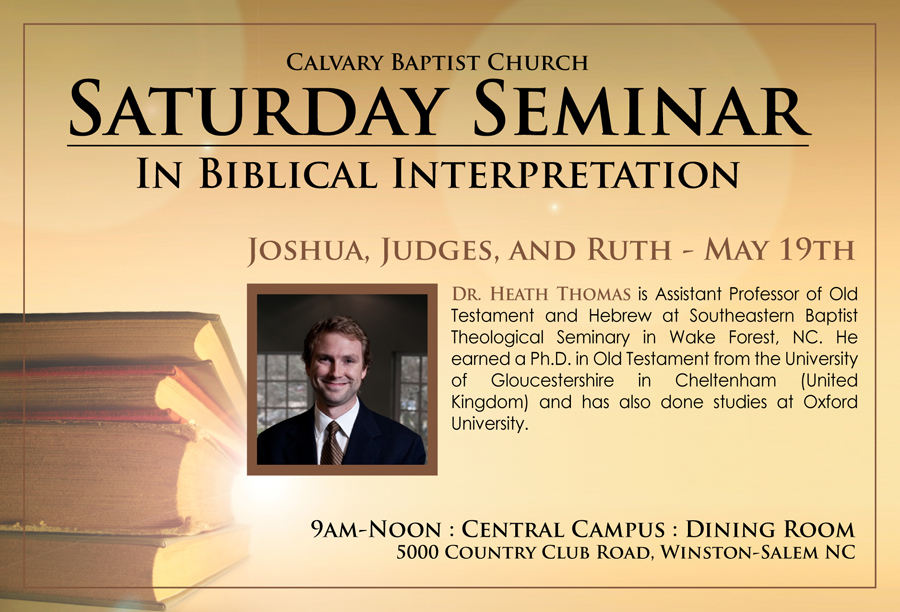
Saturday Seminar on May 19th with Dr. Heath Thomas – Joshua, Judges, and Ruth
– Click Here to register for the Saturday Seminar –
It’s time for another Saturday Seminar at Calvary! If you are a Bible Fellowship teacher, part of a Bible Fellowship teaching team, or just love to study the bible, you will not want to miss this training opportunity to learn from one of our Southeastern Baptist Theological Seminary professors! Dr. Heath Thomas will be at Calvary on Saturday, May 19th from 9am-12noon. Dr. Thomas will be walking us through Joshua, Judges, and Ruth.
Dr. Heath Thomas is Assistant Professor of Old Testament and Hebrew at Southeastern Baptist Theological Seminary in Wake Forest, NC. He earned a Ph.D. in Old Testament from the University of Gloucestershire in Cheltenham (United Kingdom) and has also done studies at Oxford University.
- Dr. Thomas is a Fellow in Old Testament Studies at The Paideia Center for Public Theology
- Dr. Thomas’ faculty page at Southeastern Baptist Theological Seminary
- “Building House to House (Isa 5.8): Theological Reflection on Land Development & Creation Care”, this paper appeared on BeginningwithMoses.org
The “ethos” of The Lord’s Supper
Dr. Russell Moore offers some good thoughts on the “ethos” of the Lord’s Supper in the book Understanding Four Views on the Lord’s Supper.
The sign aspect of the Lord’s Supper is often obscured in contemporary churches — and not only in those who hold to the Zwinglian/Baptist view of the Supper as a memorial meal. Often this has as much to do with the ethos of the Supper as with any teaching regarding it. Often Lord’s Supper services are characterized by a funereal atmosphere, complete with somber, droning organ music as the ministers or deacons distribute the elements to the congregation. The congregation is sometimes led to believe (if for no other reason than the omission of pastoral teaching) that the point of the meal is to screw up one’s face and try to feel sorry for Jesus. This is often accompanied by a psychological attempt to meditate on the physical pain of Jesus’ sufferings — an emphasis that is markedly understated in the biblical text itself. In order to recover a biblical model of the Lord’s Supper, churches need not tacitly accept a sacramental understanding of the “real presence of Christ” in the elements of bread and wine.
Instead, they must recapture the vision of the eschatological messianic banquet — and seek to recover the joyfulness and triumph of this event within their own churches. This would mean that the Lord’s Supper would be characterized by even more celebrative singing, and even laughter, than the rest of the service. The congregation would be taught to understand that the Supper is a victory lap — announcing the triumph of Christ over the powers of sin, death, and Satan. At the same time, the Supper would maintain the gravity of the moment, as the congregation recognizes that it is performing a sign of God’s freeing us from slavery through Christ — a sign of a new covenant that addresses not only other believers but God himself, the unseen demonic rulers, and even unbelievers who might marvel from outside at the meaning we find in this ancient rite. (33)
Reflections on Shepherding and Leadership
Not too long ago I finished reading Timothy Laniak’s book Shepherds After My Own Heart: Pastoral Traditions and Leadership in the Bible, which is part of the New Studies in Biblical Theology series edited by D.A. Carson. Here are some reading reflections based on this excellent volume.
The Power of Shepherding Imagery
The meaning of the metaphor of shepherd, from which we get our word pastor, is important for understanding the reality of pastoral ministry. Laniak argues that shepherd is the primary metaphor by which the biblical authors conceptualized leadership. The ancient cultural realities of animal husbandry make it clear that the primary roles of a shepherd were to provide, protect, and guide. The distinct imagery of ancient shepherding practices should elicit experiential reflection and emblazon imagery that shapes pastoral ministry. What Laniak does is provide us with a biblical theology of shepherding that is metaphor-dependent and metaphor-rich. This is important, namely because “metaphors make use of concrete or physical realities to describe less tangible realities…human thought tends towards an economy of explanatory images.” He continues by arguing that “we cultivate mental categories that preserve as much information as possible with as little effort as possible.”[1] In other words, metaphors invite both comprehension and apprehension. Laniak notes that:
- Comprehension: Emphasizes the cognitive aspects of interpretation
- Apprehension: Emphasizes the existential aspects of interpretation
“Shepherd is a felicitous metaphor for human leadership because both occupations have a comparable variety of diverse tasks that are constantly negotiated…Shepherds had to combine broad competencies in animal husbandry with capacities for scouting, defense and negotiation.”[2] The beautiful thing about metaphor is that it carries us beyond the literal meaning of shepherd and instructs us on the nature of pastoral leadership. In this sense, the vehicle of metaphor affects the way shepherd leadership is understood. There is a connection made at a deeper level, and though the details and particulars are left behind the essence of shepherd leadership remains and resonates within our imagination. Therefore, the metaphor of shepherd instructs and shapes us as pastors by way of deep emotive insight.
The Importance of Nourishing the Flock
The nourishment and protection of the flock is one of the most powerful applications we can gleam from the shepherding metaphor. Laniak argues that ‘the good shepherd knows where to find pastures that are not only lush but safe enough for his flocks to rest in peace…it is the skilled shepherd who knows the environment well enough to provide for his animals needs with compromising their security…The wilderness is a confusing environment[15]. Left to themselves, the sheep inevitably go astray.”[16]
One of the most pressing challenges for any shepherd is to provide nourishment (water, food, rest) for their flocks in harsh environments, environments that withheld essential elements for life and flourishing. A good shepherd watches their flock. Eating and drinking bring nourishment. Rest is a function of being well provided for. Rest also points to a state of security that comes from the shepherd’s protective presence. The idea of provision by way of nourishment and protection is carried forward in the context of theology in pastoral ministry. Consider Jesus words to Peter in chapter 21 of the gospel of John, “feed my sheep”. And in Acts 20 Paul charges the Ephesian elders to protect the flock from those who would twist doctrine. It seems that the picture that Laniak provides is apt: “the image of a gathered flock lying down in green pastures”[17], imagery of satisfaction and safety.[18] Satisfaction comes from the nourishment provided by the whole counsel of God, and safety comes from shepherds who pay careful attention to the lives and doctrine of the flock. The church is to be a community of rest, a place for the weary to refresh from the wilderness of everyday life. The call is clear for pastors to nourish the people God has placed in your care.
The Necessity of Leading and Protecting the Flock
Psalm 23 is one of the most recognizable Psalms that utilizes the shepherding metaphor. In this Psalm David reflects on the confidence one can find in the good shepherds care, even in times of deep darkness. Reflecting on this psalm Laniak notes that “even in the deadly shadows that fall at dusk in the desert’s canyons there is safety in his presence. Though easily frightened by nature, this trusting sheep will move through the shadows without fear.”[19] The language of the psalm provides us imagery of the two simple but versatile tools that ancient shepherds carried to face unexpected challenges within and outside of his flock.
- The Rod: This defense instrument allowed the shepherd to be ready for any predator. This short club was a crude weapon used to beat cumin[20], as a weapon in battle[21], it was also the shepherd’s implement used for counting a flock at night as the flock passes under it.[22]
- The Staff: This was the instrument that the shepherd used to nudge wandering sheep back in line, is was a source of comfort because it was used for picking off branches, snagging a trapped animal with the crook, or redirecting misbehaving members of the herd. The staff became a symbol for the protective presence of the shepherd.[23]
Laniak notes that “these two rods may represent the two functions of a shepherd: protector from external threats and peacekeeper among the flocks”.[24] Pastoral ministry calls for gentile assistance, direction, rescue, and encouragement among the flock of God. Pastors are also called to defend the flock from outside threats and even discipline the flock to avoid dangers from within. Both instruments represent the weight of authority that a shepherd carries among the flock. The fruits of this authority are security and comfort among the flock because of a good shepherds care and discipline.
Shepherds Know their Flock
In his devotional book While Shepherds Watch Their Flocks, Tim Laniak comments on the importance of knowing and naming the flock. “Naming is a powerful, tangible expression of the shepherds intimate bond that begins at birth and grows through an animal’s tenure with a flock. Once you begin to fathom how many times an animal may have been counted, checked, carried, nursed back to health, rescued, protected, milked, and shorn, it dawns on you why Bedouin always say, ‘They are family’.”[25]
According to Laniak “responsible shepherds know every member of their flocks in terms of their birth circumstances, history of health, eating habits and other idiosyncrasies. It is not uncommon to name each goat and sheep and to call them by name[26]. One of the most striking characteristics of the shepherd-flock relationship is that control over the flock is exercised simply by the sound of the shepherd’s voice or whistle[27]. This provides a rich depiction of Jesus’ words in John 10:27, “My sheep hear my voice, and I know them, and they follow me.” As for pastoral ministry, this imagery does give some credence to the old adage “people don’t care how much you know until they know how much you care.” To know someone requires time and care. Isaiah provides a good picture of a caring shepherd in 40:11. Explaining how God shepherds his people the prophet writes “He will tend his flock like a shepherd; he will gather the lambs in his arms; he will carry them in his bosom, and gently lead those that are with young”. The imagery is powerful and emotive. This type of care would be expressed in the life of the church through pastoral visitation, counseling, and ministry in times of sickness and grief. “Shepherds who love their sheep notice when their sheep are hurting and seek to be with them to care for them.”[28]
Continue reading “Reflections on Shepherding and Leadership”
Pastors…Read and Get Out of Your Office!
A good word from Pittsburgh Theological Seminary’s Andrew Purves from The Crucifixion of Ministry.
“Get out of your offices and get into your studies. Quit playing office manager and program director, quit staffing committees, and even right now recommit yourselves to what you were ordained to do, namely the ministry of Word and sacraments. Pick up good theology books again: hard books, classical texts, great theologians. Claim the energy and time to study for days and days at a time. Disappear for long hours because you are reading Athanasius on the person of Jesus Christ or Wesley on sanctification or Augustine on the Trinity or Calvin on the Christian life or Andrew Murray on the priesthood of Christ. Then you will have something to say that’s worth hearing” (44).
Registration is Open for the “Together for Adoption Regional Conference” in N.C.

Each year Together for Adoption offers several 1-day conferences in various regions of the county. The hope is that attendees will leave these regional events with a deeper sense of God’s adopting love and a better understanding of how to love and care for orphaned and vulnerable children in tangible ways. This conference is not just for those who are considering adoption/fostering, in the process of adoption/fostering, or have already adopted/fostered. The approach is to consider what our adoption in Christ is and to explore its implications for Christian living, orphan and foster care, and adoption.
Registration for the Together for Adoption Regional Conference near Winston-Salem NC, April 28th, is now open. The conference will be hosted at Calvary Baptist Church (West Campus), see link for directions. Registration is only $29 per person, and it will be well worth it. As for lodging, T4A has negotiated special agreements with these two area hotels. Here is what you can look forward to at the conference.
Conference Schedule:
8:00am – Doors Open (Check-in & Registration)
9:00am – Main Session 1 – The God Who is a Father to the Fatherless | Dan Cruver
10:30 am – Breakout Session 1
- Orphan Care 101 – John Raymer
- Foster Care 101 – Tamarian McIntyre
- Adoption 101 – Jim Woodward
- Orphan Care & Grassroots Movements – Chris Marlow
- Transracial Adoption – Jena Penner
- Adopting Older Children – Jodi Jackson Tucker
- Worship and Social Justice – Jake France
- How to Choose an Adoption Agency – Lifeline
11:30 am – Lunch & Networking
1:00 pm – Main Session 2 – Eating at the King’s Table | Burk Parsons
2:00 pm – Breakout Session 2
- Being a Church That Cares for the Orphan – Matt Capps
- After Adoption: Unique Challenges & Joys – Shelly Roberts (ABBA Fund)
- Funding Your Adoption – Dwain Gullion (ABBA Fund)
- Trafficking and the Orphan – Michael Vinson (HopeChest)
- Special Needs Adoption – Nikki Esquivel
- HIV / AIDS Orphan Care and Adoptions – Deanna Jones (Project Hopeful)
- Foster Care as a Demonstration of the Gospel: Reconciliation and Adoption – Jon Bolin
- Singles and Adoption – Jason Cornwell
3:15 pm – Main Session 3 – What Makes God Excited (Ephesians 1:1-10) | Jason Cornwell
4:15pm – Close & Networking
– Here is more information about the Main Session Speakers –
Dan Cruver
 Before founding and directing Together for Adoption, Dan was a college professor of Bible and Theology. He has also served as a pastor of family ministries. As one who has been adopted by God and has adopted two children, Dan founded Together for Adoption to equip churches and educate Christians theologically about orphan care and horizontal adoption. Dan regularly writes and speaks about the Gospel and its implications for earthly adoption and the care of orphans. Dan is the editor and primary author of Reclaiming Adoption: Missional Living Through the Rediscovery of Abba Father, wrote the foreword to Heirs with Christ: The Puritans on Adoption by Dr. Joel Beeke and is a regular contributor to The Gospel Coalition Blog.
Burke Parsons
 Burk Parsons serves as associate pastor at Saint Andrew’s, and he is editor of Tabletalk magazine. He holds a Bachelor of Arts degree in biblical studies from Trinity College and the Master of Divinity degree from Reformed Theological Seminary, where he is also completing his Doctor of Ministry degree. He speaks regularly at various conferences and schools in the United States and abroad and has contributed to various books and journals. He is author of the forthcoming booklet Why Do We Have Creeds? . He is editor of the books Assured by God: Living in the Fullness of God’s Grace and John Calvin: A Heart for Devotion, Doctrine, and Doxology .
Jason Cornwell
 Jason is a resident of Greenville, SC, where he assists Pastor Brian Habig and the other elders at Downtown Presbyterian Church (PCA). Originally from Western PA, Jason holds a Bachelor of Science in Music Education and a Master of Arts in Biblical Studies. He earned his Master of Divinity degree from Reformed Theological Seminary-Charlotte in 2006 and is the author of Gospel Quality. Jason has been heavily involved with all four of the Together For Adoption Conferences.
The Roots Reading Initiative from PLNTD, Round 3!
For the third round of the Roots Reading Initiative we are focusing on Marriage. We allowed a few extra days in the first week to give you guys some time to jump in, while keeping the schedule to one book per month. Even though we are in the second week its not too late to join in.
Tim Keller – The Meaning of Marriage
- March 1 – March 10 (9-76)
- March 11 – March 17 (77-133)
- March 18 – March 24 (134 – 191)
- March 25 – March 31 (192 – 244)
Paul David Tripp – What Did You Expect?
- April 1 – April 7 (9-83)
- April 8 – April 14 (85-149)
- April 15 – April 21 (151-217)
- April 22 – April 30 (219-287)
To sign up join the PLNTD Cobblestone Network for pastors/church planters.
8 Insights from Tim Keller’s “The Meaning of Marriage”
I recently finished Tim and Kathy Keller’s book The Meaning of Marriage. While I was reading it I highlighted and took plenty of notes. As an overview I have organized those notes below as “8 Insights from the Meaning of Marriage”.
Keller begins the book by stating that many of us come into marriage with unrealistic expectations, philosophical objections, conflicted personal emotions, and negative experiences pertaining to marriage and family life. On top of that, there seems to be a pessimism from an unrealistic idealism about marriage, born of a significant shift in our cultures understanding of the purpose of marriage. Keller makes the case that “we come into our marriages driven by all kinds of fears, desires, and needs. If I look to my marriage to fill the God-sized spiritual vacuum in my heart, I will not be in a position to serve my spouse.” (72)
Ironically, this post enlightenment (marked by gratification, satisfaction, and fulfillment of our desires) view of marriage “actually puts a crushing burden of expectation on the spouses in a way that more traditional understandings never did. And it leaves us desperately trapped between both unrealistic longings for and terrible fears about marriage.” (29) The situation seems dire. But there is hope, hope for those who learn to apply the gospel of Jesus Christ to/in their marriages. It seems that Keller writes with an aim to assist couples move from a fragile into a tested and durable marriage. It is important to note how Keller defines marriage.
“a lifelong, monogamous relationship between and man and a woman. According to the bible, God devised marriage to reflect the saving love for us in Christ, to refine our character, to create stable human community for the birth and nurture of children, and to accomplish all this by bringing the complementary sexes into an enduring whole life union.” (16)
I will certainly not rehearse every argument in the book. I encourage you to read it for yourself. But I would like to highlight some important insights from my own book notes.
1. Marriage is Glorious but Hard
Marriage is anything but sentimental. Marriage is glorious but it is hard. Coming to know your spouse is difficult and painful yet rewarding and wondrous. Keller argues that in marriage we are forced to “changes our natural instincts, rein in our passions, learn denial of one’s own desires, and to serve others.” (32) What makes this hard is that we have “two flawed people coming together to create a space of stability, love, and consolation – a haven in a heartless world.” (35) The Christian view of marriage does not offer a choice between fulfillment and sacrifice but rather mutual fulfillment through mutual sacrifice.
2. Marriage Unites Neighbor/Strangers
Keller writes that “when you first fall in love, you think you love the person, but you don’t really. You can’t know the person right away. That takes years. You actually love the idea of the person – and that is always, at first, one-dimensional and somewhat mistaken.” (94) But one quickly learns that marriage brings you into more intense proximity to another human being than any other relationship can, Beyond that, “over the years you will go through seasons in which you have to learn to love a person you didn’t marry, who is something of a stranger. You will have to make changes that you don’t want to make, and so will your spouse.” (39) Stanley Hauerwas argues that “the primary problem [in many marriages] is…learning how to love and care for the stranger to whom you find yourself married.” (134) Marriage brings out and reveals traits in you that were there all along but were hidden from everyone including you, but now they are all seen by your spouse. In marriage you are exposed. You finally have your mask and finery stripped away, as it were. “Marriage does not so much bring you into confrontation with your spouse as confront you with yourself.” (140)
3. Marriage Requires Mutual Grace
“To be loved but not known is comforting but superficial. To be known and not loved is our greatest fear. But to be fully known and truly loved is, well, a lot like being loved by God. It is what we need more than anything. It liberates us from pretense, humbles us out of our self-righteousness, and fortifies us for any difficulty life can throw us.” (95) This is true, but it is hard. It requires us to face the truth about ourselves and one another. But alone with truth, we need love. “Love without truth is sentimentality; it supports and affirms us but keeps us in denial about our flaws. Truth without love is harshness; it gives us information but in such a way that we cannot really hear it.” (48) See, truth without love ruins oneness, and love without truth gives the illusion/ of unity but actually stops the journey, this is why marriage needs grace. Without grace truth and love cannot be combined. Spouses either stay away from the truth or attack one another. “One of the most basic skills in marriage is the ability to tell the straight, unvarnished truth about what your spouse has done – and then, completely, unself-righteously, and joyously express forgiveness without a shred of superiority.” (165)
4. Marriage Revolves Around Service
It takes a loss of pride and self-will for a person to humbly serve others. Keller argues that only if you have learned to serve others by the power of the Holy Spirit will you be able to face the challenges of marriage. “There are three possibilities: you can offer to serve the other with joy, you can make the offer with coldness or resentment, or you can selfishly insist on your own way.” (54) When facing any problem in marriage, the first thing you look for at the base of it is, in some measure, self-centeredness and an unwillingness to serve or minister to the other. (59) The Christian principle that needs to work is Spirit-generated selflessness – “not thinking less of yourself or more of yourself but thinking of yourself less.” (66)
5. Marriage is a Covenant of Action
When one studies a covenant it becomes clear that love is fundamentally action rather than primarily emotion. To be united to someone through a covenant is to be bound by promise, or oath. A covenant has horizontal aspects as well as vertical. “The covenant made between a husband and a wife is done ‘before God’ and therefore with God as well as the spouse.” (83) “Love needs a framework of binding obligation to make it fully what it should be. A covenant relationship is not just intimate despite being legal. It is a relationship that is more intimate because it is legal.” (85) It gives us the assurance of commitment (it fortifies you) so wedding vows are not a declaration of present love but a mutually binding promise of future love. (87) “This enables one to grow in breadth and depth, because a covenant gives the security necessary to open ones heart and speak vulnerably and truthfully without being afraid that the partner will walk away.” (89) Our emotions are not under our control, but our actions are. This is why Keller pleads with the reader not to waste time bothering whether you “love” your neighbor, but act as if you did.
6. Marriage has a Sanctifying Mission
Being created in God’s image means that we were designed for relationships. Our intense relational capacity, created and given to us by God, is purposely not fulfilled completely by our “vertical” relationship with him. God designed us to need “horizontal” relationships with other human beings. (111) Keller argues that marriage is for helping each other to become our future glory-selves, the new creation that God will eventually make us.” (120) One must be able to say “I see your flaws, imperfections, weaknesses, dependencies. But underneath them all I see growing the person God wants you to be.” (122) This is the essence of true spiritual friendship, eagerly helping one another know, serve, love, and resemble God in deeper and deeper ways. Sanctification is a group project, and most intense between two spouses. “On the one hand, the experience of marriage will unveil the beauty and depths of the gospel to you. It will drive you further into reliance on it. On the other hand, a greater understanding of the gospel will help you experience deeper union with each other as the years go on.” (48) This is The reason that marriage is so painful and yet so wonderful is because it is a reflection of the gospel, which is painful and wonderful at once.” (48)
7. Marriage Necessitates Understanding
Everyone comes into marriage with an idea of gender roles and expectations. God originally intended men and women together, in full participation, carrying out God’s mandate to build civilization and culture. Neither sex has all the characteristics necessary to fulfill this alone, only in complementary union can mankind achieve God’s purposes. But often these differences are turned into opportunities for rebellion and oppression. The gospel calls both women and men to “play the Jesus role” in marriage, men modeling sacrificial authority and women modeling sacrificial submission. This requires a full embrace of the other. We accept and struggle with the otherness of the spouse, and in the process, we grow and flourish in ways otherwise impossible.
8. Marriage is not the “End All Be All”
We should be neither overly elated by getting married nor overly disappointed by not being so – because Christ is the only spouse that can truly fulfill us and God’s family the only family that will truly embrace and satisfy us. The Christian hope makes it possible for singles to live fulfilled lives without a spouse or children, but it also was an impetus for people to marry and have children and not be afraid to bring them into this dark world. See, “without a deeply fulfilling love relationship with Christ now, and hope in a perfect love relationship with him in the future, people will put too much pressure on marriage to fulfill them.” (198) We need to guard from idolizing marriage but also idolizing the independence or personal fulfillment that keeps one from marrying.
You can purchase the book from Amazon here. Also, take time to explore the Meaning of Marriage web site.
Theological Reflections on Death and Dying
Introduction
It has been said that all we have to do is live long enough as we will be bereaved by death, and ultimately we ourselves will die. In a fallen world this is part of the framework of our existence, and yet when death comes it is, for the most part unexpected. We are often unprepared.
More so, in the modern western world death is something we rarely square up and face. D.A. Carson argues that “death has become the last taboo” (How Long, O Lord?, 103). We usually dont see the deceased until they have been “prepared”. Only in rare circumstances is it ok to express ones grief transparently. Again, “we find it exceedingly difficult to look death squarely in the face and talk about it.” (How Long, O Lord?, 104) But I propose that it would be helpful to look at death as preventative medicine in trying to establish some firm biblical theological structures to help us, as Christians, think about death. This is true not only for Christian thinkers but even for the secular. In fact,
“From Plato to Hegel and beyond, some of the greatest philosophers declared that what you think about death…is the key to thinking seriously about anything else – and, indeed, that it provides one of the main reasons for thinking seriously about anything at all. (Surprised by Hope, 6)”
A Theology of Death
The bible teaches that death, in a general sense, is ultimately the result of sin. (Gen. 2:17) The apostle Paul makes this explicitly clear in his letter to the Roman church by writing that “the wages of sin is death. (Rom. 6:23)” What does death entail? Traditionally theologians have viewed death in three categories.
Physical Death. In Genesis 3:19 the judgment for sin pronounced by God is physical death. God tells man that he will return to the dust of the ground from which he has come (Gen. 2:7) Paul also picks up on this connection in 1 Corinthians 15:55-56. Furthermore, several passages referring to Jesus physical death show that it was a direct consequence to human sin. (Rom. 4:25; 6:10; Gal. 3:13) To put it simply, post fall physical death is an inevitable reality for all of humanity. As Augustine argued, humanity moved from a state of being “able not to die” to “not able to not die.” (On Rebuke and Grace, 33) Furthermore, God’s common grace is seen in the sense that humanity continues to experience life, though fallen, is nonetheless still life.
Spiritual Death. The bible also talks about man being spiritually dead while physically living. The immediate consequence to the sin of Adam and Eve was spiritual death (Gen. 2:17). The language of this verse is often misunderstood. One might ask, why did Adam and Eve not drop dead at the moment their teeth broke the skin of the fruit? I believe the expression “in the day that you eat of it” is best understood as a Hebrew idiom meaning “as surly as you eat of it.” (See Geerhardus Vos, Biblical Theology, pp. 48-49) No longer did Adam and Eve enjoy the life giving presence of God, they were banished from the garden. This is, in many ways, the deepest loss of death – since the deepest meaning of life is fellowship with God. Similarly, Paul reminds the Ephesians that they were once dead apart from Christ but now have been made alive (Eph. 2:1-3).
Eschatological Death. This final death is often seen as the extension or finalization of spiritual death. This final death is the culmination of the spiritual death in which the individual is banished from the presence of God forever (Rev. 20:14-15) Eschatological death is the permanent abode following physical death.
Implications from a Theology of Death
First, death must not be seen as a supreme instance of cosmic lack of fairness, but as God’s just sentence against our sin. We are responsible participants in our own death, in that it is not simply something that happens to us, but we cause death by our sinfulness.
Second, One may ask ‘why death?’ Death is God’s limit on creatures whose sin is that they want to be gods (Gen. 3:4-5; Rom. 1:18-23). We are not gods; and by death we are reminded that we are only human.
Lastly, with 1 and 2 in mind, there is also another sense in which we cry out against this limitation because we have been made in the image of God and we want to live. Often people will rage against God because of death, but this assumes that He was unfair in passing the sentence that our sin deserved. Our rage is better directed at the ugliness of death and the wretchedness of sin.
The Christian’s Hope in Death
The Bible does not encourage us to suppress our grief when loved ones die, but it does insist that we do not “grieve like the rest, who have no hope” (1 Thess. 4:13) Where is our hope then? This may be, perhaps, one of the most underdeveloped aspects of evangelical practical theology. Our hope rests in Christ, more specifically, in his own defeat of death and bodily resurrection from death (John 11:25) N.T. Wright makes an important observation on this point.
“God’s intention is not to let death have its way with us. If the promised final future is simply that immortal souls leave behind their mortal bodies, then death still rules – since that is a description not of the defeat of death but simply death itself. (Surprised by Hope, 15)”
Christ’s bodily resurrection is the seal that sin and death have been defeated. Christ’s resurrection is also the first taste of what is to come, the physical reality, for those of us who are in Christ. In a very true sense, God is going to do for us what he had done for Christ at Easter.
Therefore, believing the resurrection must cease to be a matter of inquiring to an event in the first century, but is a matter of hope here and now. The resurrection is ‘the’ defining event of the new creation, the new world that is coming through Jesus Christ. See, Jesus comes out of the tomb and inaugurates God’s new creation right in the middle of the old one, the world we occupy. This is our grounds for hope, and the down payment for our future lives.
We thank God that through the work of Christ we may also be delivered form this body of death and may look forward to receiving from Christ at the final resurrection a new body that will be conformed to “the body of his glory” (Phil. 3:21). And we, who are in Christ, also hope in the life to come, eating from the tree of life from which our first parents were driven away (Rev. 22:2). Our ultimate hope is found in the new heaven and new earth (Rev. 21:3-4).
Ministering to the Grieving
D.A. Carson writes:
“Anyone who has suffered devastating grief or dehumanizing pain has at some point been comforted by near relatives of Job’s miserable comforters. They come with their cliches and tired, pious mouthings. They engender guilt when they should be administering balm. They utter solemn truths where compassion is needed. They exhibit strength and exhort to courage where they would be more comforting if they simply wept. (How Long, O Lord?, 221)”
First, we must recognize that grief normally passes through different stages and is expressed by a variety of emotions, which is all dependent on the person mourning and the circumstances of their loss. Be sensitive and wise with how you comfort.
Second, sometimes it takes longer for a person to heal than you might expect. There needs to be a balance of patience and encouragement. It might take months or even years until one has completely moved through the grieving process, perhaps before they are ready to move on or even talk about it.
Third, in the midst of suffering the most comforting thing is simply presence, help, silence, and tears. Intellectual answers do not readily satisfy. There is much wisdom in the word “mourn with those who mourn” (Rom. 12:15).
Fourth, keep in mind that once the initial shock lifts the questions will come. Sometimes questions simply reveal that the grieving is seeking comfort. Carson notes that sometimes the questions reveal that the grieving do want an answer, even if brief. Perhaps a brief answer is all they can bear.
Lastly, above all, our aim must be to help the grieving know God better. To this end we must aim and pray, that “God himself is the one who comforts the downcast; He is the God of all comfort” (2 Cor. 7:6; 2 Cor. 1:3)
Continue reading “Theological Reflections on Death and Dying”
D. Martyn Lloyd-Jones on Gospel Preaching
When one preaches the gospel of Jesus Christ there are usually religious legalists who claim that it produces antinomianism. Lloyd-Jones said this is a good sign:
There is no better test as to whether a man is really preaching the New Testament gospel of salvation than this, that some people might misunderstand it and misinterpret it to mean that it really amounts to this, that because you are saved by grace alone it does not matter at all what you do; you can go on sinning as much as you like because it will redound all the more to the glory of grace. That is a very good test of gospel preaching. If my preaching and presentation of the gospel of salvation does not expose it to that misunderstanding, then it is not the gospel.
From Martyn Lloyd-Jones, Romans: A New Man, 8-9. Quoted in Jared Wilson, Gospel Wakefulness, 114.
 Matt Capps