Reading The Bible In Community

groupmatters-group-600x250

This blog was first posted at Facts and Trends.

The availability of the Bible for Christians in the West is a blessing.

Most of us have Bibles in various translations at our disposal, ensuring God’s transformative Word is always within arm’s reach. This affords us the ability to read the Bible any time we choose.

While this personal reading is essential for Christian formation, the practice of individual Bible study in the modern church may have eclipsed the historic practice of reading the Bible in community with other Christians.

Think about it: Before Johannes Gutenberg invented the printing press, few Christians had access to personal copies of the Scriptures. One could argue it wasn’t until the revolution of mass printing that personal quiet times were even possible for the majority of Christians.

Before that time, God’s Word was almost always studied in the context of community—primarily as part of a corporate gathering (Deuteronomy 31:12; Nehemiah 8:1; Luke 4:16-21; Acts 13:44). While most of us have the benefit and blessing of reading the Bible personally on a regular basis, we may be downplaying the transformative power of studying the Bible in Christian community.

For the most part, the modern world has exchanged information for intimacy. In our world, relationships are increasingly built through technology like phone calls, video chats, and social media, rather than face-to-face encounters. Yet, we were created for intimate community and fellowship (Genesis 2:18), which take place best when we are together with other people. “It is easily forgotten that the fellowship of Christian brethren is a gift of grace,” Dietrich Bonhoeffer wrote in his book Life Together.

The church has a unique opportunity to hold up intimate community and face-to-face fellowship as a value that meets the deepest needs of humanity. Something absolutely beautiful, transforming, and miraculous happens as God’s children gather to study God’s Word.

The Apostle Paul proclaims in Colossians 3:16 we are to “teach and admonish one another.” It’s hard to do this when we’re not together with other members of the body of Christ (1 Corinthians 12). Christian sanctification is as much a group project as it is an individual pursuit. Community Bible study guards and guides our beliefs and feelings about God as we hold each other accountable and challenge one another with God’s Word.

In community study, we also benefit from the insight, wisdom, and perspective of others. We’re able to hear from those who are at different life stages, enabling us to see through the rich prism of the experience of others.

“When people are deeply affected by the Word, they tell other people,” Bonhoeffer wrote in Life Together. “God has willed that we should seek and find God’s living Word in the testimony of other Christians, in the mouths of human beings. Therefore, Christians need other Christians who speak God’s Word to them”

As we study in community, our understanding of God’s Word progresses as we grow together. And studying in a group may also improve our personal quiet time.

A recent study, published in the book Transformational Groups, found that 42 percent of Protestant churchgoers who are actively involved in a small group say they also regularly study and reflect on God’s Word on their own throughout the week. That drops to 10 percent for those who aren’t part of a small group.

The Bible is clear: none of us lives to himself (Romans 14:7). We are living stones being built up together (Ephesians 2:20, 22). We are to speak the truth in love to one another, as the body of Christ, being conformed to Christ together (Ephesians 4:15-16).

At the center of the biblical picture of spiritual growth is the study of God’s Word in the context of community. As J.I. Packer argues in his book Grounded in the Gospel, “The church is to be a learning-and-teaching fellowship in which the passing on of what we learn becomes a regular part of the service we render to one another.”

God designed us for community and fellowship. And God gave us His Word as the foundation for our community life. Like jagged rocks thrown into the rock tumbler of community, as we study God’s Word together, we will work out the rough edges of our life, and end up as beautiful, smooth stones reflecting the image of His Son.

The Seven Deadly Sins

tgpblog_851x315_sds

The Winter 2015 adult and student editions of The Gospel Project examined the truth of human sin and the beauty of God’s salvation. In conjunction with the studies, we launched a blog series on the Seven Daily Sins. Here is a list of the blog posts from the completed series.

Desiring God also released a free eBook titled Killjoys: The Seven Deadly Sins, you can download it here.

full_killjoysOur hearts were designed to enjoy a full and forever happiness, not the pitiful temporary pleasures for which we’re too prone to settle. Pride, envy, anger, sloth, greed, gluttony, and lust are woefully inadequate substitutes for the wonder, beauty, and affection of God. They will rob you, not ravish you. They will numb you, not heal you. They will slaughter you, not save you.

Killjoys was written to lead you deeper in love with our God and further into war against your sin. The truths, warnings, and promises in these pages are meant to chart a life-giving path to greater holiness and greater joy.

The Cross of Christ and Human Pride

tgpblog_851x315_sds

This post first appeared at The Gospel Project blog.

We Are All Prideful, Aren’t We?

We all struggle with pride. It is a perpetual nagging temptation. Pride is what causes us to connect every experience and every conversation with ourselves. In a sense, pride is the sin beneath every other sin because at its core, pride is self-worship. What makes pride so dangerous is that it can be subtle, perverse, and sometimes undetectable.

Certainly there are people whose pride exudes from them as if it were a badge of honor. In some cases, this happens unknowingly. Pride has very effective ways of blinding self-awareness. And there are others who proclaim their humility by complaining about (or condemning) prideful people. How prideful! Even those who seem to be the least prideful of people—people quietly paralyzed by low self-esteem, anxiety, and worry—can actually be full of pride. To echo the words of the apostle Paul in Romans 7:24, what wretched men we are!

What Can We Do About Our Pride?

Feel exposed yet? Good. As long as you know that you are proud, you are safe from the most subtle form of pride. The first step of fighting pride is to realize that you are proud. And since pride and humility are direct opposites (Prov. 16:19; 29:23), shouldn’t we aim for humility? Yes, but this is not as simple as it seems. As C.S. Lewis once put it, “A man is never so proud as when striking an attitude of humility” (Christian Reflections). In other words, it is possible to adopt an outward demeanor of humility while burning with pride on the inside.

In order to develop true humility we need to take the focus off of ourselves entirely because true humility means we stop connecting every experience and every conversation with ourselves. To put it another way, Tim Keller says that the “… essence of humility is not thinking more of myself or thinking less of myself, it is thinking of myself less” (The Freedom of Self-Forgetfulness). And the only way to take the focus off ourselves is to be totally enraptured by something else.

How Can the Cross Deal with Our Pride?

To break our pride is to fix our eyes on God and bask in His beauty and splendor (Ps. 27:4). As long as someone is proud, they cannot know or love God (Ps. 10:4). True humility is the necessary condition of not only seeing God but also accepting His grace in Christ Jesus. No one stands before God looking down through their nose. Certainly, no Christian stands at the foot of the cross with their chest puffed out.

Before God we all, like Abraham, realize that we are mere “dust and ashes” (Gen. 18:27). We have nothing to be proud of. This gives us the deep humility we need. Yet, on the other hand, we also realize that in Christ God accepts us and loves us on the basis of His perfect life and sacrificial death. These truths crucify any reason for pride, as if we had one in the first place.

Hope for the Humble

Seeing that we can only boast in Christ—and in Christ alone—gives us hope (2 Cor. 10:17; Gal. 6:14). The Bible is clear: God opposes the proud and gives grace to the humble (Prov. 3:34; Jas. 4:6). So, one of the best ways to fight pride is to reflect continually on one’s true position before God, namely, as a dependent child (Matt. 5:3-5; 18:1-4). We are dependent on Christ and on what He has done on our behalf (Matt. 20:28; Rom. 5:7,10). The good news is that Christ’s work is perfect and complete, lacking nothing. Even better, we have a Father who loves us dearly.

See, proud people rely on themselves, and seek their own glory. Humble people realize they are reliant on God, and in response to His love, they seek to live for His glory. Pride gives us the deadly illusion that we are competent to run our lives, attain our sense of worth, and find purpose or meaning on our own. However, pride ends in a fall (Prov. 29:23). On the other hand, “The poor in spirit are blessed, for the kingdom of heaven is theirs” (Matt. 5:3).

Gospel Formed by Jeff Medders

Gospel FormedThis review first appeared on The Gospel Coalition.

This is the golden age of publishing books that are gospel-centered. And rightly so. Very few Christians would doubt that the gospel should be central to the spiritual formation of individuals and at the center of the church as a kingdom community. There is no arena of life outside the purview of the gospel; there is no area of life the gospel does not speak to. Therefore, Christians should make it their habit to reflect on the good news of the gospel deeply and often.

C. S. Lewis once pointed out that the danger for many Christians is that long exposure to the miraculous truths of God’s Word can eventually become commonplace. The gospel is “the old, old story,” but it should never feel like “the same ol’ story.” The good news that saves you is also the good news that sustains you throughout your Christian journey. As J. A. Medders writes in the opening pages of his new book Gospel Formed: Living a Grace-Addicted, Truth-Filled, Jesus-Exalting Life, “We grow by the gospel, we grow in the gospel, and we grow with the gospel.”

For this reason we should welcome voices that help us re-angle the light of the multifaceted gospel to shine on our hearts in a fresh way. Jesus’s declaration that “it is finished” should echo off every corner of our lives in perpetuity. Medders, lead pastor of Redeemer Church in Tomball, Texas, is a trustworthy guide in helping us meditate long and hard on what it means to, as his subtitle states, live a grace-addicted, truth-filled, Jesus-exalting life.

The best way to approach this book is to take your time. This is how it’s intended to be read. While you could speed through it quickly, it’s best to let each chapter stand alone as part of the journey.

In the introduction Medders shares his personal correspondence with some of the most respected living scholars, pastors, and writers on the question “what is gospel-centeredness?” Reading Jerry Bridges, Matt Chandler, Sam Storms, Doug Wilson, Russell Moore, and others explain their understanding of gospel-centeredness is a nice addition to this book. From there, Medders lays the groundwork for the gospel-centered mediations that follow. “The gospel, Jesus’s death and resurrection for our sins, is our starting block and our anchor and our wings,” Medders makes clear. “The gospel is our center, our core, our fuel. It’s our framework for understanding reality.” The bulk of Gospel Formedis centered on four questions:

  • What is gospel worship? Gospel worship is glorifying God in all of life in light of, in acceptance with, motivated by, and empowered by the gospel of grace. Gospel worship is living in response to the gospel in spirit and in truth.
  • What is gospel identity? Gospel identity is discovering the Christian’s meaning, purpose, acceptance with God, and position in the universe based on our union with Christ. Gospel identity is first, foremost, and always that we are “in Christ”.
  • What is gospel community? Gospel community is a group of Christians encountering and exhorting each other to walk in a manner worthy of the gospel of Christ. Gospel community is the people of God living out the gospel ethics of the kingdom of God.
  • What is gospel mission? Gospel mission is the call and commitment to spread the good news of gospel grace to all kinds of people in all kinds of places. Gospel mission is the spread of the name and fame of Jesus by means of gospel proclamation.

Each chapter in Gospel Formed is framed with a Bible verse or passage, and the meditations throughout each chapter are sprinkled with God’s Word. Simply put, the whole volume is saturated with the Bible. In every chapter Medders helps the reader linger on the perfect life of Christ, the bloodstained cross, the victorious empty tomb, and our beautiful King who reins forevermore. As I slowly worked through Gospel Formed, I often found myself in joyful exultation, proclaiming “Yes, that is good news!”

Medders’s goal is clear: he aims to serve the readers in the worship of God. At its heart, the book is written in a warm devotional tone. His punchy, poignant, and often funny prose is reminiscent of Spurgeon’s Morning and Evening, with a fresh enthusiasm that adds to the enjoyment of the reader’s experience. It’s not often that one can find a book that treats the precious doctrines of our ancient faith with language that today’s blue-collar Christian can fully grasp. But Medders accomplishes this well. This is the kind of book you can hand to new Christians who need to understand the heart behind soteriology, ecclesiology, and missiology. And this is the kind of book you can hand to old saints who need to experience the depths of soteriology, ecclesiology, and missiology in a renewed way.

It is a difficult thing to communicate such deep truths without being dry. The simplicity of Gospel Formed is deceptive since you will often find yourself reflecting deeply on the truths of theology long after you put it down. I wholeheartedly welcome this volume into the expanding collection of works that advance the cause of gospel-centeredness in the church today. As Russell Moore remarked, “If the gospel has become something routine to you, not the kind of news that lights up a Galilean sky with angels, read this book with expectation. . . . [Medders’s] enthusiasm can shake you out of routine toward glory.”

“God With Us!” Charles Spurgeon on Isaiah 7:14-15

In 1854, Charles Spurgeon preached a Christmas Eve sermon on Isaiah 7:14-15. A portion of that sermon has been turned into this video. You can read the whole sermon here.

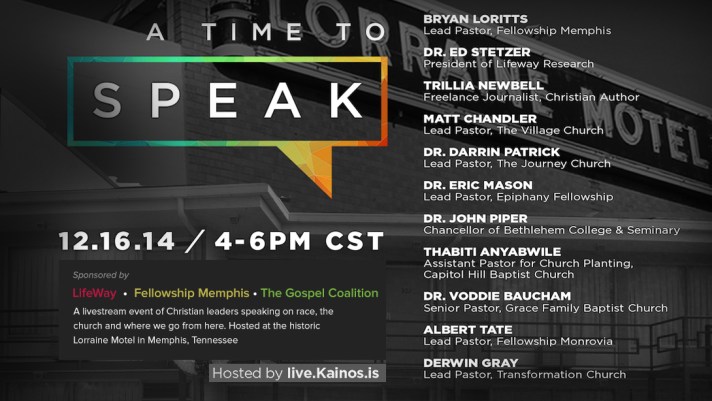
A Time To Speak

a-time-to-speak

Today, December 16th, a panel of Christian leaders will gather at the Lorraine Motel in Memphis, Tennessee to discuss race, the church, and what we can do from here. The Lorraine Motel is a significant location for this event. On April 4, 1968, Dr. Martin Luther King, Jr. was killed at the Lorraine Motel. Today, it is the National Civil Rights Museum in the United States and will be the host for this event.

Here’s a brief explanation from the event’s organizer, Pastor Bryan Loritts:

“We want to boldy declare there is hope…The grand jury’s decision not to indict the officers involved in the deaths of Eric Garner and Michael Brown has left many in our nation angry, saddened and hopeless…The fact that such heart-wrenching decisions have taken place some 50 years after the civil rights movement have left the children of those who marched in such places as Birmingham and Selma wondering if justice has not only been delayed, but has she finally and permanently been denied.”

A number of well-known Christian leaders will aim to bring their wisdom and love for the gospel in this discussion panel. As Ed Stetzer has said, “We want to listen well, dialogue on the issues, and point to Jesus.” Here are the pastors and leaders slated to take part in this discussion:

  • Bryan Loritts, pastor of Fellowship Memphis
  • Trillia Newbell, writer and author
  • Matt Chandler, pastor of The Village Church in Dallas-Fort Worth
  • Darrin Patrick, pastor of The Journey Church in St. Louis
  • Eric Mason, pastor of Epiphany Fellowship in Philadelphia
  • John Piper, chancellor of Bethlehem College and Seminary
  • Thabiti Anyabwile, assistant pastor for church planting at Capitol Hill Baptist Church in Washington, D.C.
  • Voddie Baucham, pastor of Grace Family Baptist Church in Spring, Texas
  • Albert Tate, pastor of Fellowship Monrovia in Monrovia, California
  • Derwin Gray, pastor of Transformation Church in Indian Land, South Carolina

The event is not open to the public, due to our location and our limited time there, but anyone can watch online on Tuesday afternoon from 4pm to 6pm CT (5pm to 7pm ET). It is expected to be widely viewed and discussed – so join in. The discussion will be honest and Christlike, and the hope of the panelists is that the viewers will benefit from their time together.

Click here to visit the website. 

The Resurrection and the Life (John 11:1-44)

This is the sermon I preached at The Fellowship at Two Rivers on 12/14/2014.

The Healing of the Man with a Withered Hand (Mark 3:1-6)

This is the sermon I preached at The Fellowship at Two Rivers on 12/07/2014. The sermon begins at 31:20.

The Healing of the Ten Lepers (Luke 17: 11-19)

This is the sermon I preached at The Fellowship at Two Rivers on 11/23/2014.

Tim Keller Lectures On Preaching

Dr. Timothy Keller recently delivered the John Reed Miller Lectures on Preaching for 2014 at Reformed Theological Seminary in Jackson, MS. Watch or listen to them below.

Video

Audio