10 Tips For Leading A Small Group

groupsmatter_logo_white

Groups are absolutely essential to the health and mission of a church. They are likely the starting point for community, discipleship, and service in your church. In fact, recent research shows that people involved in groups are healthier spiritually than those who aren’t. People in groups read the Bible more, pray more, give more, and serve more. Simply stated: groups matter.

What happens when groups gather also matters. I found Rick Howerton‘s list 10 Practices of Great Small Group Facilitators helpful. Here are his very practical suggestions.

  1. Do ice-breakers that everyone participates in and that build individual trust and team unity.
  2. Affirm each person when they speak, especially early in the group’s life.
  3. Draw everyone into the conversation. When there is a person who seems slow to jump into the discussion, graciously ask their opinion or request their input.
  4. Be relaxed yourself. A relaxed facilitator creates a relaxed environment.
  5. When asking the group to speak of a sensitive life issue or situation, be the first to tell your story.
  6. Involve your apprentice when possible.
  7. Talk less than 30% of the time.
  8. Converse with those in your group between group gatherings.
  9. When you don’t know the answer to a question asked of you, say you don’t know but that you’ll try to find out and that you’ll get back to the group with the answer to the question.
  10. React to delicate situations/moments with grace and sensitivity.

This list origionally appeared on ChurchLeaders.com

Jesus and the Ten Commandments

10-Commandments.851x315

This post origionally appeared at The Gospel Project blog in a series on the Ten Commandments. 

For too many Christians the Ten Commandments are impossible imperatives. While we would affirm that God’s commands are good, they seem to bring nothing more than a moral burden that crushes us under the weight of God’s holiness. Our difficulty with the Ten Commandments can be resolved by understanding the aim of God’s law in the context of redemptive history. Furthermore, when we fail to see the context in which the law was given, we tend to overlook the relationship of the law of God to the grace of God.

You have seen what I did to the Egyptians and how I carried you on eagles’ wings and brought you to Me…I am the LORD your God, who brought you out of the land of Egypt, out of the place of slavery. –Exodus 19:4; 20:2 (HCSB)

These are the words of the God of Israel to Moses as he stood on Mount Sinai and looked back at what God had done for His people, how He had delivered them from slavery in Egypt. It is important to remember that when God gave the Israelites the law, their status as God’s people had already been established.

Since Israel was given a new life after God delivered them out of Egypt, the law functioned to show Israel what this new life was to look like. And the laws given at Sinai were not arbitrary but stemmed from the character of God and His original purpose for humankind in creation. The purpose of Israel’s obedience was to reflect God’s nature to the world around them as a concrete expression of their devotion to God. The same is true for Christians today; God’s law establishes a separate and unique identity for God’s people.

However, the history of Israel (and our own hearts) confirm that the ideals of God’s law cannot be achieved without God’s divine intervention. The Ten Commandments expose our sinful motives and behavior for what they are, namely, transgression of specific commands. And we know from experience that the Ten Commandments do not have the power to transform us or liberate us from the power of sin. So, the law is like a teacher who shows us God’s holiness, our sinfulness, and our need for salvation. And the needed divine intervention ultimately comes through Jesus Christ. This is the good news of the gospel.

By faith we receive the gift of Jesus’ law-keeping, which was perfectly achieved on our behalf, and in Him we become righteous. Therefore, we uphold the law by turning our backs on our own warped efforts to keep the law and by putting all our confidence and trust in the One who satisfied all the laws demands on our behalf (Romans 3:31). Thus, when one is saved through repentance of sin and faith in Jesus Christ, they are released from the power of sin and the condemnation of the law. In salvation we are given new hearts to know and understand God’s order for creation. The spirit of rebellion against the authority and rule of God is replaced by a spirit of obedience. Gospel-driven internal motivation replaces external moral constraint (Jeremiah 31:31-33; Ezekiel 11:19-20, 36:26-27).

Therefore, God’s law is still authoritative and necessary for Christians today. Jesus did not so much replace the Old Testament law as make explicit its proper application to the heart and not just external behavior (Romans 6:14, 8:1-4). Jesus’ idea of obedience moves beyond religious observance, focusing not only on the things we do but on who we are (Matthew 5–7). Only the gospel changes the heart and can lead to lasting change in our lives.

You will remember that when asked by one of the religious leaders to identify the greatest commandment in all of the law, Jesus replied by quoting Deuteronomy 6:5 and Leviticus 19:18.

Love the Lord your God with all your heart, with all your soul, and with all your mind. This is the greatest and most important command. The second is like it: Love your neighbor as yourself. All the Law and the Prophets depend on these two commands. –Matthew 22:37-40 (HCSB)

In many ways, Jesus’ response summarized the heart of the Ten Commandments. The first four of the Ten Commandments have to do with our relationship to God, while Commandments six through ten addresses our relationship to one another. Jesus came to fulfill the law (Matthew 5:17). Jesus is the true Israelite who perfectly loved God with all of His heart and perfectly loved His neighbors (Luke 22:42; John 15:13). The Old Testament law pointed to Jesus Christ and is only properly revealed in Him (Romans 8:3; 10:4; Galatians 3:24).

In fulfilling the law through His life, death, and resurrection, Jesus enables us to attain righteousness greater than that of religious obedience. Jesus has delivered us from a slave master greater than Egypt—that of sin and death. Jesus was crushed under the weight of our sin so that we could be free to obey God’s commands. Our gospel-empowered desire to obey God’s commands creates a separate and unique identity for us as God’s holy people sent out in His name into the world. Those who love God will express their love for Him in obedience and missionally in their love for others.

In response to what Christ has done, knowing that our status as God’s people is secure, we submit to the words of Paul, who declared in Romans 12:1, “by the mercies of God, I urge you to present your bodies as a living sacrifice, holy and pleasing to God; this is your spiritual worship.”

4 Suggestions on “Sharing the Gospel” from Matt Chandler

In a recent interview with Bob Smietana for Facts and Trends Magazine, Matt Chandler offered four practical suggestions for teaching Christians how to share their faith.

1. Get the gospel right.

Strategy doesn’t matter if churches don’t get their message right. And people can’t share the gospel if they don’t know it. “Get the gospel message right,” he says. “And then be confident in that message. Not in your delivery but in the message. Here’s what we do—we love well and we share the gospel.”

2. Admit your faults.

Self-righteousness is one of the biggest turnoffs for nonbelievers, says Chandler. Don’t pretend being a Christian makes you superior to other people. “If you really understand grace, it’s not us and them,” he says. “It’s us. The ground at the cross is flat. The gospel of Jesus Christ has set me free to not pretend that I am perfect in front of you.”

3. Don’t try to scare people into following Jesus.

Chandler’s not afraid to talk about hell. He says it’s an “awful reality” that can’t be avoided. But avoiding hell isn’t the main message of the gospel. “If hell is how you are trying to motivate people toward heaven, then you have missed a key component of what God has done for us in Jesus Christ,” he says. “Namely He has justified us, sanctified us, and is adopting us as sons and daughters. You have missed the entire delight piece—where God delights in those He has rescued.”

4. Focus on the gospel instead of arguments about non-essentials.

Chandler tries to steer clear of arguments over issues like creation, evolution or the age of earth, where he’s not an expert. “If you think you don’t have all the answers,” says Chandler, “Just say ‘I don’t know. But here’s what I do know—Jesus changed my life.’ A passionate belief in Jesus Christ that has changed your life is still the best apologetic.” Remind people their job isn’t to save nonbelievers. Instead, they need to share the gospel and let God do the work. “I have tried repeatedly to lay out the reality that it is God who saves,” he says. “God saves. That takes the pressure off of people.”

To read the whole article, click here.

Free eBook: Keeping The Ten Commandments by J.I. Packer

851x315_kttc

We are excited about the newest release of The Gospel Project! Our adult/student summer study, titled God’s Way, explores the Ten Commandments from a Christ-centered perspective. The writers for God’s Way include Trevin Wax, Mike Cosper, Rey De Armas, and J.D. Greear. These are 13 sessions that you will not want to miss.

In conjunction with the launch of God’s Way, The Gospel Project and Crossway have teamed up to offer J.I Packer’s book Keeping The Ten Commandments free. Here are a few words about the book.

400x_keepingcommandments_cover“They’re often mistakenly considered God’s “rules”- his outdated list of do’s and don’ts that add up to a guilt-ridden, legalistic way of life. But as beloved author and Bible scholar J. I. Packer probes the purpose and true meaning of the Ten Commandments, you’ll discover that these precepts can aptly be called God’s blueprint for life. They contain the wisdom and priorities everyone needs for relational, spiritual, and societal blessing-and it’s all coming from a loving heavenly Father who wants the best for his children.

Not only does Packer deliver these truths in brief, readable segments, but he includes discussion questions and ideas for further study at the end of each chapter. This book will challenge you to view the commandments with new eyes and help you to understand-perhaps for the first time-the health, hope, and heritage you’re offered there.”

The Gospel Project strives to provide solid additional resources that enrich your study as you move through our material. This free Crossway eBook will only be available for a limited time, so download it now and pass the info on to your friends.

Jesus is the True and Better…

This video was produced by Dan Stevers, and is a beautiful visual rendition of Tim Keller’s “True and Better” sermon delivered at The Gospel Coalition in 2007. The full text from the video can be found here.

Christ Motivates a Sacrificial Life

Wax Header

This was first posted at The Gospel Project‘s site in the atonement series. 

It has been a long day at the office, and the drive home drags on as the weight of unfinished tasks rest on your shoulders. As soon as you walk through the door the couch is calling your name, but your spouse asks if you could do a few things around the house before you relax.

You just sat down to read a book on the back porch, and the phone rings. You sigh as you see that it’s your friend who lives life under the dark clouds of negativity. Every time life’s storms wreak havoc on his emotional stability you are the first person he reaches out to and every conversation drains the life out of you.

Once again, you find yourself at an elderly family member’s house doing odd jobs and random chores. For some reason, every time something breaks, goes missing, lets out an odd sound or smell, you are the one she calls. As one task multiplies into several, you see your Saturday plans pass by.

Requests like these often cut in to your plans and desires, don’t they? Why do people burden you with wishes that you do not want to carry? If we are honest, more often than not, serving others can feel more like a drudged duty than a delight. And your desire to push everyone away and find solitude easily turns to guilt. After all, it seems like those who request the most of our attention are usually our nearest and dearest neighbors. To make matters more difficult, as a Christian you are called to love your neighbor in the same way that you love yourself. These are the moments when theology meets life.

What, if anything, will compel you and I to sacrificially love those around us? There is only one answer for the Christian. The gospel of Jesus Christ. The Bible teaches that the sacrificial life and death of Jesus not only provides salvation, impels us towards sanctification, but also inspires us to reflect God’s sacrificial love to others (2 Cor. 5:14, Rom. 8:35-39). However, there are moments when sacrificial love for others is the farthest thing from our hearts.

Let us be reminded of the words of Jesus, the greatest display of love is found in laying down one’s life for his friends (John 15:13). Specifically, it’s not “losing” one’s life; it’s “laying it down.” That’s a proactive statement. There is a sense in which Jesus is saying, “Choose sacrifice”. What motivates our loving sacrifice? His sacrificial life and death of love on our behalf motivates our loving sacrifice for others (Eph. 5:1-2; Phil. 2:3-8).

The apostle Peter exhorted the church: “For to this you have been called, because Christ also suffered for you, leaving you an example, so that you might follow in his steps (1 Peter 2:21).” In other words, the compelling beauty of Christ’s sacrificial example dissolves our indifference to the need of others. So, when you see how Christ has loved you, it will melt your heart and transform how you love others (2 Cor. 5:14).

The application of the gospel to our indifference to the need of others is simple. It is in those moments when we do not feel like loving others that our commitment to, and thankfulness for, Christ’s sacrificial love shines. Don’t kid yourself, the very nature of loving sacrificially makes it abundantly clear that we will not always be happy about it, even in those moments when it’s needed most. As followers of Christ we are called to forfeit our self-centered desires in favor of serving others.

When we repent of our indifference towards others and refocus on the gospel, our hearts will be softened toward others as we serve and Christ will turn our duty into delight. Very simply, the gospel will change our heart toward others so that we desire to love them sacrificially as an opportunity to reflect the love of God. There is great joy in serving others! Not only does it honor and reflect Christ, it is also a tangible way of loving our neighbors.

For Christ’s love compels us, since we have reached this conclusion: If One died for all, then all died.  And He died for all so that those who live should no longer live for themselves, but for the One who died for them and was raised. – 2 Corinthians 5:14-15 (HCSB)

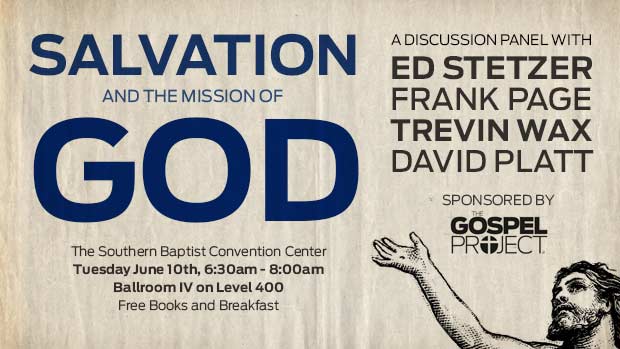
SBC Panel Discussion on “Salvation and the Mission of God”

tgpbreakfast_620x3491

Sign Up Here!

  • Does one’s belief on the extent of the atonement affect their understanding of mission and the offer of the gospel?
  • Can two Christians disagree on soteriology and partner in ministry?
  • Does the order of salvation affect how one does evangelism?
  • When it comes to the theological particulars of salvation, what is the difference between compromise and cooperation?

Join us at The Southern Baptist Convention to hear Ed StetzerFrank PageDavid Platt, and Trevin Wax discuss the topics of salvation and mission. Only 500 seats available, so sign up now!

  • Date: Tuesday, June 10th
  • Time: 6:30am – 8:00am (Be there at 6:15am!)
  • Place: The Baltimore Convention Center
  • Location: Ballroom IV on Level 400
  • Free breakfast and books

Each attendee will receive a bag of free books including:

We look forward to seeing you at The Southern Baptist Convention. Sign up for the breakfast here. 

The ERLC Leadership Summit

leadsummitBANNER

The Ethics & Religious Liberty Commission of the Southern Baptist Convention will host the first annual ERLC Leadership Summit April 21-23 in Nashville, Tenn. The inaugural Summit’s theme is “The Gospel and Human Sexuality.” It will equip pastors, church leaders and lay people to speak to these critical issues in their congregations.

Speakers include ERLC President, Russell D. Moore; J.D. Greear, Pastor of The Summit Church in Raleigh, N.C.; and Trillia Newbell, ERLC’s Consultant for Women’s Initiatives. Keynote addresses, panels and breakout sessions will focus on how the gospel shapes a person’s sexual identity, redeems sexual desire and sets free people held captive by sin.

“So many of the questions that pastors grapple with today deal with situations that would not even have been possible a generation ago,” Moore said.

“As technology advances and the culture changes, the questions that we have to grapple with are often increasingly complex. At the ERLC Leadership Summit, we’ll talk about these questions, and how we can be be faithful in ministry, gospel-focused in engagement and Christ-shaped spiritual warriors in the ways we seek to wrestle with the principalities and powers of this age.”

The main sessions will be live-streamed on erlc.com. Follow the conversation on Twitter by following @ERLC, @ERLCPressRoom and #erlclive. A complete schedule of events and speaker information can be found online.

Evangelism as Captivating with the Gospel

open-bibles

I recently wrote this article for Facts & Trends magazine on The Power of Story: Captivated by the Gospel.

Do you remember the last time you heard a good story? 

It’s easy to become captivated by a compelling narrative or a fascinating myth. Stories are instruments of powerful mnemonic and formative capability.

From movies to novels or warm conversations over dinner, stories can capture our imagination and shape the way we think about the world like nothing else can. We love stories.

And like children sitting on the edge of a bed awaiting their parents to read a beloved bedtime book, we long to be told a good story. But more importantly, we want to be part of a good story.

Stories help us make sense of where we find ourselves, what has gone wrong with things, and what can be done about it. Stories shape and narrate how we view ourselves. These narratives speak to a deep longing in our hearts, opening the doors of possibility to things that could be.

However, most of the narratives that captivate the imaginations of children are nothing more than fanciful myths.

Sadly, the same can be said of the worldviews that narrate the worlds of most adults. The burning question that each of us must ask is, who gets to narrate my world?

The true story of the whole world

As Christians, we understand all people are confronted by a host of master narratives that compete with, and often contradict, the gospel of Jesus Christ. We also believe God has revealed the true story of the whole world. The story of Christ is, as C.S. Lewis put it, “the true myth.”

In many ways, the Bible presents redemptive history as a four-part drama—creation, fall, redemption, restoration. In that drama, Jesus isn’t part of the story; He is the point of the story.

Evangelism is sharing the greatest story ever told, namely, the story of redemption through Jesus Christ.

In order to make sense of our lives, we depend on narratives that provide us a broader framework of meaning.

I believe Alasdair MacIntyre was correct in After Virtue, when he wrote: “I can only answer the question ‘What am I to do?’ if I can answer the prior question ‘Of what story or stories do I find myself a part?’”

This principle is extremely important for evangelism. Not only do we need to understand the true story of the whole world, we also need to understand how to read the story of those we talk with. What narrative shapes their worldview, outlook and self-image?

Reading their story, sharing Christ’s story 

Too often our evangelism efforts are driven by one-sided, canned presentations. How often do we listen to those we are sharing with in order to present the gospel to them with wisdom and care?

What if our efforts in sharing the good news were less about putting people in evangelistic headlocks until they make a decision and more about capturing their imagination with the beautiful gospel?

We believe the story of Jesus’ life and work is directly related to the story of our world, and to the personal stories of everyone we meet.

When we share the gospel with others, do we ever stop to wonder if they are able to perceive how the gospel is good news for them? How does Jesus’ story enter their story?

What people need to know is not only what the gospel is, but also what the gospel does. We need to show them the beauty of the gospel and pray that God would open their eyes to see it.

In his book Unbelievable Gospel, Jonathan Dodson suggests that using gospel metaphors at the prompting of the Holy Spirit is a more effective way to aim at the heart of the listener.

In other words, apply the gospel to their story.

  • To those searching for acceptance in all the wrong places, we can point them to perfect acceptance in the gospel of justification.
  • To those searching for fulfilling relationships, we can point them to profound, personal union with Christ.
  • To those who struggle with tolerance, we can show them the uniqueness of Christ in the gospel of redemption.
  • To those who fear disapproval or demand the applause of others, we can share the gospel of adoption, which offers an enduring approval and produces humble confidence.
  • To anyone longing for a new start, there is the hope of new creation.

Tell His story

This is not changing the message of the gospel, but aiming that message to hit people at their deepest needs.

The gospel story is the only story that will help your family, friends, coworkers and neighbors make sense of the world they find themselves in, what has gone wrong with it, and what has been done about it.

As those who are captivated by God’s story, let us go as storytellers and captivate others with the grace of God found in Jesus Christ.

Sin and death may be part of the story, but we know where the story ends. Paradise may be lost, but in Christ we are headed for peace and satisfaction forever after.

The gospel story is good news. Do you remember the last time you told this great story?

Free Theology Books for Kindle

Old-Books-header

Here is a list of classic theology books for free on Kindle. HT Justin Holcomb.

St. Aquinas

Martin Luther

John Calvin
Jonathan Edwards
D. L. Moody
William Wilberforce
John Bunyan
R. A. Torrey

G. K. Chesterton