Tim Brister on “From Strangers to Missionaries”

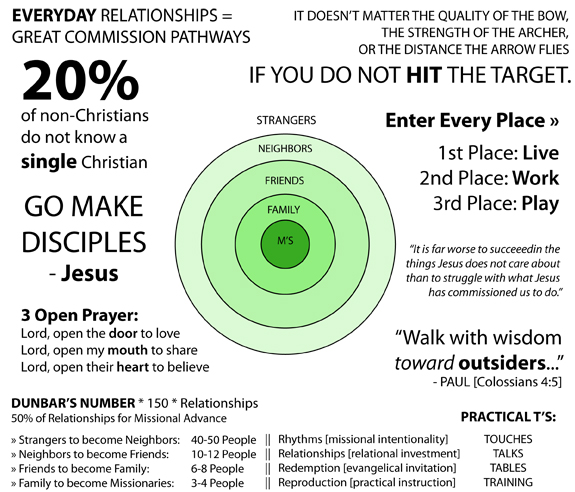
Over the last year or so I have watched my friend Tim Brister devote a considerable amount of time to writing about missional living. Not too long ago Tim posted a summary blog of his reflections and writings on this subject. I have found his thoughts beneficial and challenging, so I wanted to share them here.

Strangers to Missionaries Overview Graphic

Brister’s Series:

Other Supplementary Articles from Brister:

Teaching a Class on The Doctrine of Humanity

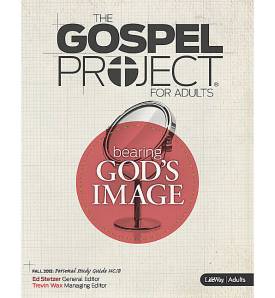
Next week I will begin teaching a class on the doctrine of humanity with Philip Nation at The Fellowship, Two Rivers. The class will last 8 weeks and will roughly follow the outline of The Gospel Project’s Fall study titled “Bearing God’s Image”.

  • August 21st – Created to Reflect: Reflecting the Image of God
  • August 28th – Created to Relate: Relating to God, Others, and the WorldTGP
  • September 4th – Created to Work: Vocation and Labor
  • September 11th – Created to Rest: Resting from Work, Resting in Christ
  • September 18th – Created to Rule: Authority in Representing God
  • September 25th – Living in Redemption: Salvation and Sanctification
  • October 2nd – Learning to Trust: Perseverance and Assurance
  • October 9th – Longing for Restoration: Future Glorification

If you are in the Nashville area, come and join us!

It is an honor to serve on The Gospel Project team! I am excited to join over 400,000 other believers who will dig into this study over the next few months.

In my preparation for the class I have found several resources helpful, and wanted to share them here.

  1. John Hammett’s chapter on “The Doctrine of Humanity” in A Theology for the Church, edited by Daniel Akin. Hammett’s chapter is a great introductory work on this topic.
  2. Also, check out Anthony Hoekema’s book Created in God’s Image. Hoekema’s work is an excellent volume for someone who would like to dig a little deeper into the doctrine of humanity.
  3. Charles Sherlock’s book The Doctrine of Humanity in the Contours of Christian Theology series is also a great resource to have in your library. While Sherlock’s work the most dense of these three, its scope and depth is well worth its weight.

If you are teaching through The Gospel Project this fall, be sure to check out these resources which we have made available at The Gospel Project’s website.

Consider the words of one theologian, “…our wisdom, in so far as it ought to be deemed true and solid wisdom, consists almost entirely of two parts: the knowledge of God and of ourselves.” My prayer is that we would come to know God in this study, and come to know ourselves in the way God has created us and redeemed us to be.

Why Do We Need Physical Rest?

TGPblog315x851final

This was originally posted at The Gospel Project site. To see the entire series click here.

The Need for Physical Rest

As we get older, it is inevitable that we will wear down physically. In turn, our need for rest and recuperation becomes more noticeable. At least, that’s been my experience in the last few years. When I do not get as much rest as I need, I become impatient and irritable towards my family and friends. So, the older I get, the more I cherish rest. Many nights I collapse into the bed exhausted, and sink into the mattress from the weight of the day’s activity.

Physical rest repairs and rebuilds the body and mind. When we exert ourselves physically or mentally, we long for the restoration of our energy. Researchers have shown that both the physical stress of manual labor and even the emotional stress of a desk job require subsequent rest for the body and mind to recuperate.

Many of us need more rest; we live in a culture that forfeits rest to chronically overwork. Studies have shown that the average American doesn’t get nearly enough sleep for what their body requires to function at peak performance. This scientific information is good and all, but research can only offer observations about rest and our need for rest. The Bible, on the other hand, can actually offer the deeper reasons for unrest and lasting motivations for rest.

A Theology of Rest?

What actually drives us to unrest is rooted in our hearts, usually idolatry. For example, the workaholic sacrifices rest to the god of success, power, and productivity. This pattern can be seen in almost all areas of our life. The good news is, God is not silent about our need for rest nor has He left us without good reason or motivation for rest. The Bible is very clear that humans need rest, and interestingly enough, rest teaches us something about God.

Physical Rest is a Gift from God

God building in the need for rest in the lives of His creatures is a gift of grace. In Psalm 127, we read that God “gives to His beloved in his sleep.” The nights that I sleep well lead to mornings when I am most refreshed and days that I am most productive. Let’s face it; the anxieties of everyday life can wear us down to the point of physical and emotional fatigue. I am thankful that the infinite God granted this finite man the need for rest. In fact, it is impossible for a finite being like you and I to live well without rest.

Physical Rest Reminds us that We are not God

Again, the psalmist proclaims that God will “neither slumber nor sleep” (Psalm 121:4). How different from us? We need rest. If we do not rest it has massive implications for our physical, emotional, and mental health. However, God does not need rest. Not only is God all-powerful (not needing rest), He is ever-watchful (watching us while we rest). For some of us it is a scary thing to consider that we lay down all control and consciousness when we sleep. The most powerful people in all of humanity spend a third of their lives asleep, as helpless as an infant, and the world still progresses. Simply put, we are not God.

Physical Rest requires us to Relinquish Control

God handles the world quite well while on His own. God is sovereign over our world while we are awake, even more so when we are at rest.  John Piper once said, “…Sleep is like a broken record that comes around with the same message every day: Man is not sovereign.” We’ve all heard the hard worker wax all self-righteously about his/her early morning and late night working hours, as if they run the world. How silly. It’s better to work well and sleep well, rather than to sacrifice rest in an effort to stay in control.

Lying Down and Laying it Down

God intended sleep to be a gift, a time every day where we remind ourselves that we are not God, and that God is in control. If you are like me, you probably have trouble sleeping when you are worried about something. Well, Jesus is pretty clear on the fact that worrying accomplishes nothing (Matthew 6:27-29).

So, I’ve learned that when I lie down to sleep it helps me to say to myself, “God, I am powering down, even though there is a ton to do, and lots to worry about, You are awake, working, and in perfect control, so I trust You to handle what I can’t.” It helps me rest well knowing that everything is in His hands.

The Discipleship Interview with Eric Geiger

I recently had the opportunity to dialog with Eric Geiger about discipleship at his blog. Eric serves as one of the Vice Presidents at LifeWay Christian Resources, leading the Church Resources Division, which means he is my boss. I highly respect Eric and count it a joy to work under him on the church resources team. For the interview, Eric asked me three questions concerning discipleship in the local church. I have posted the interview in its entirety below.

Eric: Discipleship is such a broad term, often a junk-drawer term that has been used to describe many things. How do you define it?

Matt: The term discipleship is somewhat convoluted in today’s church. I’ve seen churches call everything from bible classes, financial courses, theology groups, marriage seminars, and speculative classes on the end times, ‘discipleship’. Certainly, discipleship involves having a biblical understanding of every aspect of life. However, calling everything done under the auspices of the local church ‘discipleship’ is unhelpful at best. When Jesus called the twelve to make disciples, baptize them, and teach them to observe all he commanded them, I doubt he had in mind what most churches call discipleship today. (see Matthew 28:19-20)

eric-geigerThe word translated ‘disciple’ in the New Testament communicates the idea of a ‘learner’. A Christian disciple is one who learns the good news of the gospel and applies it to all of life. If you read through all that Jesus commanded the disciples you will find both gospel proclamation and kingdom demonstration. That is, teaching on the Scriptures and application of those teachings. Discipleship should be gospel-centered, word focused, and mission oriented. So, what is discipleship? To use the words of J.I. Packer, discipleship involves “grounding and growing God’s people in the gospel and its implications for doctrine, devotion, duty, and delight” (Grounded in the Gospel, 29). Discipleship is the intentional passing on of the biblical faith.

Moreover, disciples are not merely learners but fruit-bearing disciple-makers; they multiply themselves. (Acts 20:26-35; 2 Timothy 2:2) Those who follow Jesus are called and charged to be people who, having themselves learned, now reach out to teach what they have learned. This involves both formal and informal discipleship. Formal discipleship would include bible teaching and doctrinal instruction, what the church once called catechesis. (Jeremiah 6:16; Galatians 6:6) While informal discipleship would be intentional gospel centered encouragement and accountability in more intimate relationships. (Deuteronomy 6:6-7)

Eric: In terms of discipling new believers, what is of chief importance?

Matt: A new believer needs to understand the gospel first and foremost. What is the good news, what does it means for me, and why does it matter? And honestly, this process of understanding and applying the gospel will last a lifetime. So, of central importance is grasping the gospel. The initial steps of discipleship with a new believer might be more informal, almost like craftsmanship. It takes time, energy, patience, and skill to walk a new believer through the gospel and its implications, applying it to every area of life.

At the same time, I also think that new believers need to be involved in the formal process of discipleship, again, it used to be called catechesis. While the modern church rarely uses the word catechesis, we often engaged in catechesis training, which is simply doctrinal instruction. This involves spiritual, moral, and theological foundations that can help mature a young believer. Many old Saints from church history have argued that a faithful catechesis was absolutely essential to the healthy continuance of Christ’s church. In pastoral ministry I gave much thought to teaching the essentials of the Christian faith for the maturity of the body. Out of this time of study I developed five courses designed to be taught and discussed in both formal and informal settings.

  • Gospel – The gospel in its simplicity and depth.
  • Story – The story of redemption of which the gospel is the climax. (Biblical Theology)
  • Theology – The doctrines of the faith that conform to the gospel. (Systematic Theology)
  • Community – The power in the gospel that flows from our relationship with God and to others. (Ecclesiology and Biblical Counseling)
  • Mission – The manner of living that conforms to the truth of the gospel. (Missions, Missional Living, Ethics, and Culture)

These courses charted out with an end goal in mind, as not to perpetuate the continual learner but to train and equip every person for fruitful personal ministry. The end aim of these courses is to fully equip our people with essential theological understanding so that they can minister with discernment within their spheres of influence. I wrote and taught these classes with the new believer in mind. The initial question that set everything into motion was, what are the essential things I want every member of this church to believe and understand? After several semesters of teaching the courses, it was encouraging to see other church members who had completed the courses teaching them alongside me and the other pastors.

Eric: When thinking or training on discipleship, what passages are anchor passages for you? 

Matt: The Apostle Paul charged the leaders in the Ephesian church to “equip the saints for the work of ministry, for building up the body of Christ, until we all attain to the unity of the faith and of the knowledge of the Son of God, to mature manhood” (4:12). God has gifted His church with pastors, elders, and leaders with various gifts who are called to equip the church body to do the work of ministry (Ephesians 4:11). Notice Paul’s words, equip the saints for ministry.

Too often pastors operate as if they are the only ones capable of ministry. This has been called the professionalization of the ministry. However, it seems that Paul had a different ministry philosophy in mind. I think Michael Green captures this idea in his classic work Evangelism in the Early Church:

“It would be a gross mistake to suppose that the apostles sat down and worked out a plan of campaign: the spread of Christianity was, as we have seen, largely accomplished by informal missionaries, and must have been to a large extent haphazard and spontaneous.”

In other words, ministry was the prerogative of every church member. The ordinary people of the Church saw it as their prerogative. In fact, if one studies church history they will see that Christianity has been supremely a lay movement, spread by informal missionaries. As Green said, “The spontaneous outreach of the total Christian community gave immense [momentum] to the movement from the very outset.”

One of the keys of a multiplying discipleship ministry is intentionality in both informal relationships and formal training structures. All Christians have spiritual gifts that are to be used in ministering to others (1 Cor. 12:7, 11; 1 Pet. 4:10). All training and discipleship should be aimed at these ends, gospel proclamation and kingdom demonstration. In becoming a Christian, each one of us becomes a disciple. As Christians we never stop being disciples. We never reach the point where we no longer require daily discipleship by the gospel word and the gospel community. Moreover, as Christians, we are all called to make disciples.
The Gospel Project is now available with ESV Bible text!

ESV TGP Banner. Now Available

The Gospel Project is now available with the ESV Bible text in the curriculum. As part of this exciting news, LifeWay and Crossway are partnering together to give away 15 Group Starter Kits worth $100, each including:

  • ESV Heritage Bible
  • 2 Gospel Project leader guides
  • 10 Gospel Project personal study guides

Win this, and you’ll have all you need to start a new small group, home group, or bible study class. To earn your chance to win simply follow these steps!

  1. Sign up to download free samples of The Gospel Project with ESV text at gospelproject.com/esv
  2. Post about The Gospel Project and ESV combination on your blog including the Gospel Project and ESV graphic, linking back to the download page (gospelproject.com/esv).
  3. For a greater chance to win, include #2 in a blog post related to the importance of studying the Bible with others. These posts can focus on a range of issues from teaching, leading, or being involved in small groups, homes groups, or Sunday school. If you have an earlier post related to these topics, dust if off and add #2.
  4. Feed your blog post through twitter (make sure to tag @gospel_project) and facebook.

On August 19th the 15 winners of the Group Starter Kits will be announced!

The Dynamics of Spiritual Revival


Yesterday I had the privilege of preaching at The Fellowship at Two Rivers and Mt. Juliet, where Laura and I are now members. I am thankful for Philip Nation and the Elders/Pastors/Leaders for giving me the opportunity.

This sermon is on Nehemiah 9-10, continuing in the series “Build Up” through the book of Nehemiah.

Instruments in the Redeemer’s Hands by Paul Tripp

Here are some quick thoughts on Paul Tripp’s Instruments in the Redeemer’s Hands. I love this book for several reasons. In Instruments in the Redeemer’s Hands, Tripp explores the practical applications of the belief that we must not simply offer people a system of redemption, a set of insights and principles – but offer the redeemer. Tripp argues that counselors are  instruments in the redeemer’s hands, being used to bring about change. In my opinion, the sections that emphasize community as the context for change, and asking the right questions to get at the heart of a matter, are the most compelling portions of the book.

InstRdmsHandsTripp rightly argues that “personal insight is the product of community. I need you in order to really see and know myself…If I am going to see myself clearly, I need you to hold the mirror of God’s Word in front of me.” (54) Again, “God transforms people’s lives as people bring his Word to others . . . . The combination of powerful truth wrapped in self-sacrificing love is what God uses to transform people” (21). God’s purpose is for relationships to be the setting/environment/etc. in which his work of change can thrive.

The sections of the book exploring how the heart relates to particular struggles are an excellent resource for counselors and pastors. From my experience, the guiding questions that outline Tripp’s method have been very helpful in pastoral counseling sessions, teaching, and preaching – especially in exploring the deeper issues of the heart.

  1. Our hearts are always being ruled by something.
  2. The most important question: “what is ruling your heart in this particular situation?”
  3. God changes us not by teaching us different things, but by recapturing our hearts.
  4. The deepest issues of humanity are worship issues. What rules your heart?

I believe that Tripp is most helpful in unearthing heart issues by teaching one to ask the right questions. He argues that “…asking good questions is doing the work of change. Through them, we give sight to blind eyes and understanding to dull minds, we soften hardened hearts, encourage flagging souls, and stir hunger that can only be filled by the truth.” (173).

Why passive-aggressive Christian leadership must go away

Passive-aggressive attitudes manifest themselves in different ways, and in different situations. As with all sinful attitudes and actions, Christians are not immune to passive-aggressive responses to conflict.

My friend Marty Duren just posted a good blog post titled “Why passive-aggressive Christian leadership must go away“. Marty gives five reasons.

  1. Jesus was not passive-aggressive.
  2. It fosters a negative “blame the many instead of the problem” culture.
  3. It is contrary to New Testament fellowship.
  4. It creates distrust in the leader.
  5. It removes the imperative for the person to change his or her ways.

He expounds on these reasons on his blog. Marty begins this post on a personal note:

“When I was a young pastor I had a scattergun approach to preaching. Like many I tended to take a text, depart therefrom and go everywhere preaching the gospel.

Regrettably this approach also led to preaching in which I would “confront” a member of the congregation at the expense of the many. Rather than meeting with people individually about a certain issue, I would use the preaching time to address it. I would scattershot. In my ignorance it never dawned on me that the majority of the congregation had no idea what I was talking about and the intended target probably thought I was talking about someone else.

When I wanted to do it, I could really put the “bully” in bully-pulpit. This was a terrible pattern of preaching and leadership. Over the course of many years God got me mostly beyond preaching and leading that way, and I am grateful.”

I encourage you to read the whole thing here.

Christ-Centered Preaching and Teaching Discussion: Audio

tgpCHRISTwebad960x355

Here is a link to the audio: Christ-Centered Teaching and Preaching

photo (1)In case you missed it…

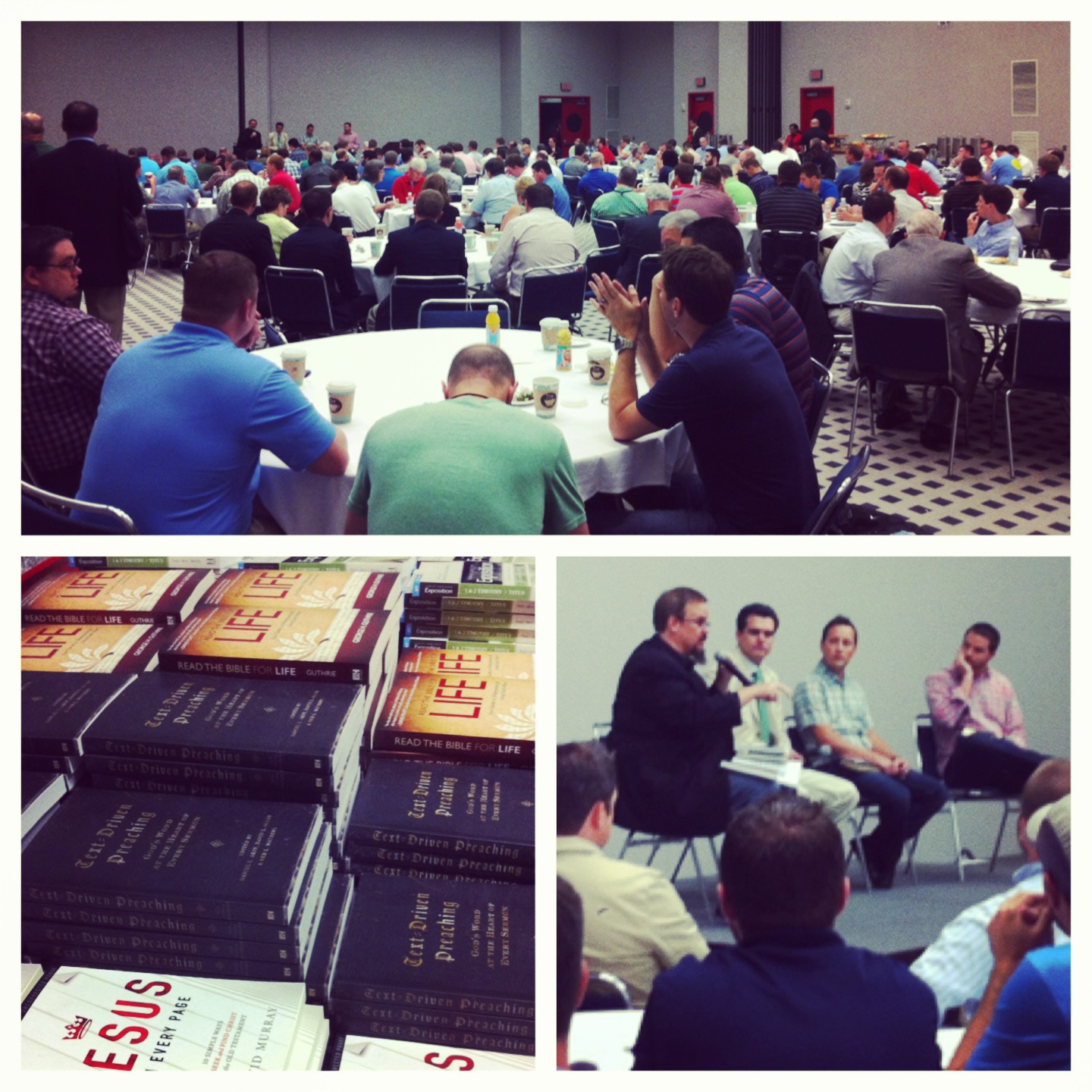
One of the highlights of the 2013 SBC was The Gospel Project‘s panel discussion on Christ-centered teaching and preaching. The room was packed out, which would suggest that people think this is an important topic. The panel featured Ed Stetzer, Eric Hankins, Trevin Wax and Jon Akin.

I Just Received My First Book Contract!

about_main_image

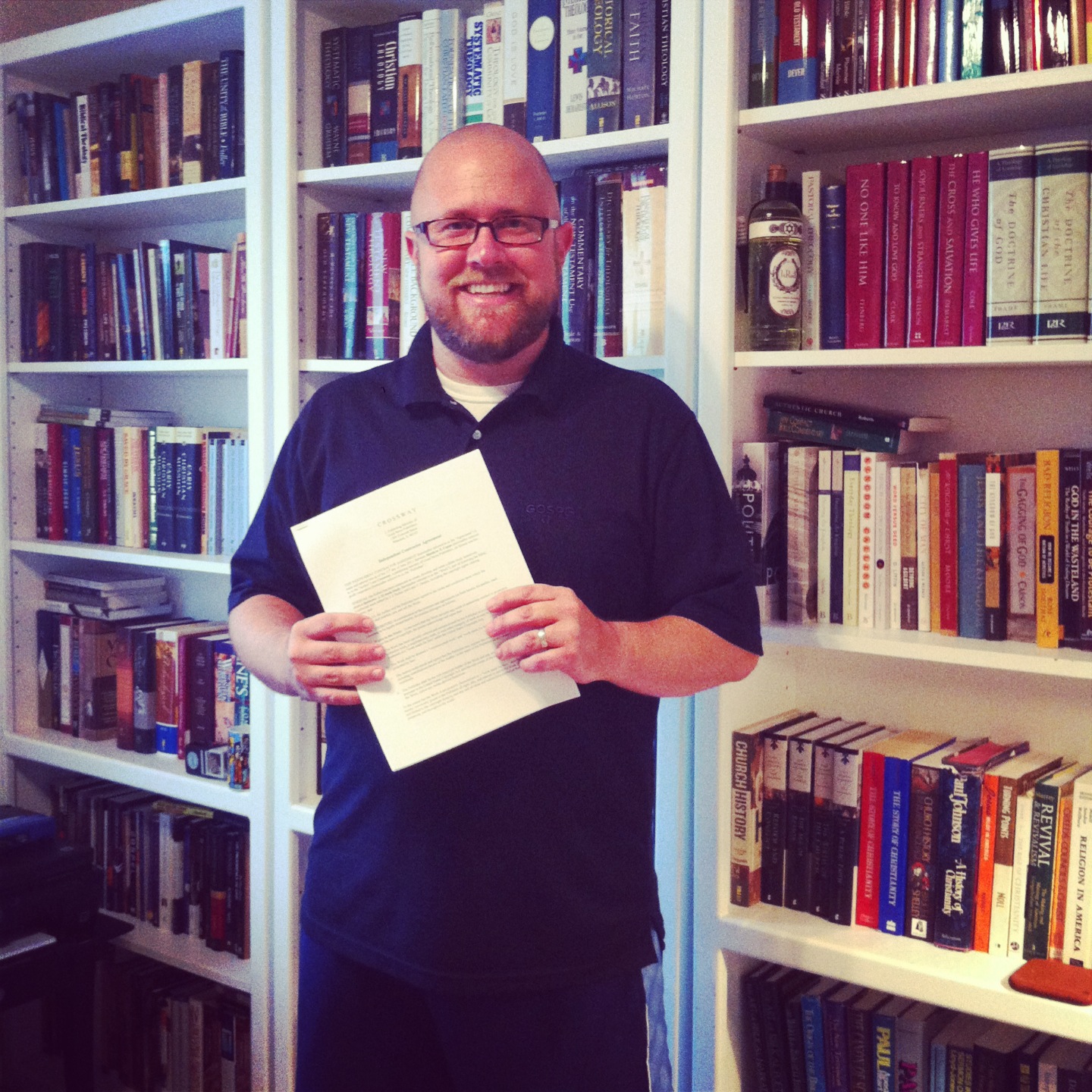
Last night I signed my first book contract. If you cannot tell by my picture below, I am thrilled. I will be writing a 12-week study on the book of Hebrews for Crossway‘s “Knowing The Bible” series. I am not only excited about publishing a Bible study; I am also excited about the series as a whole. Here is the vision for the Knowing the Bible:

The Knowing the Bible series is a new line of Bible studies designed to help Bible readers better understand and apply God’s Word.

Each study covers one book of the Bible over 12 weeks, making practical applications and connections between the passage and the rest of Scripture. The series is edited by theologian J. I. Packer, and includes contributions from an array of influential pastors and church leaders. Perfect for both small groups and individuals, these gospel-centered studies will help you see and cherish the message of God’s grace on each and every page of the Bible. Each study includes:

  • Reflection Questions designed to help you engage the text at a deeper level
  • Gospel Glimpses highlighting the gospel of grace throughout the book
  • Whole-Bible Connections showing how a passage connects to the Bible’s overarching story of redemption culminating in Christ
  • Theological Soundings identifying how historic orthodox doctrines are taught or reinforced throughout Scripture

I am thankful for Dane Ortlund and Crossway, who are granting me this opportunity. Pray for me, that I write well for the glory of God and the good of the church!

photo (2)