Unbelievable Gospel by Jonathan Dodson

Francis Schaeffer was once asked what he would say if he had an hour to share the gospel with someone. He responded by saying: “I will spend the first fifty-five minutes asking questions and finding out what is troubling their heart and mind, and then in the last five minutes will share something of the truth. (18-19)”
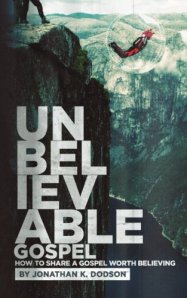
DodsonThis quote is refreshing to those of us who grew up in the age of canned gospel presentations. Many of us have been trained to put others in evangelistic headlocks and wait for them to tap out with a decision to follow Christ. This is why many readers will find Jonathan Dodson’s Unbelievable Gospel refreshing. Dodson does a good job of balancing gospel truth with patient proclamation.

According to Dodson, an “…evangelist isn’t someone who coughs up information about Jesus or proselytizes people…an evangelist is someone who communicates the gospel of Jesus with patience and wisdom. (18)” Like Schaeffer modeled, the work of an evangelist includes listening patiently in order to wisely show others why the gospel is actually worth believing.

“How is the gospel good news to those we evangelize? Evangelicals are proficient at rehearsing the information of the gospel but we often lack the ability to situate the gospel in the lives of others. (9)”

When we share the gospel with others do we wonder if they are able to perceive how the gospel is good news for them? What people need to know is not only what the gospel is, but also what the gospel does. We need to show how Jesus is better! Dodson suggest that using gospel metaphors at the prompting of the Holy Spirit is a more effective way to aim at the heart of the listener. In other words, use the gospel for how we share the gospel. Here are some examples:

  • To those searching for acceptance in all the wrong places, we can point them to perfect acceptance in the gospel of justification.
  • To those searching for fulfilling relationships, we can point them to profound, personal union with Christ.
  • To those who struggle with tolerance, we can show them the uniqueness of Christ in the gospel of redemption.
  • To those who fear disapproval or demand the applause of others, we can share the gospel of adoption, which offers an enduring approval and produces humble confidence.
  • To anyone longing for a new start, there is the hope of new creation.

Moreover, Dodson argues that Gospel theology should drive evangelistic methodology. People do not want to hear a memorized presentation, they want to know how the gospel is good news to them. So the gospel is not only the evangelistic message but also provides an evangelistic method. In other words, the gospel also informs how we share the good news.

  • Instead of preachy self-righteousness, we can point people to Christ’s righteousness, which is based on his performance not ours.
  • Instead of impersonal evangelism, we can share the hope of Jesus from our personal union with Christ.
  • Instead of being intolerant, we can lovingly tolerate the differences between religions while also communicating the unique redeeming work of Christ.
  • Instead of using right answers to gain approval or applause, we can share an enduring approval that comes through faith in the Father who adopts through the Son.
  • Instead of sharing a shallow gospel of information, we can communicate the deep transformative gospel of new creation.

The premise of this book is simple. Dodson observes that people often find the gospel unbelievable and reasons that two groups of Christians contribute to this unbelief.

  • The first group shares a gospel that is preachy, impersonal, intolerant, condescending, or shallow—mediocre news at best. We may mention who Jesus is, even what he has done, without lifting a finger to delve into the doubts and struggles people face.
  • The second group remains silent hoping their actions will remedy evangelistic concerns. The problem, however, is that the “good news” must be heard.

Dodson offers a better way. Using the concept of gospel metaphors, illustrated with real life stories, Dodson suggests that we listen to others in order to share a gospel worth believing. This concise book is a very welcome addition to the category of evangelism. Pick up your copy here.

Jesus in Exodus

The story of Matthew 1-2 finds its roots in the Old Testament stories we heard as children in Sunday School. We all know the story line of the book of Exodus. In the first pages we find that while in Egypt Israel had been “fruitful and multiplied”, echoing God’s call to Adam and Eve. Israel became so many that Pharaoh became fearful and enslaved, even killed the sons, of all these people known as “God’s son” (Exodus 4:22-23).

But God raised up a deliverer by the name of Moses who called for Israel’s release. When Pharaoh refused to release Israel from slavery, God threatened to execute judgment on every first born son in Egypt. Keeping to His covenant love, God instructs the Israelites to spread the blood of a spotless lamb over their doorpost so they will be graciously spared from death. God judged Egypt, and He also delivered Israel out of slavery with His servant Moses leading the way.

It is interesting that here in Matthew we find that Jesus, God’s Son is immediately seen as a threat to Herod. Like Pharaoh, Herod became so fearful that he also executed all the male children in Bethlehem and the surrounding regions trying to kill God’s Son. But God called Joseph to flee and take Jesus into Egypt for safety. And once Herod died, Joseph is instructed to bring Jesus “out of the land of Egypt” echoing Hosea 2:15.

What you see is that Jesus is whispered in the Exodus account. Furthermore, if you are seeking Jesus, every story in the Old Testament points to Him. Jesus, God’s Son, is even more than the true and greater Israel. Jesus is also the spotless lamb whose blood is spread over our hearts to spare us from death (1 Peter 1:18-20). Jesus is the true and greater Moses who delivers us out of slavery to sin. This is the Good News, foreshadowed long ago in the book of Exodus.

Devotions in Hosea

Hosea 1-3

Hosea is a story of marital brokenness and redeeming love. On one level it is a story about a married couple, Hosea and his unfaithful wife, Gomer. Yet the marriage of Hosea and Gomer is much more; it is a parable of God’s relationship with his people.

Often we read these passages in the Old Testament and we are horrified at the despicable morality of people like Gomer. We are even shocked by the continual spiritual adultery of Israel in light of God’s persistent grace. As we are swept into the narrative of the story something begins to swell deep within our souls, a cry for justice. “Shouldn’t Hosea abandon Gomer?” “Shouldn’t Israel be cast from God’s presence?”

But something different happens. Hosea pursues his wife like God allures His people. In 3:1-5 Hosea reflects the relentless love of God by purchasing his estranged and adulterous wife off the slave block and restoring their relationship. What a breath-taking picture of the gospel of Jesus Christ.

According to the Bible all people are sinful, rebellious and adulterers. We don’t deserve God’s mercy. Like Gomer and Israel, it would be just for God to crush us in judgment. But what does God do? God pursues us and makes us “His people” and shows us His mercy.

Continue reading “Devotions in Hosea”

The Beauty and Fragility of Human Life

Orthodox, protestant, evangelical, conservative Christians must value human life, from conception until death. Genesis 1:26-31 informs us that God intimately created humans in His likeness, male and female. We see that humanity is set apart and crowned with authority over the earth and its creatures, a position of honor and responsibility.

Theologian John Hammett rightly argues that creation in the image of God is the basis for human dignity and that killing a human or to even curse one is an affront to and an attack upon the living God. The utterly depraved and unimaginably horrible actions of the gunman in Newtown, Conn., are still relatively close as I write this.

embryoWe know that all human beings are, as Psalm 139 describes, knitted together in their mother’s womb. The God of the universe has His loving eyes on every single one of us and always has even when we were “unformed substance,” to use modern language “an embryo.” But we also understand that we live in an entirely broken world.

Almost every night on the news Americans are brought to the precipice of life and forced to look down at our seemingly hopeless plight because of sin. However, as Christians we run to the cross, where the truly innocent God-man gave his life in our place, for our sin, to make all things new.

And while death is a perpetual reminder of our fragile humanity, we have a greater and eternal hope. That one day Christ will return. And in that day He will wipe away every tear from our eyes, and death shall be no more (Revelation 21).

The Beauty, Truth, and Goodness of The Cross

Evangelical Christians prize truth and goodness. It seems like we write and talk about what is true and good often. We should. But, what ever happened to beauty? For the ancient philosophers and theologians beauty was always considered in relation to truth and goodness. If something was true, it was also good and beautiful. For something to be good, it also had to be beautiful and true.

The CrossFor many of our theological forefathers, compartmentalizing these great transcendental realities would deconstruct the majesty of the whole. Yet we rarely talk about beauty anymore. For us, beauty is no longer in concert with truth and goodness. So its always refreshing when I find a theologian who explores all three.

Drawing from the writing of Hans Urs von Balthasar, specifically The Glory of the Lord: A Theological Aesthetic, theologian Dr. Stephen Garrett makes a wonderful observation relating the transcendental realities of beauty, truth, and goodness to the work of Jesus Christ and the cross.

“[Beauty] seen through the One who is beauty, truth, and goodness, reveals an intertwined and interpenetrating triad that should not be compartmentalized.  To separate beauty, truth, and goodness results in distortion and misunderstanding not only of the triad but also of Christ himself. 

  • To see the act of Christ on the cross as merely beautiful is to turn towards sentimentality. 
  • To see the act of Christ on the cross as merely good is to understand Christ as a good moral example incapable of transforming humanity. 
  • To see the act of Christ on the cross as merely true is to reduce Christ to a brute unattractive historical fact that has no relevance for our lives. 

To keep beauty, truth, and goodness together however lifts up Christ’s act of love on the cross in order to draw humanity to himself so that they may live a virtuous life full of meaning.  Beauty understood then in concert with truth and goodness works to glorify and make God known yet when separated from them disparages Christian worship, wisdom, and witness.”

According to Garrett, the reasons for retaining an interconnected relationship between beauty, truth, and goodness are significant. The dangers of separating them are massive.

G.K. Chesterton: The Lunacy of Believing Too Much in Oneself

I revisited G. K. Chesterton’s Orthodoxy the other day while traveling and was reminded of his splendid indictment against the lunacy of believing too much in oneself. This is still a problem in our society today. His prophetic words ring true. He wrote;

chesterton

“Once I remember walking with a prosperous publisher, who made a remark which I had often heard before; it is, indeed, almost a motto of the modern world. Yet I had heard it once too often, and I saw suddenly that there was nothing in it. The publisher said of somebody, “That man will get on; he believes in himself.”…I said to him, “Shall I tell you where the men are who believe most in themselves? For I can tell you. I know of men who believe in themselves more colossally than Napoleon or Caesar. I know where flames the fixed star of certainty and success. I can guide you to the thrones of the Super-men. The men who really believe in themselves are all in lunatic asylums.” He said mildly that there were a good many men after all who believed in themselves and who were not in lunatic asylums.”

Chesterton then quipped, consider the actors who cannot act and still believe in themselves. See, according to Chesterton complete self-confidence is not only a sin; complete self-confidence is also a weakness. It is a blindness. It is hysterical. In response to Chesterton’s comments his walking partner responded;

“Well, if a man is not to believe in himself, in what is he to believe?”

Devotions in Jonah

These devotions were recently published as a series in The Biblical Recorder.

Jonah 1-2

Most likely you know the story of Jonah from Sunday School. The first few chapters describe Jonah’s call from God to go and cry out against the great and evil city of Nineveh. Instead of obeying God’s call, Jonah traveled downward in the opposite direction of Nineveh toward Tarshish and away from the presence of God.

While Jonah was on a ship full of pagan sailors headed for Tarshish, God hurled a great wind at the sea. The storm was so strong that the boat was close to breaking apart. The pagans called out to their gods and begged Jonah to call out to his God with the hope that He would save them from death.

It is revealed that Jonah’s disobedience had brought about this judgment of God in the form of a storm. Finally, the pagan sailors hurled Jonah into the sea and the storm stopped. While this story is already amazing it also points to something even more magnificent, namely, the gospel of Jesus Christ. If we read this story through the lens of Jesus we see that the saving of pagans through the sacrifice of Jonah points to the salvation of all nations through the death of Christ (1 John 2:2). Moreover, Jonah’s rescue from death points to the resurrection of Christ from the dead (Matthew 12:40). In a certain sense, Jesus is like Jonah in that He hurled himself into the storm of God’s wrath so that we could be brought in to safety.

Continue reading “Devotions in Jonah”

New Book: Orphan Justice by Johnny Carr

Congratulations to my friend Johnny Carr! On March 1st his book Orphan Justice will be released. In this valuable and needed book Carr calls the church to move from talking about orphan care to actually doing something about it. Here is Russell Moore‘s endorsement;

“No one has stood more at the forefront of the evangelical orphan care movement than Johnny Carr. He prophetically calls the church to care for orphans by combating racism, trafficking, poverty, and abortion.”

Orphan JusticeIn Orphan Justice Carr explores the orphan care and adoption movement in the U.S., and discusses the role of the church worldwide in meeting the needs of orphaned and vulnerable children. Moreover, Carr helps the reader understand the connections between social justice and biblically based orphan care. All this is done with an aim to provide the reader with practical steps to getting involved and making a difference today.

I highly recommend Orphan Justice to anyone interested in doing something about the global orphan crisis.

John Stott’s “The Living Church”

Stott’s The Living Church is a very good, concise, and introductory general ecclesiology. Reading this little volume gives one the feeling of sitting under a well-seasoned churchman as he talks about life within the church. A few insights were very helpful:

Stott notes that we must listen to the voices of the world in order to be able to “respond to them sensitively though without compromise” (12). The church should transform secular space, rejecting the sacred-secular divide. Later in the book Stott picks this idea back up by asking the question: Will Christians be able to influence the secular world so that the values and standards of the kingdom of God will permeate their communities? Stott rightly notes that Christians cannot be utopians. A point that modern Christians often leave out of the missional equation. He also charges that while Christians are spiritually and morally distinct, they are not to be separatists. Stott writes: “…the influence of Christians on society is intended by Jesus to be both negative (checking the spread of evil) and positive (promoting the spread of truth and goodness, and especially the gospel)” (133). The Living Church

Stott’s threefold common commitment for the local church is helpful – to the church, its mission, and its renewal (see pages 19-21). Moreover, his explanation of God’s vision for the church as a learning church, a caring church, a worshiping church, and a evangelizing church are good categorical marks (The second appendix of Mark Dever’s book 9 Marks of a Healthy Church titled “The Numerical Nineties and Beyond” has several lists that are similar.) Both of these explanations would be helpful for training church members and outlining the ministry of the church for potential church members.

Continue reading “John Stott’s “The Living Church””

The Gospel Project Experience: May 17-18

tgp-experience-banner

On May 17-18, LifeWay is hosting The Gospel Project Experience – a conference that will focus on the main events of the gospel. The purpose of The Gospel Project Experience is to walk participants through the entire gospel story (incarnation, life of Christ, death, resurrection, and second coming). J.D. GreearDavid NasserEd StetzerTrevin Wax and Ken Whitten will each speak on one of those five gospel themes. Matt Boswell will lead worship for the event.

For those who are currently using or considering LifeWay’s Gospel Project Bible study, there will be break-out sessions that help train and inform participants on how to get the most out of the Bible study. But even if you are not using The Gospel Project, you are invited to attend.

Prayerfully this event will be a time of refreshment, training, and inspiration focused on living out the implications of the gospel in your life, in your church family, and in your community.

The Gospel Project, led by General Editor Ed Stetzer and Managing Editor Trevin Wax, is designed to unify the entire church under a single Christ-centered curriculum. In every lesson that each age group studies, participants are immersed in the gospel story and ultimately challenged to live on mission for God. If you’re not sure what it is, I’d invite you to check it out when you have a moment. You can even sample four of the lessons for free.