Free eBook: Keeping The Ten Commandments by J.I. Packer

851x315_kttc

We are excited about the newest release of The Gospel Project! Our adult/student summer study, titled God’s Way, explores the Ten Commandments from a Christ-centered perspective. The writers for God’s Way include Trevin Wax, Mike Cosper, Rey De Armas, and J.D. Greear. These are 13 sessions that you will not want to miss.

In conjunction with the launch of God’s Way, The Gospel Project and Crossway have teamed up to offer J.I Packer’s book Keeping The Ten Commandments free. Here are a few words about the book.

400x_keepingcommandments_cover“They’re often mistakenly considered God’s “rules”- his outdated list of do’s and don’ts that add up to a guilt-ridden, legalistic way of life. But as beloved author and Bible scholar J. I. Packer probes the purpose and true meaning of the Ten Commandments, you’ll discover that these precepts can aptly be called God’s blueprint for life. They contain the wisdom and priorities everyone needs for relational, spiritual, and societal blessing-and it’s all coming from a loving heavenly Father who wants the best for his children.

Not only does Packer deliver these truths in brief, readable segments, but he includes discussion questions and ideas for further study at the end of each chapter. This book will challenge you to view the commandments with new eyes and help you to understand-perhaps for the first time-the health, hope, and heritage you’re offered there.”

The Gospel Project strives to provide solid additional resources that enrich your study as you move through our material. This free Crossway eBook will only be available for a limited time, so download it now and pass the info on to your friends.

Christ Motivates a Sacrificial Life

Wax Header

This was first posted at The Gospel Project‘s site in the atonement series. 

It has been a long day at the office, and the drive home drags on as the weight of unfinished tasks rest on your shoulders. As soon as you walk through the door the couch is calling your name, but your spouse asks if you could do a few things around the house before you relax.

You just sat down to read a book on the back porch, and the phone rings. You sigh as you see that it’s your friend who lives life under the dark clouds of negativity. Every time life’s storms wreak havoc on his emotional stability you are the first person he reaches out to and every conversation drains the life out of you.

Once again, you find yourself at an elderly family member’s house doing odd jobs and random chores. For some reason, every time something breaks, goes missing, lets out an odd sound or smell, you are the one she calls. As one task multiplies into several, you see your Saturday plans pass by.

Requests like these often cut in to your plans and desires, don’t they? Why do people burden you with wishes that you do not want to carry? If we are honest, more often than not, serving others can feel more like a drudged duty than a delight. And your desire to push everyone away and find solitude easily turns to guilt. After all, it seems like those who request the most of our attention are usually our nearest and dearest neighbors. To make matters more difficult, as a Christian you are called to love your neighbor in the same way that you love yourself. These are the moments when theology meets life.

What, if anything, will compel you and I to sacrificially love those around us? There is only one answer for the Christian. The gospel of Jesus Christ. The Bible teaches that the sacrificial life and death of Jesus not only provides salvation, impels us towards sanctification, but also inspires us to reflect God’s sacrificial love to others (2 Cor. 5:14, Rom. 8:35-39). However, there are moments when sacrificial love for others is the farthest thing from our hearts.

Let us be reminded of the words of Jesus, the greatest display of love is found in laying down one’s life for his friends (John 15:13). Specifically, it’s not “losing” one’s life; it’s “laying it down.” That’s a proactive statement. There is a sense in which Jesus is saying, “Choose sacrifice”. What motivates our loving sacrifice? His sacrificial life and death of love on our behalf motivates our loving sacrifice for others (Eph. 5:1-2; Phil. 2:3-8).

The apostle Peter exhorted the church: “For to this you have been called, because Christ also suffered for you, leaving you an example, so that you might follow in his steps (1 Peter 2:21).” In other words, the compelling beauty of Christ’s sacrificial example dissolves our indifference to the need of others. So, when you see how Christ has loved you, it will melt your heart and transform how you love others (2 Cor. 5:14).

The application of the gospel to our indifference to the need of others is simple. It is in those moments when we do not feel like loving others that our commitment to, and thankfulness for, Christ’s sacrificial love shines. Don’t kid yourself, the very nature of loving sacrificially makes it abundantly clear that we will not always be happy about it, even in those moments when it’s needed most. As followers of Christ we are called to forfeit our self-centered desires in favor of serving others.

When we repent of our indifference towards others and refocus on the gospel, our hearts will be softened toward others as we serve and Christ will turn our duty into delight. Very simply, the gospel will change our heart toward others so that we desire to love them sacrificially as an opportunity to reflect the love of God. There is great joy in serving others! Not only does it honor and reflect Christ, it is also a tangible way of loving our neighbors.

For Christ’s love compels us, since we have reached this conclusion: If One died for all, then all died.  And He died for all so that those who live should no longer live for themselves, but for the One who died for them and was raised. – 2 Corinthians 5:14-15 (HCSB)

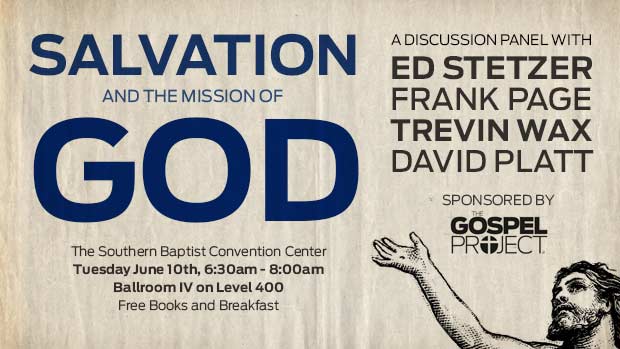
SBC Panel Discussion on “Salvation and the Mission of God”

tgpbreakfast_620x3491

Sign Up Here!

  • Does one’s belief on the extent of the atonement affect their understanding of mission and the offer of the gospel?
  • Can two Christians disagree on soteriology and partner in ministry?
  • Does the order of salvation affect how one does evangelism?
  • When it comes to the theological particulars of salvation, what is the difference between compromise and cooperation?

Join us at The Southern Baptist Convention to hear Ed StetzerFrank PageDavid Platt, and Trevin Wax discuss the topics of salvation and mission. Only 500 seats available, so sign up now!

  • Date: Tuesday, June 10th
  • Time: 6:30am – 8:00am (Be there at 6:15am!)
  • Place: The Baltimore Convention Center
  • Location: Ballroom IV on Level 400
  • Free breakfast and books

Each attendee will receive a bag of free books including:

We look forward to seeing you at The Southern Baptist Convention. Sign up for the breakfast here. 

Evangelism as Captivating with the Gospel

open-bibles

I recently wrote this article for Facts & Trends magazine on The Power of Story: Captivated by the Gospel.

Do you remember the last time you heard a good story? 

It’s easy to become captivated by a compelling narrative or a fascinating myth. Stories are instruments of powerful mnemonic and formative capability.

From movies to novels or warm conversations over dinner, stories can capture our imagination and shape the way we think about the world like nothing else can. We love stories.

And like children sitting on the edge of a bed awaiting their parents to read a beloved bedtime book, we long to be told a good story. But more importantly, we want to be part of a good story.

Stories help us make sense of where we find ourselves, what has gone wrong with things, and what can be done about it. Stories shape and narrate how we view ourselves. These narratives speak to a deep longing in our hearts, opening the doors of possibility to things that could be.

However, most of the narratives that captivate the imaginations of children are nothing more than fanciful myths.

Sadly, the same can be said of the worldviews that narrate the worlds of most adults. The burning question that each of us must ask is, who gets to narrate my world?

The true story of the whole world

As Christians, we understand all people are confronted by a host of master narratives that compete with, and often contradict, the gospel of Jesus Christ. We also believe God has revealed the true story of the whole world. The story of Christ is, as C.S. Lewis put it, “the true myth.”

In many ways, the Bible presents redemptive history as a four-part drama—creation, fall, redemption, restoration. In that drama, Jesus isn’t part of the story; He is the point of the story.

Evangelism is sharing the greatest story ever told, namely, the story of redemption through Jesus Christ.

In order to make sense of our lives, we depend on narratives that provide us a broader framework of meaning.

I believe Alasdair MacIntyre was correct in After Virtue, when he wrote: “I can only answer the question ‘What am I to do?’ if I can answer the prior question ‘Of what story or stories do I find myself a part?’”

This principle is extremely important for evangelism. Not only do we need to understand the true story of the whole world, we also need to understand how to read the story of those we talk with. What narrative shapes their worldview, outlook and self-image?

Reading their story, sharing Christ’s story 

Too often our evangelism efforts are driven by one-sided, canned presentations. How often do we listen to those we are sharing with in order to present the gospel to them with wisdom and care?

What if our efforts in sharing the good news were less about putting people in evangelistic headlocks until they make a decision and more about capturing their imagination with the beautiful gospel?

We believe the story of Jesus’ life and work is directly related to the story of our world, and to the personal stories of everyone we meet.

When we share the gospel with others, do we ever stop to wonder if they are able to perceive how the gospel is good news for them? How does Jesus’ story enter their story?

What people need to know is not only what the gospel is, but also what the gospel does. We need to show them the beauty of the gospel and pray that God would open their eyes to see it.

In his book Unbelievable Gospel, Jonathan Dodson suggests that using gospel metaphors at the prompting of the Holy Spirit is a more effective way to aim at the heart of the listener.

In other words, apply the gospel to their story.

  • To those searching for acceptance in all the wrong places, we can point them to perfect acceptance in the gospel of justification.
  • To those searching for fulfilling relationships, we can point them to profound, personal union with Christ.
  • To those who struggle with tolerance, we can show them the uniqueness of Christ in the gospel of redemption.
  • To those who fear disapproval or demand the applause of others, we can share the gospel of adoption, which offers an enduring approval and produces humble confidence.
  • To anyone longing for a new start, there is the hope of new creation.

Tell His story

This is not changing the message of the gospel, but aiming that message to hit people at their deepest needs.

The gospel story is the only story that will help your family, friends, coworkers and neighbors make sense of the world they find themselves in, what has gone wrong with it, and what has been done about it.

As those who are captivated by God’s story, let us go as storytellers and captivate others with the grace of God found in Jesus Christ.

Sin and death may be part of the story, but we know where the story ends. Paradise may be lost, but in Christ we are headed for peace and satisfaction forever after.

The gospel story is good news. Do you remember the last time you told this great story?
T4G Panel on “Group Ministry in the Local Church”

tgp_gminlocalchurch_851x315

Groups are a big part of local church ministry. Whether they come in the form of discipleship groups, accountability groups, Sunday School, or home groups, it’s clear that evangelicals believe groups matter.

For this reason, The Gospel Project is excited about hosting a discussion panel on Group Ministry in the Local Church at Together for the Gospel on Wednesday, April 9th in the zero dollar book store from 2:00-2:40. Our panelists will include:

During the discussion our panelists will explore the theological foundations (why) and practical applications (how) of group ministry. We’ll be tackling issues like:

  • How do you integrate a group philosophy into your church’s overall theological vision for ministry?
  • Should groups be on campus or off campus?
  • How do you raise and train new leaders for groups?
  • Should groups monologue or dialogue?
  • How do you connect the spiritual disciplines into the structure of your groups?
  • How do you multiply groups?
  • Should groups have an outward or inward focus?
  • How do you cast vision for groups from the pulpit?
  • Should groups primarily gather to study the Bible or focus on fellowship?

According to the research behind Transformational Groups, the majority of church attenders don’t believe groups are that important to the church. However, a survey among Protestant pastors, 76% agree (32% strongly) that groups are the primary network to mobilize their church and its work. Why is there such a discrepancy between the church leaders and their members? Join us for the panel discussion as we explore the answers.

The Moral Influence of The Cross

Wax Header

This post first appeared at Trevin Wax‘s blog in his Theology of the Atonement series.

The spring study of The Gospel Project for Adults and Students leads participants through the “Atonement Thread,” which helps people put the Bible together to see how the theme of atonement runs from Genesis to Revelation.

The Moral Influence of the Atonement

Discussions concerning the atoning work of Christ have, for the most part, been relegated to the purpose and extent of Christ’s sacrifice, and rightly so. After all, our evangelical faith holds this doctrine of penal substitution at the center of what we believe about the atoning work of Christ (1 Cor. 15:32 Cor. 5:21Col. 2:14).

Even so, there is another aspect of the atonement of Christ often overshadowed by our wonderfully cross-centered theology. If we are seeking a truly comprehensive and robust survey of that wonderful cross, the moral influence of the cross is a necessary companion to the atonement conversation.

The Cross Moves Us

When I survey the wondrous cross
On which the Prince of Glory died,
My richest gain I count but loss,
…And pour contempt on all my pride.
Love so amazing, so divine,
Demands my soul, my life, my all.

This portion of Isaac Watt’s 1700′s hymn “When I Survey the Wondrous Cross” has regained popularity in recent years and illustrates this doctrine well. The words focus on the emotive effect of the cross on the observer. Before we go any further, it may be prudent to address a few concerns many of you may have already begun to consider.

1. Does the theory of the moral influence of atonement necessarily lead to legalism?

No, and we must be careful not to react legalistically to anything that holds Christ up as an example. As John Stott reminds us, the way to holiness is not by imitation of Christ, but through union with Christ.

How do we express union with Christ? We would all acknowledge that to some degree, worshipping the Lord through a holy lifestyle is a part of that equation, especially if we take seriously Paul’s words in Romans 12:1-2.

2. Isn’t the moral influence theory of the atonement the bastion of mainline liberal theology?  

Well, it is, unless the moral influence of the cross is rooted in the purpose of the atonement. Leon Morris has rightly argued that by itself the moral example of the cross is inadequate, but this does not render it untrue. In every instance where Christ’s death is presented as an example to be followed, one can also find his substitutionary sacrifice as the foundation and motivation for that example close by. We cannot disconnect the two.

The Bible teaches that the sacrifice of Jesus not only provides salvation, but also impels us towards sanctification, inspiring us to reflect God’s love to others (2 Cor. 5:14Rom. 8:35-39).

Did Jesus not tell His disciples that the greatest display of love is found in laying down one’s life for his friends (John 15:13)? The motivating power of His sacrifice is seen on the cross. Jesus’ obedience to God and His petition that God would forgive those who crucified Him moved one of the criminals on the cross beside him to believe (Luke 23:39-43Mark 15:39).

Likewise, Paul argues that the death of Christ not only provides the way of salvation, but also provides the supreme demonstration of love (Rom. 5:8). For this reason, he called the church to imitate Jesus’ love and compassion and adopt an attitude of unselfish concern for others (Eph. 5:1-2Phil. 2:3-8).

Peter also exhorted the church: “For to this you have been called, because Christ also suffered for you, leaving you an example, so that you might follow in his steps (1 Peter 2:21).” Christ serves as the example of love and perseverance for the church when they suffer unjustly.

The Supreme Example

Jesus Christ is the supreme model of Christian discipleship, the ethical exemplar of the Christian life (1 Cor. 11:1Heb. 12:2). The compelling force of Christ’s sacrificial example is one answer to indifference and inaction in our broken world. Once we truly grasp what Christ did on our behalf, we will be compelled to live our lives in a way that reflects his self-sacrifice for all others (2 Cor. 5:14).

The cross of Christ not only atones for sin; it also provides a gripping vision that demands our souls, our lives, and our all.

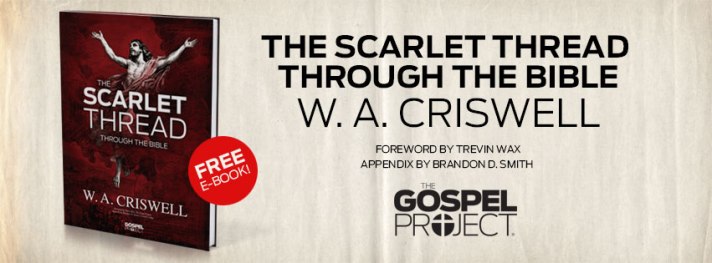
Free eBook: “The Scarlet Thread Through The Bible” by W.A. Criswell

851x315_tst_img

Download the free eBook The Scarlet Thread Though The Bible by W.A. Criswell as a gift from The Gospel Project.

There is a scarlet thread that runs throughout the Bible and it is the binding that holds the pages of the Scripture together. That great scarlet thread is redemption through Jesus Christ. In this book, Criswell traces the scarlet thread of redemption from the blood of covering after the fall in the Garden of Eden to the blood-washed multitude standing before the throne of God in eternity. The content of this eBook was originally delivered as a sermon by W. A. Criswell at First Baptist Church, Dallas, Texas. In his introductory remarks Dr. Criswell said:

400x_scarletthreadcover“The sermon is as if a man stood on the top of a great height and looked over the whole creation of God. As Moses stood on the top of Mount Pisgah and saw from afar the Promised Land, so this message tonight. We are standing as it were on a great and lofty eminence. And we are looking over the entire story of human history from its beginning in the eternity of the eternities, in the unknown distant ages of the ageless past, and as it reaches forward to the great incomparable consummation of the ages that are yet to come.”

To download the free eBook of The Scarlet Thread Through The Bible by W.A. Criswell, click here.

5 Benefits of a Membership Class

This post was originally posted at The Ministry Grid.

POUR-OUT-300Joining a local church is an important decision. As pastors and leaders we need to not only help people understand that, but we also need to properly shepherd them through the process of uniting with a local church body. However, according to LifeWay research 64% of churches either have nothing to assimilate new members, or no systemic plan to move people towards membership. This is where a church membership class can be beneficial.

1. Membership Classes Help Guard the Purity of the Church

In our culture the statement “I am a Christian” can mean ten thousand things, therefore it is important to make sure as humanly possible that everyone desiring membership in your church understands and believes the gospel. It is not uncommon to hold a membership class and find that some have never heard the gospel clearly articulated – even people that grew up in church. For this reason it is beneficial to hear someone’s testimony along with their understanding of the gospel before they join your church. A membership class provides a church the opportunity to explain the gospel for the benefit of the attendants evangelization or edification.

2. Membership Classes Help People Understand the Church

Membership classes help everyone in the church enter “on the same page.” I believe that a prospective member should know what the church believes on essential and non-essential doctrines, how a church works, and how it makes decisions. Therefore, communicating the church vision, core values, and explain its ministry philosophy can be an important aspect of helping someone make the decision to join the church. By implication, teaching these things can also help people learn what they can expect from the church leaders, processes, and its ministries.

3. Membership Classes Help People Plug In to Serve the Church

Membership classes are also an effective environment to plug people into serving the local church. When someone first joins a church it can be difficult to figure out where to get involved. Too many churches just assume that a new member will automatically want to get involved in ministry and will know how to do so. In a membership class people should learn that the church expects them to get involved, and learn of entry level opportunities for service.

4. Membership Classes Help Guard the Unity of the Church

Most churches emphasize membership expectations in their membership class. Not only can churches raise the bar of membership by holding a class, but also by talking about what would happen if church members did not live up to membership covenant and expectations. Being clear in the membership class as to what the church expects goes a long way in setting the church member relationship on the right path. It is important to note that the membership class can serve to preempt potential church discipline issues.

5. Membership Classes Help People Assimilate Into the Church

The membership class is an opportunity to encourage prospective members to get to know other potential members of the church as well as leaders in the church. Obviously, the primary purposes of a membership class are church orientation and teaching doctrine. However, relational orientation to the churches leaders and other potential members should not be overlooked. The significance of connecting with others in the class can pay dividends for a long time to come.

Conclusion

Perhaps you are involved in or are a leader a church that doesn’t currently offer a membership class.  The good news, according to Chuck Lawless in his book Membership Matters, is that most church leaders face little opposition when starting a required or encouraged membership class. It has also been noted by Thom Rainer, in his book High Expectations, that churches who require or encourage membership classes have a much higher retention rates than churches that do not.

The writers of the New Testament always assumed that the local churches to whom they were writing had a clear understanding of who was a member of the church and who was not (1 Corinthians 5:2; Colossians 4:5; Galatians 6:10). Church membership classes are one of the most effective ways to examine, assimilate, and clearly demarcate new members into a church family.

A God-Centered Worldview (Blog Series)

tgp_blogheader_oct13-Copy

In correlation with the Winter Gospel Project adult and student study The Gospel Project team has lined up a great series of blog posts that will encourage you to dig deeper and reflect on some of the most important topics and issues facing Christians today.

Enjoy!

Pastors, Preach Through The Gospel Project This Winter…?

Why is planning your preaching important?

Sunday comes every week, which is 52 times a year. Preaching pastors know that one of the inevitable realities of ministry is that sermon preparation cannot be postponed. For this reason it is particularly important to plan a preaching schedule. While determining a preaching strategy requires thought and energy, it also allows you to organize and use their time more efficiently in weekly sermon preparation. When the schedule is set one doesn’t have to carry the weight of “what’s next?” from week to week. Taking time to plan extended pulpit work can provide the parameters you needs to prepare and preach more effectively. I tend to agree with Spurgeon who argued that habitually entering “… into the pulpit unprepared is unpardonable presumption (Lectures to My Students).”

I’ve heard some contend that planning a preaching schedule in advance could squelch the Holy Spirit. Their argument assumes that the Holy Spirit will only move “in the moment.” Mark Dever rightly opposes this assumption by writing that “… of course He does that sometimes [moves in the moment], but that’s not the only way He does it. The Holy Spirit also moves and directs months in advance when planning a preaching schedule (Preach: Theology Meets Practice).”

What is your plan for the winter?

M00050082There are many ways to approach series preparation. One is that you work through a book of the Bible and move chapter by chapter through that book, like “A Walk through Exodus.” Another is that you work systematically through a section of a book, like a series on “The Sermon on the Mount.” Or you can develop a series of sermons dealing with a particular topic or aspect of the Christian life and living. Let me first state that I am not a proponent of topical expository preaching, however I do think it has its place in preaching. One doesn’t want the felt needs of the congregation to drive the preaching schedule. John Stott once wrote, “… if we become exclusively preoccupied with answering the questions people are asking, we may overlook the fact that many of them often ask the wrong questions and need to be helped to ask the right ones (Between Two Worlds).”

With that said, it is important to address personal and cultural issues head on once and a while. Sermons ought to come from Scriptural texts, and it is important to answer cultural questions directly from a biblical framework. Honestly, developing a series on particular topics can be the most time consuming method of series planning. However, one approach to developing a topical series is to adapt an outline from a book or some other resource.

A Proposal for Preaching “A God-Centered Worldview”

As the brand manager of The Gospel Project I am going to unashamedly encourage you to consider developing a series of sermons to coincide with the adult and student winter study of The Gospel Project: A God-Centered Worldview (Also see Leader Guide).

The first reason I propose this sermon series is that preaching alongside a curriculum sequence not only aligns preaching to small groups, it also allows the preachers to encourage small group participation, and permits for more thoughtful group discussion following the sermon since all of the participants have read about the topic. As for The Gospel Project’s winter study for adults and students, the units are broken up so that one can actually develop three series from the curriculum with four to five sermons in each. Here are some of the topics covered in The Gospel Projectwinter study. I have adapted the lesson titles to be sermon titles as if I were going to preach them myself.

A Biblical Worldview

  1. Does Having a Christian Worldview Matter? (Romans 12:1-2)
  2. What is the Difference Between Man-Centered vs. God-Centered Living? (Exodus 33:19-23, 34:5-9; 2 Corinthians 3:12-18)
  3. How Did We Get the Bible? (2 Timothy 3:16-17)
  4. Can We Trust the Bible? (Matthew 1:1-17; Luke 2:1-3, 3:23-38)
  5. Is Christianity Is Unique Among the Religions? (John 14:1-11)

The Big Questions

  1. Does Life Have Meaning Without God? (Ecclesiastes 3:16-20, 4:1-3; 1 Corinthians 15:12-19)
  2. Is The God of The Bible a Good God? (Deuteronomy 7:1-5; Matthew 15:21-28)
  3. Why Do We Suffer? (Job 1:20-22; 2 Corinthians 1:3-7; James 1:24)
  4. Is Hell Real or Necessary? (Exodus 9:13-17; Luke 16:19-31; Romans 10:11-17)

The Big Debates

  1. What is God’s View of Sex? (Genesis 2:8-9, 15-25; Luke 5:29-32; Romans 1:21-28)
  2. What is God’s View of Marriage? (Matthew 19:1-9; 1 Corinthians 7:1-9; Ephesians 5:22-33)
  3. Is Human Life Sacred? (Genesis 9:5-6; Jeremiah 1:5; Acts 22:1-5)
  4. Should We Care for Others and the World? (Genesis 9:8-17; Matthew 6:19-21, 24; 2 Corinthians 8:1-4)

The Preaching Plan as Evangelism and Discipleship Tool

The second reason I encourage you to consider adopting this preaching plan is that this particular study lends itself well to be used in evangelistic conversations and for directional discipleship. If you commit to this plan it enables you to publish a preaching schedule for your church in advance. A preaching schedule not only allows your people to read in advance, it also allows the Holy Spirit to begin working in their hearts beforehand. Therefore, the people gather with their own questions and insights, allowing for greater listening.

The preaching plan can also be used as a tool allowing your church members the opportunity to begin spiritual conversations on these topics with their family, friends, co-workers, and neighbors. If they have a non-Christian friend who might be interested to hear about a particular topic a natural invitation can be issued. As LifeWay Research has shown us, 67 percent of Americans say a personal invitation from a family member would be very or somewhat effective in getting them to visit a church. Also, 56 percent of Americans say a personal invitation from a friend or neighbor would be very or somewhat effective in getting them to visit a church. With provocative topics such as the ones listed above, I can only imagine that these statistics would be even higher.

Equip Your Church to Thoughtfully Engage the Public Square

The third reason I encourage you to consider adapting The Gospel Project lesson sequence for the winter is to train your church to thoughtfully engage the public square. In the last decade we have seen massive shifts in our culture, and not all Christians are equipped to respond to these changes form a particularly Christian perspective. A Christian worldview, perhaps its more precise to say a theistic worldview, could have been assumed 50 years ago, but that is not the case anymore. What was once culturally accepted is now rejected and even labeled as intolerant.

When asked how he prepared a Sunday sermon Karl Barth once said, “I take the Bible in one hand and the daily newspaper in the other.” Considering the content of today’s news, this quote is more timely than ever before. How would the members of your church engage the big questions and big debates of our time? Our churches need to be full of people who are grounded in the foundational doctrines that shape our identity as Christ followers. As Ed Stetzer argues in his editorial introduction to the winter material, “The big questions and big debates of our day find their answers not in the shifting views of the culture but in the steadfast, unchanging word of God.”