Is The Law Still Binding On The Christian?

Is the law still binding on the Christian? This is a question that many Christian’s ponder. And for good reason. In my studies I recently returned to a little book by John Stott titled Men Made New. This exposition of Romans 5-7 was first published in 1966 and is now out of print. I am not sure how I got a copy of it, but I am glad I did. In it Stott makes some helpful comments on this issue concerning the law of Moses.

He begins by stating that there are three possible attitudes to the law of God (attitudes that Tim Keller has popularized in the last few years). Attitudes represented first by the legalist, second by the libertine (or antinomian), and thirdly by the law-abiding believer. The first two represent the those who are not living in line with the gospel. The legalist is one who is in bondage to the law, one who imagines that their relationship to God depends on obedience. The libertine is one who rejects the law all together. But the law-abiding believer holds a proper balance, recognizing that while the law is not a means to salvation it should be delighted in as an expression of the will of God. Stott writes;

Is the law still binding on the Christian? The answer to that is “No!” and ‘Yes!’ ‘No’ in the sense that our acceptance before God does not depend on it. Christ in his death fully met the demands of the law, so we are delivered from it [as a means of salvation]. It no longer has any claims on us [to condemn us for sin]. It is no longer our lord. ‘Yes’ in the sense… we still serve… But the motive and means of our service have altered. Why do we serve? Not because the law is our master and we have to, but because Christ is our husband and we want to. Not because obedience to the law leads to salvation, but because salvation leads to obedience to the law. The law says, ‘Do this and you will live’. The gospel says, ‘You live, so do this.’ How do we serve? Not in oldness of letter, but in the newness of spirit. That is, not by obedience to an external code, but by surrender to an indwelling Spirit. (65-66)

This does not mean that the written law of God in the Holy Scriptures is not binding on us, but rather that we obey in a new motivation and in a new framework. Our motivation to obey is a response to God’s grace, and our framework is that we are accepted on the basis of Christ’s fulfilling the law, not ours. Now, undoubtedly this is a very simplistic answer and there are many nuances to this issue. But, in the spirit of simplicity and general attitude towards the law – I think we can learn much from this quote.

Vern Poythress’ Three Ways to Read the Bible

I recently read Vern Poythress’ book Symphonic Theology and I thoroughly enjoyed it. He makes a wonderful case for the validity of utilizing multiple perspectives in developing a robust theology. One of the ways he demonstrates this thesis is by arguing that one should contemplatively read the bible with multiple perspectives in mind. He notes that while the bible is a unified body of literature, it has come to us through a variety of inspired authors, metaphors, and themes. Poythress contends that approaching the text from different perspectives will have implications that are far-reaching for theology and doxology. So what are we to do with this? Well, he advocates for reading with these three perspectives in mind…

  1. Ethical – Reading the bible to understand our duty focuses on the ethical principles and their implications for daily living and decision making. What are we to do and not do as the people of God?
  2. Devotional – Reading the bible devotionally is primarily interested in the psychological dimensions of communion with Christ. What is the inspirational thought that will help me maintain a spiritual outlook?
  3. Doctrinal – Reading the bible for doctrine typically approaches the text asking, what does this passage say about God, Christ, and the Holy Spirit? What theological doctrine is being revealed here?

Poythress proposes that many people only read the bible from one perspective. He compares this to the husband who only pays attention to the mechanical utility when he shops for curtains, ignoring their aesthetical appeal. Basically, if we only read with one perspective we may only notice what we are already looking for. But what if there is more? What if we are missing something deeper? Dr. Poythress writes:

“Suppose that [one] reads the same passage of the Bible ten times. Suppose that each time the person adopts a new perspective from the ones mentioned above. Would not that person learn something new about the passage each time? A given perspective can be dangerous or stultifying if we use it all the time. But looking at a familiar passage in a fresh light can make it suddenly come alive again…consequently, each time we may notice something new or something that did not really capture our attention before. If we are to sound the depths of the passage, we need to come back to it again and again…Thus when we use a multitude of perspectives on a passage…we use each perspective to reinforce and enhance our total understanding. “[1]

Dr. Poythress offers free downloads of his books in PDF here.

An Evening with C.S. Lewis

In this one-man show, British actor David Payne portrays famous author C.S. Lewis. I have always been fond of Lewis’ wit and thought, and have, like many of his readers, longed to have known him personally. Perhaps Payne gives us a glimpse for what an evening with Lewis would be like. The setting is 1963, the last year of his life, as he hosts a group of American writers at his home just outside of Oxford. As his website proclaims “Payne captures the essence of the man who created the Narnia Chronicles in an enthralling, laughter-filled and poignant performance….utterly captivating!”

Seen on Justin Taylor’s blog.

Also see this dramatization from the PBS Special The Question of God.


Living with Dual Citizenship – Matthew 22:15-22

– To Watch Sermon Video Click Here –

The very word patriotism comes from the word patriarch; and we all acknowledge that each of us have a connection to a “father land.” This has with it identification to a particular kinship, a kinship that has worked, and sometimes fought to sustain and protect the family. I believe that just as one honors father and mother one should also honor where God has placed you. My great grandfather served in World War I, my grandfather served in World War II as a helmsmen on a Navy ship.

Obviously, these men did not battle the other side because they hated the individual men in front of them, they simply loved the men behind them.[3] They stood for their fellow Americans and stood against the ideals that the enemy represented. When I hear the Patriotic songs and pledge allegiance to the flag that represents our “father land”, it stirs deep within me , because I know the cost of our freedom. We should be all deeply grateful for the freedom that we benefit from every day of our lives. When I think about my family history, and American history, I recognize that I am dependent on others, brave men and women who have given their lives for our freedom. I want to affirm that. Today, I am talking about our citizenship, I am talking about the day to day, broad strokes of living in our country.

But I think all of us who are Christians would acknowledge that there is tension in living as dual citizens. The apostle Paul tells us that “our citizenship is in heaven, and from it we await a Savior, the Lord Jesus Christ.”[4] But at the same time we love our country and desire proper patriotism. The apostle Peter tells us that we are “sojourners, exiles”[5] just passing through. This is our temporary home. So what is proper patriotism? What does it mean to live as Dual Citizens? How are we supposed to think and act as citizens of the Kingdom of God, while at the same time being citizens in the Kingdom of Man?

In an effort to be transparent with you, this is a very heavy message. It is a message I have struggled to write. It is a message that has weighed heavy on my heart. Emotionally I have been very burdened by this topic of dual citizenship. What are the church people going to hear me say? Am I saying to little, am I saying too much? So my prayer is that Jesus words will guide this sermon in a very balanced way. I think that Jesus words in Matthew chapter 22, verses 15-22 are very appropriate for this topic.

Then the Pharisees went and plotted how to entangle him in his words. 16 And they sent their disciples to him, along with the Herodians, saying, “Teacher, we know that you are true and teach the way of God truthfully, and you do not care about anyone’s opinion, for you are not swayed by appearances. 17 Tell us, then, what you think. Is it lawful to pay taxes to Caesar, or not?” 18 But Jesus, aware of their malice, said, “Why put me to the test, you hypocrites? 19 Show me the coin for the tax.” And they brought him a denarius. 20 And Jesus said to them, “Whose likeness and inscription is this?” 21 They said, “Caesar’s.” Then he said to them, “Therefore render to Caesar the things that are Caesar’s, and to God the things that are God’s.” 22 When they heard it, they marveled. And they left him and went away.

This is a fascinating encounter between Jesus and a group of questioners, who by most accounts were strange “bed-fellows” in the kingdom of man.

  1. The Pharisees were anti-Rome – Were supremely loyal to their religious establishment. Pharisees did not favor taxes to Caesar for religious reasons[6], it intruded on their dominion.
  2. The Herodians[7] were pro-Rome – Were supremely loyal to the Herod, and thus the Roman government. Herodians favored taxes to Caesar because it provided their livelihood and expanded their dominion. The Herodian dynasty was dependent on Roman rule.

So why would these two groups join together in attempting to trap Jesus with a question about taxes to Caesar? Well, the goal was to get him to say something that might prove to be incriminating.[8] The trap was simple, in their minds there were two possible outcomes to this situation; either Jesus is “pro-Rome” or “anti-Rome.” Politically speaking, the only two options were either “complete devotion to civil government” or “complete devotion to the God of Israel.” If Jesus were to say;

  1. It is unlawful to pay taxes to Caesar – The Herodians would charge Jesus with advocating resistance, for inciting a political rebellion. The Pharisees would have been partial to this answer because this would make Jesus a threat to Rome. Many of the Israelites were waiting for a messiah, a political savior to deliver them from Rome.
  2. It is lawful to pay taxes to Caesar –The Pharisees would charge that Jesus was advocating a compromise with Rome. The Herodians would have been partial to this answer, because Jesus would no longer be a threat. The Israelites viewed these taxes as a painful reminder of Roman occupation, a potent symbol of political subjection.[9] For many Israelites loyalty to Caesar was disloyalty to God, because the coin was a symbol of the pagan Roman religion, the imperial cult.[10]

Essentially, both sides were waiting for Jesus to come out from behind “the smoke” and reveal himself as a political messiah or political revolutionary. But there is something deeper going on here.

Dual Citizenship Requires us to Resist Political Simplicity

“Teacher, we know that you are true and teach the way of God truthfully, and you do not care about anyone’s opinion, for you are not swayed by appearances. Tell us, then, what you think. Is it lawful to pay taxes to Caesar, or not?”

From the very outset the questioners acknowledge that Jesus is not afraid of Caesar, nor anyone else for that matter, so they ask him “Is it lawful to pay taxes to Caesar, or not?” The wording “is it lawful” is important here. They are asking that Jesus interpret what the Torah, the law of God, says on “paying taxes to Caesar”. Essentially, they are asking what does morality require? Should one pay the taxes and, politically speaking, forfeit ones complete devotion to God? Or not pay the taxes and forfeit ones civil responsibility to the state? In their minds it would either be blasphemy or insurrection.

Jesus took the initiative away from the questioners and asked them to bring out the coin that this tax would have been paid with. What he does is shift the discussion from politics to the deeper issue of devotion.[11]

Show me the coin for the tax.” And they brought him a denarius. 20 And Jesus said to them, “Whose likeness and inscription is this?” 21 They said, “Caesar’s.”

See, this coin (denarius[12]), would have the head of the Caesar on one side, with the Latin inscription “Caesar, Son of the Divine.” On the other side it would have read “high priest”.[13][14] To the religious establishment of the day this coin proclaimed that Caesar was a “god”. Furthermore, this coin was a painful reminder of the Roman government’s occupation and rule.

So on one level, the listeners expected Jesus to signal that he was in favor of a revolt against the civil government or the establishment of a new political order. But Jesus knew that the question was much deeper political allegiance, “Jesus, are you pro government or not?” Although they wanted a simple “yes” or “no” answer, Jesus does not give them a simple answer and leave it at that.[15] And even though he did not give them a simple “yes” or “no”, he didn’t avoid or dodge the question either; he answered, but with a caveat that forces them to think, forces us to think.

One of the wisdom themes in the Bible teaches to answer fools according to their folly,[16] to both answer a fool and, at the same time not answer a fool. The principle is that one needs to discern between situations that the Bible requires as a moral absolute and situations where the Bible only gives us guidance, but ultimately allows us to use wisdom according to the particular situation. The Bible doesn’t always give us pat-answers to life. Christianity is a complex relationship, not a mathematical equation.

Now, what do we do in most matters of wisdom? When it’s not so “black and white.” We usually give other people room to disagree; we don’t demand that they agree with us. We often try to winsomely convince them. But we realize that they aren’t necessarily evil or wrong for disagreeing. Right?

But, Jesus opponents presented the question as if it were one way or the other, with no room to apply wisdom. They had specific ideologies, primary devotions, that blinded them to only see the question that way. This is the problem when we idealize things; it often blinds us to our own folly. [17] Remember that the primary issue here is not principally about politics but about devotion. Think about how addictive it can be to place ones ultimate hope in government and politics. Devotion to a can be exhilarating. The problem with us is that when we are devoted to something we often idealize it, are our convictions towards that thing reach the same level as biblical truth. We do this today in American politics, do we not?

  1. Political Parties: Do we not idealize certain parties within government? When idealize one party, we tend to demonize the other. This leads to shouting matches and uncharitable attitudes. But I think many of us, if we were honest with ourselves, would acknowledge that no one political party can capture all of the Christian social/ethical points. There is no political party that is a perfect encapsulation of Jesus values. Both political conservatives and political liberals get certain things wrong.[18]
  2. Passing Civil Laws: Consider this question. “Is it right or wrong to pass tax cuts?” What does Christian morality require? Well, other than the fact that we all want tax breaks, we also realize that it depends on a number of factors that require great wisdom. We recognize that some citizens will benefit and some will be hurt. So, what is the most loving thing to do? These are not always yes or no questions, it is never that simple.

There are certain moral commands in the Bible that we as Christians must stand firm on. But on issues of wisdom we need to resist this type of political simplicity. Jesus is not promoting an a-political attitude, passivity, or some form of escapism. That is far from what he is doing, in fact – Jesus answer to the questioners affirms the good intention and purpose of civil government, and calls for us to be good citizens. Jesus is simply calling for a proper patriotism.

Dual Citizenship Requires Proper Activism

Let’s go back to that coin. Jesus holds it up and asks the crowd, “whose image is this?”, and “whose inscription?” Inevitably they respond “it is Caesars”. Then Jesus says, “Well, if it has Caesars image on it, it belongs to him, so give it back[19] [to him].”[20][21]

Jesus pithy words here lay down the basis for the proper relationship between God’s people and human government. In fact, it is upon this answer that most discussion on the relationship between civil government and the kingdom of God has been based ever since. In calling the people to “render to Caesar the things that are Caesar’s” Jesus acknowledges Caesars temporary rights as he carries out his God given function in politics and government[22] for the good of civilization.

We took Solomon to the pool a few days ago and it brought back memories of my own childhood when my mom would take my sister and I to the local YMCA. When she did that, and when we jumped into the pool, my mom, in some sense, was entrusting our care to the life guards. They are there to watch over the children in the pool. When a kid begins acting up, or playing in a way that is hazardous or dangerous to themselves or others what does the life guard do? They blow the whistle and make them sit out for a few minutes. So while you are in the pool you are temporarily entrusted to the jurisdiction of the life guards.

When we look at the big picture of redemptive history we see that civil government is a temporary, post-fall, common grace institution given by God for the administration of justice and to restrain evil.[23] The Apostle Paul argues this same notion in his letter to the Romans, chapter 13. On the surface level Jesus shows that Caesar has rights while he is responsible for the framework in which all of our common life is lived – to provide and protect. . In God’s plan for history civil government is a legitimate establishment. I don’t think anyone of us would disagree with that.

Let me add one caveat, this is where the issue of wisdom comes into play. Human history affirms that there are times when leaders of human government demand what God forbids. This is when Caesar demands the honor that only God deserves. In these cases I think there is cause for civil disobedience under the authority of King Jesus. We will leave that as it is, because we do not live under the totalitarian leadership of someone demanding that we do what God has restricted. If I were preaching this message in another land, a land where the government was not allowing Christians to live a quiet and peaceful life[24], this point would be applicable and worth consideration. The point is simple, rendering to Caesar what he deserves, in some situations calls for respectful resistance.

Just as those that are entrusted to watch over the citizens, citizenship itself comes with obligations and believers in Jesus Christ must wisely recognize this and act accordingly while living in the kingdom of man. Jesus affirms that one must recognize and hold in balance that “it is possible to pay ones dues to [government] and to God, to be both a dutiful citizen and a loyal servant of God.”[25] Paying dues to government is different than total heart allegiance.

The question is then, how do we do this with wisdom? How shall we live as citizens of the kingdom of God, and yet simultaneously live as citizens in this world, in this country, in this city? I believe that on one level when Jesus calls us to render to Caesar what is his, he is calling us away from political passivity and calling us to a certain type, a proper type of activism.

The Christian worldview makes it clear that our ultimate concern is for others to experience the beauty of God by the proclamation of the gospel of grace, and we yearn for God’s will to be done on earth as it is in heaven. So that all things will be as they should! But we look around our world and see that it is filled with “mixed passions, mixed allegiances, and compromised principles…Unlike God’s kingdom, the citizens of this world demonstrate deadly patterns of disobedience and revolt against the kingship of God.”[26] Why? Because of this our world is broken and deteriorating.

Yet, while this world is passing away, it is not ultimately unimportant. We should not forfeit our responsibility to love its citizens. We bear great responsibility in this world to work for the good, for justice, and peace. When Scripture instructs us to love God and love neighbor as ourselves we are given a clear mandate for the proper engagement in this world. Did Jesus not say that this is the essence of the law? So when you ponder the question “what is the most lawful thing to do?” we are essentially seeking to answer what must I do to love God and neighbor properly. I think Albert Mohler says this wonderfully when he says that:

Love of neighbor for the sake of loving God is a profound political philosophy that strikes a balance between the disobedience of political disengagement and the idolatry of politics as our main priority.[27]

Love of neighbor for the sake of loving God is the hedge against either political idealism or political escapism. As the people of God, we should as Jeremiah 29:7 teaches us, “seek the welfare of the Kingdom of Man”. As individuals we need to get involved government and politics, but do it critically with wisdom with an understanding that neither civil religion nor civil government will obtain a utopia.

Civil government, political alliances, and arrangements are, by definition, temporary and conditional.[28] There is an inherent complexity and tension between the kingdom of God and the civil governance of man. We serve as ambassadors in the kingdom of man.[29] An ambassador is one who recognizes and honors the kingdom it represents and also recognizes and honors the place where it is.

There is sensitivity to where you are, but also recognition of who you are – you are a citizen of God’s eternal kingdom.[30] The ‘ambassador’ mindset brings balance to the dual citizenship dilemma. This helps us understand why;

  1. To those who wanted to overthrow the civil government, Jesus demanded that they render to Caesar what belongs to him.
  2. To those who wanted to absolutize the civil government, Jesus told them to render to God what is God’s.

Politics and civil government was not Jesus primary concern. See, Jesus had a greater agenda, a greater campaign, and I think in understanding it we will be able to fully see what is happening in this passage. So while dual citizenship requires proper activism, it also requires allegiance to King Jesus.

Dual Citizenship Requires Allegiance to King Jesus

Consider again, Jesus question “whose image is on this coin?” from a theological perspective. We have already affirmed that on one level, to go ahead and ‘render to Caesar’, give back to Caesar what has his image on it. God has appointed people, however unfit, as authorities in this world. But remember, there is a deeper theological meaning here that we must not miss. Being familiar with the biblical narrative should draw ones attention to the language of “image” in Genesis, where we see that all human beings are created in the ‘image of God’.[31][32] So when Jesus says:

Render to Caesar the things that are Caesar’s, and to God the things that are God’s.

There is a sense irony here in this paradoxical statement. The coin bears Caesars image, but humanity bears God’s image. Jesus is saying that God always trumps Caesar because all things are God’s. See, one may be obligated to pay taxes to Caesar, but everything, all that we are and have comes under God’s dominion and kingship. So, “whatever civil obligations Jesus followers might have, they must be understood within the context of their responsibilities to God.”[33] Therefore, fulfilling civic duties does not necessarily jeopardize our devotion to God.

So, when the questioners come to Jesus and essentially ask him if he is a political revolutionary – he says no. And he is not. But at the same time, he is. It is here that we understand the deepest meaning of Jesus answer to the question. The questioners are essentially asking, Jesus, are you who you say you are? Are you really a revolutionary or are you full of hot air?

Walking around claiming that the kingdom of God is at hand was fighting talk![34] So what is going on here? While Jesus was not a political or religious revolutionary in the sense that the questioners expected, he was a revolutionary in the greater sense. What his listeners did not understand was that the real revolution would not come through the non-payment of taxes or the establishment of a new political order. See, every political revolution inside the kingdom of man is not really a revolution in the truest sense; it’s simply rearranging the furniture.[35]

Remember, Jesus kingdom is not of this world.[36] It does not operate in the same way the kingdom of man operates. The good news of the gospel is that Jesus is giving us a real revolution! And once you taste the goodness of the King and see the beauty of his rule, you will gladly bow the knee and submit to his dominion.

  1. Earthly rulers build kingdoms through conquest, by gaining power over the poor and oppressed. But Jesus builds his kingdom through grace, by giving his power to the poor and oppressed.[37]
  2. Earthly rulers are established by recognition or election by the masses, Jesus rule is established by being rejected and executed because of the masses.

The Herodians and the Pharisees did not understand what Jesus was doing. He was doing something that government and politics cannot do. Think about it, putting Jesus to death launched his revolution. Jesus resurrection inaugurated his Kingdom.

The major problems in our world are not political, they can’t be fixed by government or law — they’re spiritual. In any given situation your, and my, essential problem has to do with sin. We don’t need government overhaul or political reformation, we need redemption.[38] As C.S. Lewis once quipped: “You cannot make men good by law: [but] without good men you cannot have a good society.”[39] Jesus kingdom spread by gospel transformation, creating new men, and a new society of men.

When we understand this we can have a balanced view of government and accept that we cannot legislate new hearts; government cannot create a new society. Our hearts are idol factories.[40] Think about it, if our ultimate hope is tied to the security of America, an ideology of a specific political party, or in the power of our government or nation – we will always be let down. It is so terribly easy to exalt politics as the means by which we attempt to usher in the redemptive kingdom of God in this world.[41]

  1. If our hope is in these things, then when we receive a blow, or are attacked, it crushes us and leads us to despair and paranoia.
  2. If our hope is in a particular party, ideology, or even in the outcome of a certain political decision then we tend to demonize the opponents and resort to unloving debates and tactics to gain power.
  3. But, it is also easy to despise politics as insignificant or unworthy of Christians. But this is not proper either.

The heart issue, the problem of man is that we cannot properly render to God what is God’s. If we are really changed by the Gospel, then we are changed so that we can work with others we disagree with for the greater good. Ultimately the enemy is not the one for whom we disagree with politically, the enemy is inside. If we resort to power plays and demonizing those whom we disagree with, then we know we aren’t living in line with Christ’s kingdom which drives us to serve our enemies.

We need to come to Jesus, who deals with our deepest sin, and continues to deal with our sin.[42] See, once we catch a vision of the beauty of God’s rule and his kingdom everything changes even our view our civil responsibility and how we do politics. We look around and seek to use wisdom as we are “salt and light.”[43] Our devotion becomes less about politics and more about people.

  1. We don’t desire power for ourselves; we desire to do what is most loving for others.
  2. We don’t only seek to identify the problems in society, we work with others (even those whom we disagree) to find the solution.
  3. We don’t condemn the weak and oppressed; we come alongside them, invite them in, and love them.
  4. We don’t run from the evil in our cities, we run in and settle, we seek the welfare of our cities.

Let me put it another way. We don’t just seek to enact laws that uphold our family values; we take it a step further and lovingly pursue those who don’t uphold those values. We don’t just place our hope in legislating against things like homosexual union, we also reach out to them and seek gospel transformation in their lives. We don’t just seek to make abortion illegal, we reach out to those mothers and walk with them, help them find ways to raise those children, we even adopt those children.

Our citizenship, our allegiance to Christ and the Kingdom of God calls us to more, to go above and beyond as we live in the Kingdom of Man.[44] Any simplistic Christian response to politics, the claim that we should not be involved, the claim that we should take back our country for Jesus, is simply inadequate. As citizens of two kingdoms we need to search the Scriptures, pray diligently, and hold each other accountable to live with great wisdom, as we wait for our king to come back and place things how they ought to be. Let me close with this.

Conclusion

Perhaps you have heard the story.[45] In 1914 something amazing happened in December along the Western front during World War 1. During the weeks leading up to Christmas parties of German and British soldiers began exchanging Christmas songs across the trenches. Essentially, they were battling each other with season’s greetings, at some points individual soldiers walked across enemy lines bearing Christmas gifts. On Christmas eve and Christmas day both sides agreed to a truce, an unofficial cease fire. These enemy war units ventured into what they called “no mans land”, neutral territory, to share their rations of food and sing Christmas carols together.

Imagine that, 10,000 troops coming together, individual Christians, enemies in the kingdom of man, but brothers in the kingdom of God, coming together under the banner of Christmas, under the banner of Christ. What a beautiful picture of the power of the gospel. What a beautiful picture of what’s to come when Christ consummates his kingdom and sits down on the throne as King of Kings and Lord of Lords.

But we are not there yet, we still live in a broken world. Until that day may we seek to live with wisdom as we “render to Caesar what is Caesars, and render to God what is God’s.”

Our hope is not in government or politics[46] but in the power of the Gospel of Jesus Christ. Government, Politics, and law do not change men fundamentally, the gospel does.

Continue reading “Living with Dual Citizenship – Matthew 22:15-22”

Two Excellent Books – D.A. Carson’s “The God Who Is There” and Tim Keller’s “King’s Cross”

During the summer many people make a concerted effort to read a few books. If you are like me you might have a stack of books to be read beside the nightstand, desk, or various tables throughout the house. No matter how busy I find myself to be, good books are always waiting. Al Mohler once said that “summer is supposed to be a season of rest and relaxation — at least in theory. As one wit remarked, “A perfect summer day is when the sun is shining, the breeze is blowing, the birds are singing, and the lawn mower is broken.” During these “perfect summer days” we can read some of those volumes that we have been waiting to read. But perhaps you would like some direction on a good book or two?

The other night I was asked by someone what books I would recommend for summer reading. Now, as a pastor I want our congregation to continue growing in their faith and understanding, so this very minimal list provides two books that I think are helpful in stimulating spiritual growth. There is one common characteristic about these books that make them uniquely valuable. Each one, in my opinion, represents the outcrop of decades of study and practice by these authors in their respected fields.

“The God Who Is There” by D.A. Carson

It is quite obvious that the level of biblical illiteracy in our Western Culture continues to grow. Even in our churches there seems to be a waning understanding of the biblical narrative. Quite frankly, very few Christians have a grasp of the storyline of the Bible and its unifying message. As Ed Clowney once said, many Christians know bible stories but they do not know the bible story. Therefore we must ask the question, how do Christian’s explain the message of the bible to someone when they don’t even understand how it all fits together?

In the theological academy there has been somewhat of resurgence in the discipline of Biblical Theology in recent years. Biblical Theology as a discipline seeks to provide a synthesis, or unity, of all biblical texts taken together. But what many people have come to realize is that most of the work in this field has been done on a scholarly level and is not readily accessible to everyone.

This is where The God Who Is There comes into play. In this book we experience the fruit of decades of biblical scholarship, Christian ministry, and campus evangelism converging to explain the storyline of the bible. One of the strengths of this work is that even when Dr. Carson labors to clearly and plainly explain difficult biblical concepts he never loses the larger storyline in the theological detail.

Dr. Carson covers fourteen biblical-theological themes in near canonical order. While The God Who Is There is written to serve as an introduction to the Bible’s narrative, it is not too remedial to benefit mature Christians or even pastors. I think one reviewer put it well when he said that The God Who Is There is well suited for pastors to pass along or study with:

  1. Believers who perhaps miss the forest for the trees in their Bible reading.
  2. Those who do not know the Bible’s content at all.
  3. Mature and young believers.
  4. Unbelievers and skeptics.

See, “Carson avoids all technical jargon and provides thorough definitions and descriptions for new ideas. Further, he shows how all biblical themes converge on the person and work of Christ.”[1] What Dr. Carson does is make the case for the reliability and truthfulness of scripture based on the fact that it has one coherent message. I highly recommend this book, you will benefit greatly from reading, reflecting, and studying it.

“King’s Cross” by Tim Keller

I read a review of King’s Cross the day before I received in the mail. In this review the author proclaimed that “this is the book where Tim Keller hits his stride as an author.”[2] Within just a few years Tim Keller has established himself as one of the most sucessful living Christian authors, a “C.S. Lewis for the twenty-first century.”

One of the reasons King’s Cross is so good is that Keller has studied, written on, and preached from the gospel of Mark more than any of the other gospel accounts in the course of his ministry. As you read through this book you get a very well thought-out sermonic teaching of Mark’s gospel. It is very apparent that this book has been marinating in Keller’s heart for years. One reviewer noted that in King’s Cross we get the crystallized presentation of what so many of us love about Dr. Keller’s teaching:

  1. Religion is advice, but advice cannot save. That’s why we need to hear the good news that the King calls us to follow him.
  2. People who seek ultimate happiness in anything but God learn when they finally get what they want that nothing but God can truly satisfy.
  3. Those who condemn the self-righteous for the sake of self-discovery do so with ironic self-righteousness.
  4. God is powerful enough to prevent our suffering but sometimes chooses not to. Such situations call for faith in the God whose ways transcend our understanding. His timing does not usually match our expectations.
  5. Go to Jesus, because he can help you. But know that you’ll give more than you think you can, and you’ll get far more than you imagined.[4]

King’s Cross is “an extended meditation on the historical Christian premise that Jesus’s life, death, and resurrection form the central event of cosmic and human history as well as the central organizing principle of our own lives….[Its purpose is] to try to show, through his words and actions, how beautifully his life makes sense of ours.”[3] It is neatly organized into two parts, corresponding to the Gospel of Mark’s two halves: Mark 1-8, which reveal Jesus’ identity as king, and Mark 9-16, which reveal his purpose to die on the cross. Keller writes; “if [Jesus] were only a king on a throne, you’d submit to him just because you have to. But he’s a king who went to the cross for you. Therefore you can submit to him out of love and trust.”[5]

I would argue that King’s Cross will leave all readers, from atheist to Christian, wrestling with the beauty and implications of the gospel of Jesus Christ. Whether you read it devotionally or intensely study it, I believe that King’s Cross will prove beneficial to you.

What’s Wrong with Your Marriage?

There are a plethora of Christian books that present strategies for a healthy marriage. Implicit in the arguments of “how to have a better marriage” is that particular authors’ diagnosis of what is potentially wrong with your marriage. Usually the marriage books diagnose the problem by looking at patterns in behavior and offer solutions to help overcome those difficulties. These are usually good strategies for behavior changes, which in some way help to shape our hearts. I don’t claim to be an expert on marriage. But if I may, let me propose that the problem with your marriage is simple and the solution is simple. Now, I know that I just made a huge categorical statement. So let me explain. Let’s begin with the root problem that gives expression in wrong behavior, we find this in Genesis 3.

In Genesis 3 we read that the first husband and wife reject God’s dominion over their lives in an attempt to establish themselves “as God.” Essentially they pronounce independence from God’s established order in an attempt to become “self-existent.” Couched in this rebellion is the desire of dominion over declaring what is good and what is evil. Essentially humans declare independence of God’s rule and establish ourselves as the implementers of rule over our own lives and others; this is the heart of sin. Genesis 3:16 is where we see God declaring the manifestation of sin as it will be expressed in the marriage relationship. God declares;

“Your desire shall be for your husband,
and he shall rule over you.”

Now, I acknowledge that the meaning of this passage is often debated by scholars. Just by reading Genesis 3:16 it’s easy to imagine different ways it has been interpreted. Let me offer a suggestion made by D.A. Carson which seems to make logical sense. Carson argues that it is significant that the two verbs used in Genesis 3:16, “desire” (teshuqah) and “rule” (mashal) are used again together not long after 3:16 in chapter 4. This repeated use should be a sign that the latter passage helps us interpret the former. In Genesis 4 we read the narrative of Cain killing Abel, this is the first murder in human history. When God confronts Cain after the homicide he explains to him why He is angry. The 4:7 passage reads:

The Lord said to Cain, “Why are you angry, and why has your face fallen? If you do well, will you not be accepted? And if you do not do well, sin is crouching at the door. Its [sin] desire is for you, but you must rule over it.”

This usage of parallel wording reveals the true meaning of 3:16, namely that the overall problem in marriage is sin, which is generally expressed by the woman’s desire to dominate her husband and the husband’s desire to brutally lord over his wife. Again, the problem is the same – the desire for dominion which is expressed against your marriage partner. The result, as Gordon Wenham put it, is that “to love and cherish” becomes “to desire and dominate.” Therefore, marriage becomes a power struggle rather than an intimate, unified, and beautiful collaboration of life as God had designed it. See, the husband and wife were to enjoy the harmonious relationship of marriage (2:18, 21-25). This was how marriage worked before the fall. But this perfect harmony is now broken by the curse of sin and is further perpetuated by inordinate desires and is reinforced by a fallen world.

Interview Series with Dr. John Hammett on ‘The Importance Membership in a Local Church’

I recently posted a five part interview with Dr. John S. Hammett on the importance of local church membership. I am thankful for Dr. Hammett’s service to the church for many reasons. While working on my master’s degree I had the privilege of sitting under Professor Hammett for several lecture courses and worked with him in one independent study course. His love for the local church was contagious and propelled me to see the importance of ecclesiology in a very deep way. John Hammett is a seasoned, humble, and respectable scholar who loves Christ’s church dearly.

Dr. Hammett earned degrees at Duke University (B.A), Trinity Evangelical Divinity School (M.Div.), Southeastern Baptist Theological Seminary (D. Min.), and The Southern Baptist Theological Seminary (Ph.D.). Dr. Hammett is currently serving as Professor of Systematic Theology and the Associate Dean of Theological Studies at Southeastern Baptist Theological Seminary in Wake Forest, NC.

Hammett’s book Biblical Foundations for Baptist Churches has been instrumental in the formation of my own ecclesiology, and naturally I highly recommend it. Hammett also wrote an excellent chapter on “The Doctrine of Humanity” in A Theology for the Church. Dr. Hammett has contributed too many other books, magazines, scholarly journals, and online resources on Theology, Ecclesiology, and Missiology. (Here are a few from 9Marks Ministries) Simply put, he has given much thought to the importance of the local church.

The interview series was organized under these five questions – which are links to the posts:

1. Is local church membership really that important, is it even biblical?
2. In your opinion, what are the requirements one must meet for local church membership?
3. What are the privileges of being a member of a local church?
4. What are the responsibilities of being a member of a local church?
5. What, if any, are valid reasons for parting ways with a local church?

Hammett notes that:

“Church membership is something that can be misunderstood. It’s not the same thing as the gospel, and certainly doesn’t guarantee someone’s place in heaven. But consider this – On a typical Sunday morning, of the more than 16 million members of Southern Baptist churches across the country, more than 10 million will not be present in a local church, that’s less than 40%. Where are they? Some are sick or on vacation, but many simply choose not to come, and have made that choice consistently for years. Somewhere along the line they joined a church, but their life shows no evidence that they know Christ. My fear is that they think somehow their church membership guarantees them access into heaven, but being a church member doesn’t necessarily mean you’re a genuine follower of Jesus. It should, but in many churches it doesn’t.

Not only can church membership be misunderstood, it can also become meaningless. Churches where more than 60% of the members never even come and whose lives shows no sign of Christ’s presence make membership a meaningless mockery and expose such churches to the charge that they are full of hypocrites. All you can say is, “you’re right.” Church membership doesn’t guarantee that someone will live a Christ-honoring life. So some churches have deemphasized church membership. It doesn’t save you, and doesn’t make someone a better person, so what’s the value? While I want to keep the main thing the main thing, there can also be secondary things that have significant value. I think church membership is one of those secondary things.”

Again, I strongly encourage you to check out Hammett’s book Biblical Foundations for Baptist Churches: A Contemporary Ecclesiology

Part 5: Interview with Dr. John Hammett on ‘The Importance Membership in a Local Church’

This is question five in a interview series with Dr. John Hammett on the Importance of Church Membership. Dr. Hammett (Ph.D., The Southern Baptist Theological Seminary) currently serves as Professor of Systematic Theology and the Associate Dean of Theological Studies at Southeastern Baptist Theological Seminary in Wake Forest, NC.

Previous posts in this series: Introduction , Part 1 , Part 2 , Part 3 , Part 4

Dr. Hammett, what, if any, are valid reasons for parting ways with a local church?

1. When a geographical move makes immersion in the church body impossible. This is the most common reason people part ways with a local church.

2. When the church becomes spiritually toxic. Spiritual toxicity can make immersion unhealthy. While I regard the covenant commitment to a church as only slightly less binding than the covenant commitment of marriage, there will sadly arise occasions when doctrinal deviancy, unchecked sin, or spiritual apathy will make a church an unhealthy place. The key questions to ask are: Can I bring a non-believing friend here? Can I bring a new Christian here? If the answers are no, it is difficult to see how immersion can be healthy anymore.

3. Matters of personal conscience (I am not talking about personal desires or preference). Sometimes a church may engage in a new ministry, or change its approach in a significant way that is not necessarily sinful, but is something you cannot in good conscience support. I believe church members are called to unity. I believe church members are called to follow their leaders, but that following is never blind. If there is a matter of conscience (not personal preference), a peaceful separation may be the wise option to avoid animosity on either side.

Again, parting ways with a local church should never be easy. If you can leave a church family without feeling a sense of being severed you never truly joined that church.

Part 2: Interview with Dr. John Hammett on ‘The Importance Membership in a Local Church’

This is question two in a five part interview series with Dr. John Hammett on the Importance of Church Membership. Dr. Hammett (Ph.D., The Southern Baptist Theological Seminary) currently serves as Professor of Systematic Theology and the Associate Dean of Theological Studies at Southeastern Baptist Theological Seminary in Wake Forest, NC.

Previous posts in this series: Introduction , Part 1

Dr. Hammett, what are the requirements one must meet for local church membership?

Well, I think there is something of a pattern or paradigm laid out in Acts 2:41-42, the account of the formation of the first church.

Those who accepted his message were baptized, and about three thousand were added to their number that day. They devoted themselves to the apostles’ teaching and to the fellowship, to the breaking of bread and to prayer.

We find in these verses three steps to church membership.

1. The first and by far the most important is faith in Christ.

The text says, “those who accepted the message” were the ones that were added to the church. When one comes and requests church membership, the first and most important question has to do with one’s faith in Christ. That involves the two key aspects of believing in Christ, knowledge and trust.

There is a knowledge aspect. Do you know the gospel—that your sins have made a barrier between you and God; that you need forgiveness for not loving God and not living your life for the purposes he designed it for; that Christ died to remove that barrier, to take the punishment your sin deserved; that new life begins when you turn in repentance from the path you have been following and turn in faith to Christ, asking him for strength to follow him more and more day by day? Do you know the gospel?

The second is not knowledge, but the trust aspect. Faith can be a slippery word, but the heart of it is who do you trust in, rely upon? If it is Christ, then it will show itself in who you follow. The simplest definition I know of a Christian is a follower of Christ. If you know the truth of the gospel, and trust the offer of the gospel, you will follow the Christ of the gospel—imperfectly, to be sure, but genuinely.

Unless and until you believe in Christ, membership is meaningless, because the blessings of membership are the blessings Christ gives and the responsibilities of membership are impossible apart from living empowered by Christ. This is the main thing in membership, but it’s not the only thing.

2. The second step in the early church was baptism, and so it is in Baptist churches as well.

Baptism is the second step, after faith in Christ. That is why we practice what is called believer’s baptism, and not infant baptism. It is the open and public declaration of the decision to trust that was internal and invisible. It’s with the heart that one believes; that is internal, invisible. But we declare the reality of that faith openly and visibly.

Earlier I compared church membership to a wedding, and it fits. You fall in love with Jesus and give your heart to him in faith. Baptism is where you say, “I do.” You literally take the plunge. If that comparison is appropriate, it should cause us to think a bit more seriously about baptism and the commitment it expresses. I’m not saying the age for baptism should be the age for marriage, but baptism is more than a nice little ceremony. It’s a time for a serious declaration of commitment. Baptism is not necessary for salvation; it doesn’t complete salvation, but it is a command of Christ. The first step in obeying the Great Commission of making disciples of all nations is by “baptizing them;” the way believers confessed faith throughout the New Testament was not by walking down as aisle or saying prayer, but by baptism. It is the appointed doorway into church membership.

3. The third step is not quite as concrete, but I think the devotion to the fellowship described in the text from Acts could be called covenant commitment.

To continue the analogy to marriage, here is where we say our vows to one another. In my own church the last three steps in the process of membership involve a membership class, a membership meeting, and the final step is when you come before this body and make some covenant commitments, and we as your brothers and sisters, accept some responsibilities for you.

I want to contrast this type of membership commitment with another type I see as common and very sad. I call it consumer commitment. This is commitment to getting my needs met. Some even use the phrase “church shopping.” I’m looking for the place with the best package; worship, small groups, programs I like. My commitment to the church extends as far as it takes to get my spiritual needs met. So I show up for worship, as long as I like the music and the messages, and I may even go to a small group, as long as I feel a little bit of a lift when I leave. But if things change or I become bored, or someone hurts my feelings, or they ask something of me, I can always shop elsewhere. The idea of allowing my life to get intertwined with the lives of others, to where they matter to me and I matter to them; the idea of giving of myself to care for others, to pray for God to guide and bless this body, to really invest myself; to accept some type of accountability; that’s foreign to consumer commitment, but that’s the heart of covenant commitment.

My wife and I have moved several times in our married life, and each time we have moved, it has taken us about a year to feel at home in a new church. Because when we left, we felt a sense of literally being severed from people to whom our hearts had become attached, and it took about a year for that hurt to heal and for new attachments to develop. By the way, if you can leave a church and not feel that sense of being severed, you never really joined.

Now I emphasize this call for covenant commitment because it needs to be held up along with the privileges of church membership, and, by God’s grace, he has ordained that membership in his body be a means of great blessing on our lives, but that’s not the reason we join. If you enter with the question, what’s in it for me?, I don’t think you’ll be in the right position to receive some of these blessings, because they come in the living out of our covenant commitment to each other.

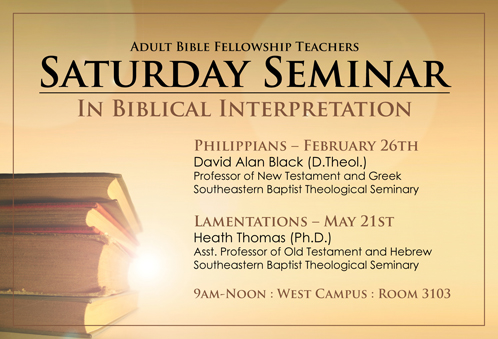
Dr. David Alan Black and Dr. Heath Thomas at Calvary Baptist Church

Sign Up Here

If you are a Bible Fellowship teacher, part of a Bible Fellowship teaching team, or even thinking about teaching, you will not want to miss this training opportunity to learn from two world class seminary professors! I am looking forward to having these two professors come and open God’s word with us.

Dr. David Black is Professor of New Testament and Greek at Southeastern Baptist Theological Seminary in Wake Forest, NC. He holds the D.Theol. in New Testament from the University of Basel (Switzerland) and has done additional studies in Germany and Israel. Dr. Black is considered a leading authority on linguistics and New Testament Interpretation. He has written over 100 articles and authored or edited over 20 books. Dr. Black is well known for his passion in teaching (watch here).

Dr. Heath Thomas is Assistant Professor of Old Testament and Hebrew at Southeastern Baptist Theological Seminary in Wake Forest, NC. He earned a Ph.D. in Old Testament from the University of Gloucestershire in Cheltenham (United Kingdom) and has also done studies at Oxford University. Dr. Heath Thomas has recently published a commentary on The Message and Meaning of the Book of Lamentations.

Coming soon will be an online registration form…


I found this post by Dr. Black on his blog:

I’ve been asked to do a 3-hour teachers’ workshop on Saturday, February 26, at Calvary Baptist Church in Winston-Salem, NC. What fun that will be! My assignment is to walk the teachers through the book of Philippians, which they will be teaching in their classes beginning in March. Exegeting a New Testament epistle is like working on a giant jigsaw puzzle of an ancient walled city in Europe. Just when you think you’ve figured out how to put together the walls, the ramparts, the towers, and the homes you encounter a blue, cloudless sky. The cry, “I got it”, is the final act of triumph. I’ll never forget the day I completed my essay on the discourse structure of Philippians (later published in Novum Testamentum). It was one of those “ah-ha!” moments the likes of which I shall never forget. I suspect that those who believe that “joy” is the theme of this New Testament book will be sorely disappointed with my essay. But as I read the epistle, I was forced to conclude that joy is at best the byproduct of something much more important.

I have said that this invitation is from a local church that is preparing its teachers to teach well and accurately. I cannot think of a better way to integrate seminary and church. Nor can I think of a single faculty member at SEBTS who would not be willing to place his or her expertise in the service of the church in such fashion.

We look forward to having both of you here! You can read an interview that Dr. Black did with Dr. Thomas here.