Adoption & Orphan Care Panel Discussion and Breakfast at the Southern Baptist Convention in New Orleans, LA.

Invitation

On June 20th, 2012, join Russell Moore, Johnny Carr, Tony Merida, and David Platt for a breakfast and panel discussion on Adoption & Orphan Care in the SBC. The gospel of Jesus Christ calls our families and churches to be at the forefront of the adoption and orphan care movement close to home and around the world. This panel discussion will address the theological foundation and practical calling that we as pastors, church leaders, and members have to care for the fatherless. Breakfast will begin at 7am and the panel discussion will start promptly at 7:15am.

This event is being sponsored by The North American Mission Board and Together for Adoption. Also, thanks to Tandem Creative for donating the promotional graphics.

The Panel

Russell Moore (Ph.D., The Southern Baptist Theological Seminary) is Dean of the School of Theology; Senior Vice President for Academic Administration; Professor of Christian Theology and Ethics at The Southern Baptist Theological Seminary. He is also a pastor, author of nine books, including Adopted for Life, and numerous articles. [@drmoore]

Tony Merida (Ph.D., New Orleans Baptist Theological Seminary) is the lead pastor of Imago Dei Church, Raleigh, NC. He also serves as Associate Professor of Preaching at Southeastern Baptist Theological Seminary. He is the author of several books including Orphanology. [@tonymerida]

Johnny Carr is National Director of Church Partnerships for Bethany Christian Services, America’s largest adoption agency. As a conference speaker and orphan care advocate to denominations and national religious associations, he has been able to speak in venues such as the Catalyst Conference and at Saddleback Church. Prior to coming to Bethany, Johnny was a Pastor of Ministry and Leadership Development at Hillcrest Baptist Church in Pensacola, Florida. [@johnwcarr ]

David Platt (Ph.D., New Orleans Baptist Theological Seminary) is head pastor of The Church at Brook Hills, Birmingham, Alabama. Platt is the author of the New York Times Best Seller Radical and the follow-up book, Radical Together. [@plattdavid]

Free Books!

 Thanks to Cruciform Press the first 200 people will receive Reclaiming Adoption by Dan Cruver. Dan Cruver and his co-authors (John Piper, Scotty Smith, Richard Phillips, Jason Kovacs) are convinced that if Christians learn to first think about their adoption by God, and only then about the adoption of children, they will enjoy deeper communion with the God who is love, and experience greater missional engagement with the pain and suffering of this world. That’s what this book is about. What the orphan, the stranger, and the marginalized in our world need most is churches that are filled with Christians who live daily in the reality of God’s delight in them. Reclaiming Adoption can transform the way you view and live in this world for the glory of God and the good of our world’s most needy.

 Thanks to New Hope Publishers the first 200 people will also receive Orphanology by Tony Merida and Rick Morton. Orphanology unveils the grassroots movement that’s engaged in a comprehensive response to serve hundreds of millions of orphans and “functionally parentless” children. You’ll see a breadth of ways to care with biblical perspective and reasons why we must. Heartwarming, personal stories and vivid illustrations from a growing network of families, churches, and organizations that cross cultures show how to respond to God’s mandate. Discover how to adopt, assist orphans in transition, engage in foster care, partner with faith-based fostering agencies, and become orphan hosts. Along with their families’ adoption stories, Merida and Morton give steps for action and features on churches doing orphan ministry, faith-based children’s homes, orphanhosting groups, and other resources.

Crossway Books has also donated 200 copies of Russell Moore‘s book Adopted for Life. Dr. Moore gives a stirring call to Christian families and churches to be a people who care for orphans, not just in word, but in deed. The gospel of Jesus Christ-the good news that through Jesus we have been adopted as sons and daughters into God’s family-means that Christians ought to be at the forefront of the adoption of orphans in North America and around the world. Moore does not shy away from this call in Adopted for Life, a popular-level, practical manifesto for Christians to adopt children and to help equip other Christian families to do the same. He shows that adoption is not just about couples who want children-or who want more children. It is about an entire culture within evangelicalism, a culture that sees adoption as part of the Great Commission mandate and as a sign of the gospel itself. Moore, who adopted two boys from Russia and has spoken widely on the subject, writes for couples considering adoption, families who have adopted children, and pastors who wish to encourage adoption.

Tell us you are coming and help us spread the word by clicking here: Adoption & Orphan Care in the SBC

9 Books That Every Bible Student and Teacher Should Own

While there is no substitute for faithful, careful, and prayerful Bible reading, the Bible’s vast size and diversity can make understanding its message a daunting task. Therefore, most Christians benefit from supplemental resources to help learn and apply Scripture. But what resources are the most helpful? Which resources are reliable? In this post I have attempted to bring together a list of the resources that I reach for most often when studying the Bible and theological issues.

In preparation for this post I imagined a scenario that helped me narrow down my list. I’ll propose the qestion to you. What if you were offered a chance to teach pastors/missionaries in a seminary-like setting somewhere in a third world country? But you could only take one small suitcase of books. Which books would you take? Here is my list. (Note that the book descriptions are taken from the publisher and edited)

The ESV Study Bible, Crossway

This is the standard in study Bibles. The ESVSB combines the best and most recent evangelical Christian scholarship with the highly regarded “essentially literal” ESV translation of the Bible. The ESVSB boasts 2,752 pages, equivalent to a 20-volume Bible resource library. Also, this volume has over 50 articles—including articles on the Bible’s authority, reliability, and interpretation; on biblical archaeology, theology, worship, prayer, ethics, and personal application.

The ESV Comprehensive Concordance of the Bible, Crossway

This volume serves as an excellent study companion for the ESV Bible. With more than 310,000 references representing every verse in the ESV Bible, this makes an ideal reference tool for quickly locating particular passages or for conducting in-depth word studies. Every Bible student should have a concordance close by.

The New Dictionary of Biblical Theology, Edited by T.Desmond Alexander, Brian S. Rosner, D.A. Carson, and Grame Goldsworthy, Intervarsity Press

The NDBT takes readers to a higher vantage point where they can view the thematic terrain of the Bible in its canonical wholeness. This volume is organized with an A-to-Z encyclopedia of over 200 key biblical-theological themes such as atonement, creation, eschatology, Israel, Jesus Christ, the kingdom of God, redemption, suffering, wisdom and worship. Over 120 contributors drawn from the front ranks of biblical scholarship in the English-speaking world make the NDBT a benchmark in theological study resources.

The Dictionary for Theological Interpretation, Edited by Kevin Vanhoozer, Baker Book House

The DTI of the Bible is a reference tool that seeks to marry the tasks of exegesis and theology with the goal of theological interpretation of Scripture. This work also aims to provide a guide to understanding various interpretative approaches and a tool for evaluating them in light of this goal. The dictionary covers a wide range of topics including the theological interpretation of individual books of the Bible, issues of hermeneutics, various biblical interpreters and interpretative communities, and the interplay of interpretation with various doctrines and doctrinal themes. The contributors represent a diverse range of theological backgrounds and interpretative approaches and are experts in their respective fields.

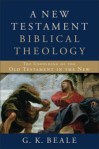
Commentary on the New Testament use of the Old Testament, Edited by G.K. Beale and D.A. Carson, Baker Book House

Readers of the New Testament often encounter quotes or allusions to Old Testament stories and prophecies that are unfamiliar or obscure. In order to fully understand the teachings of Jesus and his followers, it is important to understand the large body of Scripture that preceded and informed their thinking. This volume is made up of entries from a distinguished team of scholars to provide readers with a comprehensive commentary on every quotation, allusion, and echo of the Old Testament that appears from Matthew through Revelation.

A New Testament Biblical Theology, G.K. Beale, Baker Book House

In this comprehensive exposition Beale explores the unfolding theological unity of the entire Bible from the vantage point of the New Testament and examines how the New Testament storyline relates to and develops the Old Testament storyline. Beale argues that every major concept of the New Testament is a development of a concept from the Old and is to be understood as a facet of the inauguration of the latter-day new creation and kingdom.

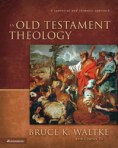
An Old Testament Theology, Bruce K. Waltke, Zondervan

The Old Testament’s every sentence is “fraught with theology, worthy of reflection.” This book is the result of decades of reflection informed by an extensive knowledge of the Hebrew language, the best of theological scholarship, a deep understanding of both the content and spirit of the Old Testament, and a thoroughly evangelical conviction. Taking a narrative, chronological approach to the text, Waltke shows that the unifying theme of the Old Testament is the “breaking in of the kingdom of God.” This theme helps the reader better understand not only the Old Testament, but also the New Testament, the continuity of the entire Bible, and ultimately, God himself.

The Christian Faith, Michael Horton, Zondervan

The Christian Faith broadly interacts with movements within the Protestant, Catholic, and Orthodox traditions. In this systematic theology Horton offers a brief synopsis of biblical passages that inform a particular doctrine; and surveys current and past works with contemporary emphasis on exegetical, philosophical, practical, and theological questions. Its features include: (1) a brief synopsis of biblical passages that inform a particular doctrine; (2) surveys of past and current theologies with contemporary emphasis on exegetical, philosophical, practical, and theological questions; (3) substantial interaction with various Christian movements within the Protestant, Catholic and Orthodox traditions, as well as the hermeneutical issues raised by postmodernity; and (4) charts, sidebars, questions for discussion, and an extensive bibliography, divided into different entry levels and topics.

Historical Theology, Gregg R. Allison, Zondervan

Allison offers students the opportunity to study the historical development of theology according to a topical-chronological arrangement, setting out the history of Christian doctrine one theological element at a time. Such an approach allows readers to concentrate on one tenet of Christianity and its formulation in the early church, through the Middle Ages, Reformation, and post-Reformation era, and into the modern period. The text includes a generous mix of primary source material as well, citing the words of Cyprian, Augustine, Aquinas, Luther, Calvin, Barth, and others. This volume is a great resource for those interested in understanding the development of Christian theology.

Which books would you choose?

The Roots Reading Initiative from PLNTD, Round 4!

It has been my privilege to serve church planters by helping out with the Roots Reading Initiative which Tim Brister started for the PLNTD Network. Here’s a brief explanation:

The Roots Reading Initiative, focuses on providing church planters targeted self-feeding opportunities through an informal structure and accountability. The goal of this initiative is for church planters to “deepen their roots” in their understanding of God, the church, gospel, mission, and the world. In doing so, we believe the RRI will be an effective way of keeping church planters “grounded” and growing as leaders, missionaries, and churchmen.

Tim says that the “five areas ministry leaders need to continually cultivate are (1) man, (2) message, (3) mission, (4) marriage, and (5) methods. Through RRI, PLNTD tackles one of these areas every two months with books targeted to develop leaders for those purposes“. So far, here’s what we have covered:

Nov/Dec 2011 :: MISSION

Jan/Feb 2012 :: MESSAGE

Mar/Apr 2012 :: MARRIAGE

Starting this week, we are now taking up the area of methods, and here are the books we are working through:

May/June 2012: METHODS

Tim writes: “For each book, a reading schedule is provided for those who participate through our network.  Additionally, discussion questions are provided each week which, when the book is completed, are compiled in a downloadable format for a book-length study guide that can be used to disciple others or train leaders in your context. To take advantage of learning in community and accessing additional resources through RRI, you need to join PLNTD’s relational communities and jump into the “Training” community online. Now’s a great time join us if you haven’t already!  Leaders cannot afford to have shallow roots and no shade for their people.

I am grateful for Tim’s vision for the PLNTD Network, and for the Roots Reading Initiative and I am thankful to be a part of it!

“A Life Worth Living” – 2 Timothy 1:13-2:2

What are you here for?

In First Corinthians 6:19-20 the apostle Paul tells us that ‘we are not our own, for we were bought with a price’. There is something deeply motivational when one meditates on this truth. You and I were bought with a price. The sad thing is that too many of us just float through life, with no real intentionality or, to be flat out honest – no real desire to do anything that counts. Very few of us take time to examine our lives and consider whether or not what we are doing or what we are living for – is really worthwhile. Socrates once said “the unexamined life is not worth living at all”.[1] Yet we only get one shot at life.

What I want to convince you of in this sermon is that there is a life worth living. Or as John Piper would say, as an imperative, don’t waste your life[2]. Let us read Second Timothy 1:13-2:2, the last letter that the aging Apostle Paul would pen to his young disciple, his son Timothy.

Follow the pattern of the sound words that you have heard from me, in the faith and love that are in Christ Jesus. By the Holy Spirit who dwells within us, guard the good deposit entrusted to you.

You are aware that all who are in Asia turned away from me, among whom are Phygelus and Hermogenes. May the Lord grant mercy to the household of Onesiphorus, for he often refreshed me and was not ashamed of my chains, but when he arrived in Rome he searched for me earnestly and found me—may the Lord grant him to find mercy from the Lord on that Day!—and you well know all the service he rendered at Ephesus.

You then, my child, be strengthened by the grace that is in Christ Jesus, and what you have heard from me in the presence of many witnesses entrust to faithful men who will be able to teach others also.[3]

Like I said earlier, my goal is to convince you that there is a life worth living. I think the central call of the text is simple.

Be bold and courageous in your witness to the gospel.[4]

That, according to Paul should be the driving point of Timothy’s life. Therefore, it should be the mission of your life.

  1. The message of God is worthy of your life.
  2. The people of God are worthy of your life.
  3. The mission of God is worthy of your life.

The Immediate Context

Before we jump into the text let me remind you of the situation. The apostle Paul is near death. He has spent his life developing leaders and planting churches in this and other regions of the Roman Empire. This is Paul’s last letter to his beloved disciple Timothy. And he wrote it as he was being held in a jail, alone, somewhere in Rome awaiting his execution. Prison accommodation’s in ancient Rome were terrible. First off, Paul was in a remote location, a dungeon like facility. Secondly, the Roman government did not feed or nourish its prisoners. Paul had to depend on family and friends to take care of him, basically to keep him alive. This is what you get Paul for preaching the gospel. But it is a message well worth it.

The Worthiness of God’s Message – 1:13-14

Follow the pattern of the sound words that you have heard from me, in the faith and love that are in Christ Jesus. By the Holy Spirit who dwells within us, guard the good deposit entrusted to you.

1.       Model the Message

Paul believes that the gospel message if worthy of his life, even considering his fate, and is calling Timothy to model his pattern of gospel living.[5] The idea is that of an “outline…such as an architect might make before getting down to the detailed plans of a building.”[6] If there are not healthy guidelines – a good blueprint, there is nothing to pattern the trustworthy building after. The word “sound” in verse 14 calls us to that which is healthy[7], to emphasize the wholeness that the gospel brings.[8] Model your life after healthy words, after the sound outline I have provided, and do so in faith and in love.[9] See, “merely repeating sound words is insufficient; one must hold them fast so that they become embedded in one’s character.”[10] In other words, believe the gospel deep down so that it impacts how you live your life. “The only way to keep doctrine is to both live and proclaim it with faith and love”[11] I believe that most of us in this room, when we think about discipleship and training – we think of a classroom setting. Now, the class room is an important piece of Christian theological training, but we often ignore the importance of teaching in everyday life, bringing the teaching out of here and imbed it in everyday life, or as Deuteronomy 6 would have it ‘teaching along the way’. Modeling the message calls for a dynamic of informal but intentional teaching.

This means, talking to others about your life, your struggles, your faith, living in such a way that reflects the all satisfying joy of being in Christ. Our weaknesses are beneficial to those we are trying to disciple. When we are honest about the state of our own heart it becomes clear that we are “imperfect people, clinging to a perfect Christ, being perfected by the Spirit”[12]. What you and I do, what we focus on, what we talk about, and invest in – teaches others what is important in our lives. Modeling the message is quite non-extraordinary, “ordinary people doing ordinary things with gospel intentionality”[13]. Let me ask you, if someone were to look at your life on a daily basis: what are you proclaiming as the most worthy of treasures? Is it the gospel or something else?

2.       Guard the Message

When you and I make a deposit into the bank, we do not want to worry about the safety of our money, right? That is what the bank is for.[14] We entrust them with our money, knowing that they will handle it rightly. This is the picture Paul is painting for us. There is a treasure, the gospel message, being handed over to trusted persons in order that it remains the property of that designated group, in this case the Timothy, and ultimately the church. Timothy, you are the guardian of the deposit, the “treasure”[15] of the gospel message. If you read through Paul’s previous letter to Timothy you will find that there were many false teachers threatening the doctrinal purity of the church. There are false teachers who are spreading myths[16], old wives tales[17], gossip[18], and contradictions to the gospel[19]. There were people in the church who were making unnecessary distinctions, raising disputable doctrines to the level of first importance.[20] And in this situation Timothy is called to prevent the essential message of the gospel from being lost or altered[21], from being corrupting of its purity, even weakened in its power.”[22] The gospel is sufficient as it is. “So when you guard the gospel, you are preventing it from being damaged, distorted, twisted, watered down or altered in any way”[23].

Consider the importance of this call. Because the gospel is truth about God, whenever it is distorted, lies are being told about God. “A lie about God becomes a lie about life…Nothing counts more in the way that we live than what we believe about God. A failure to get it right in our [doctrine] becomes a failure to get it right in our lives. A wrong idea of God translates into sloppiness and cowardice, fearful minds and sickly emotions.”[24] I often hear people say things like: well, I’ll leave theology to the professors and pastors, and Ill just focus on being a Christian. With all due respect imaginary example people: that is ridiculous. This point hit home with me when I was reading a book by Graeme Goldsworthy. He argued that theology matters because we need to know God. In fact, if you are a Christian, if you claim to know God – you are a theologian. Once you start to try to make sense of God, the Scriptures, and life, you are doing theology. So, all Christians are theologians in some sense or another. But as Graeme Goldsworthy points out, “some are more able theologians than others”[25]. The need is to be a good theologian, for your personal good, your evangelistic effectiveness, and your edification of others.

“One way we guard the gospel is to study it and know it well so that when someone distorts it, we are able to discern the distortion and prevent it from being passed on. We can also guard the gospel by teaching it faithfully. Closely related to this is to use it effectively in people’s lives. We are to use it on our own and other’s fears, insecurities, bitterness, disobedience, etc. When we do, we are able to see that only the true gospel is able to eradicate these problems.”[26]

These are two heavy burdens. It is understandable that Paul would emphasize these things as he nears the end of his life, realizing that his time of guarding the deposit is ending.[27] But don’t miss the beautiful assurance that Paul gives Timothy in verse 14: Model the message; guard the message, how, by the Holy Spirit who dwells within us. Yes, Timothy is to guard the deposit. But ultimately it is God who guards the deposit by the Holy Spirit. It is God, the Holy Spirit who is the great preserver of gospel. That is good news, especially If you and I consider weight of our own calling as Christians to model and guard the message. See, “the ground of our confidence lies in the fact that God is able to guard safely the transmission of the truth he puts temporarily in our charge. This does not imply the human energies can relax in this charge, no. It is actually a call on us to model and guard the message with great courage[28], knowing that it is God who guards not only the message, but also the messenger. The power to live out God’s call in your life does not come through human means alone, but is only possible through God who gives “you the will and the power to achieve his purposes”[29]. No man, unaided by the Spirit of God, could achieve what Paul is calling for. Paul is calling Timothy to fully trust God who can guard his life and the gospel message, and act in that trust.

The Worthiness of God’s People – 1:15-18

You are aware that all who are in Asia turned away from me, among whom are Phygelus and Hermogenes. May the Lord grant mercy to the household of Onesiphorus, for he often refreshed me and was not ashamed of my chains, but when he arrived in Rome the searched for me earnestly and found me— may the Lord grant him to find mercy from the Lord on that Day!—and you well know all the service he rendered at Ephesus.

1. Example of Shameful Desertion

The aged apostle would have suffered the natural effects of a person in his situation – long, lonely hours in a dark remote dungeon, facing certain death, and even more – forsaken by those whom he trusted to bring him support and nourishment. You can almost feel the deep sense of pain when Paul identifies two men – Phygelus and Hermogenes who were leaders, possibly friends[30] (from whom he would have expected more[31]), who deserted him. I would imagine that everyone in this room has felt embarrassed before. Either because of your own actions, or have been embarrassed by the actions of those who you associate with. Or, you have felt shame when waking up from a dream where you show up to work in your underwear. See, deep down, we are afraid of being ashamed in public. There are many different levels of shame, but even at an informal social level most of us feel a stab of shame if we turn up at a party dressed differently to everyone else. We have our hidden codes and assumptions. You wouldn’t go to the beach as though dressed for a grand concert, or vice versa. But what Paul is talking about here is much deeper. Phygelus and Hermogenes were ashamed of Paul. By their actions they had declared that he was a disgrace. “It is not [necessarily] persecution or pain which is the primary issue”[32] here. The primary issue is that not only were they ashamed of Paul, more importantly, they are ashamed of, and had deserting the gospel itself. If you look back in 2 Timothy, you will find that Paul uses this same language.

  • In 1:8 Paul writes “do not be ashamed of the testimony about our Lord”.
  • In 1:12 Paul proclaims “I am not ashamed, for I know whom I have believed”.

For Paul, having been deserted, not only refers to social abandonment, but also deserting the gospel itself.[33] To put it another way, “rejection of the Apostle and his gospel is tantamount to rejection of Christ”[34]. This is why Timothy’s loyalty is so necessary. Loyalty to Gods people is the fruit of one who truly believes the gospel. Our society often establishes for us the standards of ‘who is worthy’ of our love and devotion. These standards include not associating with those who are needy and socially unacceptable. Yet in embracing Christ we admit our own neediness and we associate with one who was rejected by society and ultimately executed.[35] While Paul’s chains were a mark of shame in society, they were a badge of honor in the kingdom of God – these chains were the fruit of his solidarity with Jesus Christ and his refusal to be ashamed of the cross

2. Example of Courageous Dedication

After the shameful example of Phygelus and Hermogenes, Paul turns his attention to Onesiphorus, a man lived up to his name, which means “help-bringer”[36] or “useful”[37]. He sought diligently until he found Paul in his remote location, and was committed to taking care of him, probably with both friendship and physical sustenance – and Paul depended on him since prisoners were often responsible for their own keep[38]. He “braced Paul up.”[39] “Here is a man who is willing to take the risk of regularly visiting one who was a state criminal and who would soon be condemned to die”[40]. Onesiphorous, a patron of a household, would have been a man of some means, whose property would typically include workers and land.[41] He had a lot, on earth, to lose. “It was no light thing to be associated with a criminal. In doing so, one ran the risk of being regarded by the authorities, family members, friends, neighbors, and business associates, as a sympathizer and possibly an accomplice, and therefore deserving imprisonment or punishment”[42].

He was not ashamed of Paul’s imprisonment, nor of the gospel that he was imprisoned for. This is the example that Paul calls Timothy to ponder. I love the word play in verse 18 where Paul writes – Onesiphorus found Paul, and Paul prays that Onesiphorous will find mercy from God. Paul prays that he would find mercy not only in facing the societal implications of ministering to Paul in that very moment (which would affect not only him but his whole household), but also in the last day when God judges the deeds of man.Onesiphorous’ ministry to Paul was the mark of his solidarity with Jesus. This is what God’s people do for one another. In this passage we see Paul’s heart:

  • The discouragement of being abandoned.
  • The joy of a friend who is not ashamed.

It hits home when considering the mercy of God. In the bible “the basic meaning of mercy envisions God seeing someone’s suffering and being moved by compassion to share in it, bringing help in time of need, when people are incapable of helping themselves”[43]. Because God is moved to compassion for his people when they are suffering or alone; we too should be moved to compassion. This is what the gospel calls us to. Consider Christ’s ministry to us even as we have abandoned God. Jesus enters in and takes the burden of our sin upon himself. Even so, Christ was “abandoned by God” on the cross so that we, the lost could be found, so that we could find mercy with God. All of the things that Paul was possibly feeling are things we all feel apart from Christ, and Christ enters into our suffering and alleviates. But, Christ also sends us out as ministers of the gospel to find the lost, to befriend the lonely, and introduce them to the one who will never dessert them. Are you an Onesiphorous? Or will you be accounted with those who were ashamed of the gospel?

3. The Worthiness of God’s Mission – 2:1-2

You then, my child, be strengthened by the grace that is in Christ Jesus, and what you have heard from me in the presence of many witnesses entrust to faithful men who will be able to teach others also.

You will notice that the first words of this paragraph stands in contrast to the desertion of those form the church is Ephesus, and immediately follows the example of Onesiphorus – “you then” do the same. Faithfulness to God’s message and to God’s family unavoidably entails faithfulness to God’s mission.

1. Seek to be empowered by God in the Mission

Timothy is in an almost impossible situation – ‘everyone’ in the area has deserted Paul and the gospel, and Paul is calling Timothy to start from scratch, and entrust others to carry on the mission. We learn in the letter that Paul is calling Timothy to leave Ephesus and come be with Paul in Rome, because of this he will need to provide the needs of the church in his absence. But the beautiful thing about this call is found not in Timothy’s part, he seems helpless, but in the fact that God will make it happen. The imperative Paul uses here is “be strong”, in the Greek text the verb is rendered in the passive tense, implying that the strength to continue this mission comes through the very power of God. In other words, seek the power of God so that God’s mission can be carried out. Timothy, go – do what only God can do. By the sheer grace of God, Timothy will be empowered to both desire and do God’s will in the face of a seemingly impossible situation. The good news for us is that “when God calls, God enables that calling to be complete”[44].

“It is not so much the case that God has a mission for his church in the world, as that God has a church for his mission in the world. Mission was not made for the church; the church was made for God’s mission.”[45] The mission of God “requires the whole church to take the whole Gospel to the whole world”[46].

A few years ago we had the North American Mission board run a demographic study for us. Did you know that if you were to draw a 4 mile radius around this building, right here – 155 Commerce Drive, there are about 25,000 people[47] who live within that circle. Just 4 miles. That is about 50x the amount of people sitting in this room. Is the mission worth it?

2. Seek to entrust others with the Mission

In order to continue the work that Paul began, it is essential that men of trustworthy character be raised up to teach the true gospel – well after Paul and Timothy are gone, in order for the continuation of the mission, of planting churches in Asia Minor. Christian leadership is always reproducing leadership, this is the nature of discipleship. What Timothy has learned he must pass on, helping ensure the integrity of the gospel message. Paul gives us a general picture of what characteristics Timothy is to look for in the men around him.

  • Trustworthy in Character – Men are only reliable in that they persevere and teach the unchanging message of the gospel.
  • Qualified to Teach – Timothy is to develop the ministry of teaching in a local church by preparing more people to give sound teaching.

I believe it was professor David Well’s popularized the term ‘Consumer Christianity’. Well’s argued that the American church has become more of a Spiritual shopping mall, offering goods and services rather than being specific about training God’s people to be on mission. And I think he’s right. Here’s the problem, when the consumer is allowed to be sovereign in the church, the church is abandoning its responsibility and organizing everything around what’s going to attract or wet the appetites of people.”[48] One of the effects of this shift in church life has been the consumer Christianity. The person that shows up for every class and signs up for every event, and is constantly being fed and fed and fed. There are people in churches all across America that have sat in classes for 10-20-30-40 years, consuming information, feeding off of others, and have not once stepped up to lead, teach, serve, or disciple someone else. Some don’t even have time – they are in the church house 5 times a week doing stuff, good stuff, but neglecting to be on mission. This is partly the leadership of the churches fault, “instead of reaching the lost, were losing the reached.”[49] God designed the church to act as the body of Christ. Here is what it should look like: Based on the gift they have received, everyone should use it to serve others. A manifestation of the Spirit is given to each person to produce what is beneficial. The church is most alive when every believer serves in God’s mission where assigned by the Spirit.

Conclusion

I agree with Thomas Oden when he wrote that “the key to renewal of modern Christianity lies in being unashamed of the [gospel].”[50] All throughout this passage Timothy is encouraged to draw on divine strength to sustain him in the mission of God.[51] The call:

Be bold and courageous in your witness to the gospel.[52]

In a little essay titled “The Worlds Last Night” C.S. Lewis argued that “we all…should remember how short, precarious, temporary, and provisional a thing [this life] is; should never give all his heart to anything which will end when his life ends”[53]. This brothers and sisters, is a life worth living.

  • A life that given to modeling the message of the gospel.
  • A life that given to guarding the message of the gospel.
  • A life that given to courageous dedication to the people of God.
  • A life that given to spirit empowered discipleship.

Only one life,

‘Twill soon be past;

Only what’s done

For Christ will last.[54]

Continue reading ““A Life Worth Living” – 2 Timothy 1:13-2:2″

Being a Church That Cares for the Orphan

This post is an edited manuscript of the breakout session I led at Together for Adoption‘s regional conference in Winston-Salem on April 28th, 2012.

Introduction

“I remember the first time I walked into a church building and was struck by the number of families with adopted children. Even though I have multiple friends who were adopted, until that moment I had never seriously thought about adoption or the plight of the orphan. But there in the lobby were all these parents with children of different races. It was the first time adoption had been so visible to me. Clearly there was something different about this church. What was it?”[1]

It may not be a stretch to assume that the picture presented in this paragraph is what you desire for your local church, a place where the beauty of adoption is on full display through your church family. It has been rightly said that “The church of Christ is the most powerful force in the world.”[2] And when a church is engaged in orphan care the world is given a taste of the power of the gospel and a picture of the kingdom of God. Considering the power of the church and her call to provide a picture of God’s new society to a broken world, I believe it is important to develop a culture of orphan care “…where the spirit of God’s heart for the fatherless permeates the church with unmistakable power and clarity.”[3].

The Theological Motivation for Orphan Care

J.I. Packer once responded to the question “what is a Christian?” as follows: “…the richest answer I know is that a Christian is one who has God as Father.”[4] In fact, Packer argues that adoption is “the highest privilege that the gospel offers.”[5] What a powerful statement. This theological truth undergirds and empowers the whole enterprise of orphan care in the church.

First, we adopt and care for the orphan because God adopted us in Christ when we were spiritual orphans. As the people of God, we have been called and have received unmerited grace from God, who we now call Father. The good news of the gospel is that we, who were once spiritual orphans, have now been brought into the family of God as sons and daughters. Therefore, the gospel becomes our motivation to demonstrate what God has done for us vertically on a horizontal plain to the poor and neglected. “Apart from the gospel, the call for every church member to care for orphans makes no sense.”[6] It is apparent all throughout redemptive history that “God loves and defends those with the least economic and social power, and so should we . . . [He is] a God on the side of the powerless, and of justice for the poor.”[7] Orphan care provides the church a unique opportunity to model God’s care to the world around us.

Second, God has a passion for his glory to fill the earth[8], to be seen and delighted in by people from every tribe, tongue, and nation.[9] “The glory of God is made known most clearly through the church declaring and demonstrating the gospel.”[10] “The heart of the gospel moves the church to mission and deeds of mercy which have always been part of the Christian mission.”[11] This is clearly seen in the words of Jesus: “You shall love the Lord your God with all your heart and with all your soul and with all your strength and with all your mind, and your neighbor as yourself”.[12] The love of our neighbor compels us to care for the orphan, for they are our weakest and most needy neighbors.

Lastly, our hope of the end transforms our vision of the present. In one of his last books before his death, pastor theologian John Stott argued this point so clearly: “The church is supposed to be God’s new society, the living embodiment of the gospel, a sign of the kingdom of God, a demonstration of what human community looks like when it comes under his gracious rule.”[13] The church anticipates the day, in the new heavens and new earth, when the very word orphan will be wiped from the human vocabulary. There will be no orphans, no orphanages, only the family of God. If the church is to be a sign of that day, should she not provide a glimpse of kingdom values here and now? One of the most moving pictures of adoption I have read was by Oxford theologian Alister McGrath.

“Adoption is about being wanted. It is about belonging. These are deeply emotive themes, which resonate with the cares and concerns of many in our increasingly fractured society. To be adopted is to be invited into a loving and caring environment. Adoption celebrates the privilege of invitation, in which the outsider is welcomed into the fold of faith and love.”[14]

Is this not also a picture of the local church as Christ envisioned it to be? The family of God should welcome with open arms people of every tribe and language and people and nation.”[15] One of the most powerful ways to put the vision on display is by concrete example. Our teaching on orphan care should be clearly explained, yes, but it should also be demonstrated in life. We mirror this familial unity before a watching world. As God called the Israelites, “seek the welfare of the city where I have sent you into exile.”[16]

The Call to the Local Church for Orphan Care

We tend to romanticize the early church, though a quick read through the New Testament letters will show us that they, like us, were a group of broken sinners dependent on God’s grace. With that caveat I will say that the early church did cause quite a fuss when they cared for the orphans in the Greco-Roman world. As one sociologist noted:

“. . . Christianity served as a revitalization movement that arose in response to the misery, chaos, fear, and brutality of life in the urban Greco-Roman world . . . Christianity revitalized life in Greco-Roman cities by providing new norms and new kinds of social relationships able to cope with many urgent problems . . . To cities filled with orphans and widows, Christianity provided a new and expanded sense of family.”[17] The societal situation called for someone to take care of the orphans and the church responded. In that time; “It was common to expose an unwanted infant out-of-doors where it could, in principle, be taken up by someone who wished to rear it, but where it typically fell victim to the elements or to animals or birds. Not only was the exposure of infants a very common practice, it was justified by law and advocated by philosophers.”[18] It was the church who tracked the voices of crying infants in the streets at night, pulled them from the community garbage yards, brought them in, nourished them, and raised them as their own.

John Piper once said of missions, but I believe it applies to orphan care as well, that the church has three possible responses: go [adopt, foster, care for the orphan], send [support spiritually, materially, and financially others who do it], or be disobedient.[19] One must realize that some in your church family will adopt, some will foster. Some have been blessed monetarily and will be able to finance adoptions. There are some people in your congregation who will intentionally pray and provide other means of support to adoptive families. Some will go overseas and give their lives to orphans and the gospel. No matter what it looks like for each church, or even each member, the current orphan crisis calls for a response from the Church.

The Situation that the Church can Minister in

According to statistics there are roughly 163 million orphans globally.[20] In the United States alone there are more than 500,000 children in the U.S. foster care system. About 130,000 of them have been legally deemed orphans and are thus available to be adopted. From numbers alone I would argue that American churches could clean out the foster care system. I would even argue that Christians should be the one’s leading the movement of orphan care. Unfortunately, this has not been the case. In a recent survey, 52% of couples indicated they would turn to their local church for advice on adoption.[21] However, couples were twice as likely to turn to their local book store than to their church for help dealing with post-adoption issues.[22] Why is it important the Church lead the orphan care movement?

First, First, Christian families enable orphans to become a part of a unique family environment. According to early childhood development expert Karyn Purvis, one third of post institutionalized children transition seamlessly into their new families. Another third bring moderate concerns, while the latter third come into the family with such trauma histories that they carry potential damage to the family unit and it requires a strong intact marriage and family to maintain stability.[23] The church has a wonderful opportunity to transform the lives of orphans by providing them with what they need most – “a family, temporary or permanent, that will be committed to their welfare in every way possible, emotionally, physically, and spiritually.”[24] Orphan care advocates must acknowledge that orphan care is a lifelong process and a commitment to families should be consistent regardless of what may come. While orphan care is beautiful, it is also difficult. While engaging in ministering to the orphans and their forever families, “. . . honestly consider the needs, realities, and dynamics of these families as they expand. As the ministries grow the need for various support systems also increases because the culture of the church is evolving.”[25]

Second, our culture needs to see the unity of the family of God. Robert Peterson argues that “at a time when many predicted that bigotry would be a thing of the past, sadly, it is still very much alive. This does not bode well for an America that will be marked by even greater racial, economic, and age diversity in the years ahead.”[26] Furthermore, “because our age is characterized by bigotry, loneliness, and insecurity, we who live in it need the unity of the family of God, the fellowship of a heavenly Father, and the security that comes from knowing the Son of God.”[27] Even greater, “Our common family tie explains the wonderful phenomenon that every Christian experiences . . . language, culture and education may all be different, but a common bond . . . unites us as members of the same family. We have the same Father, the same Elder Brother.”[28]

Practical Steps to being a church that Cares for the Orphan

“Just as each church develops its own distinctive identity in terms of worship and fellowship, churches need to facilitate and support an environment of both adoption and caring for the orphans that is uniquely their own.”[29] Many people rely on the pastors or the more visible leaders to champion the orphan care ministry to the extent that it either rises or falls based on their leadership. I submit these words to you for consideration: “If you cannot move the culture of your church from the top down, be encouraged that many churches have had their cultures transformed by one couple or one person stepping out in radical, patient, and persistent faith.”[30] The ideal situation is that a church would have both pastors and congregants who are committed to orphan care ministry. Here are a few suggestions that may or may not apply to your context. As the church gathered and scattered:

  1. Pray about orphan care in public and in private.
  2. Develop study groups and fellowship gatherings to discuss orphan care.
  3. Host and support events that bring awareness to orphan care.
  4. Celebrate stories from within your church related to orphan care.
  5. Simply support orphan care ministries with passion.
  6. Ask your church to set aside Orphan Sunday once a year.
  7. When teaching call people’s attention to the need for orphan care, specifically as one speaks on general subjects such as: loving ones neighbors, missions, caring for the poor, hospitality, or the family. [31]
  8. Consider contacting an international orphanage that is not open to adoptions, you may be able to support them by sending teams to love and care for the kids, perhaps even build a facility.
  9. Gather with other churches and leaders in your community and start a conversation about orphan care.
  10. Connect with churches and organizations already engaged in orphan care in your area.
  11. Talk with your local department of social services and ask how you and your church family can help relieve the orphan crisis in your area.
  12. Consider doing something to fight child trafficking.

Concluding Thought

What I have learned most through orphan care, especially in the adoption of our son, is that God’s grace in adopting me as his son is so beautifully moving. Many times you will find that one of the side effects of engaging in orphan care is that your sensitivity to the theology of adoption becomes heightened, especially in prayerfully reading God’s word. I agree with Puritan minister Thomas Manton who once proclaimed “all of God’s children have the spirit of adoption in the effects, though not in the sense of feeling it.[32] He adds, but “the mature child of God . . . grows in the consciousness of his adoption and assurance through Word and Spirit”.[33] Every time I look at my own son, I am overcome with love for him and reminded of God’s love for me. As I read Scripture now and come across the words – orphan, son, father, adoption – I am stirred deep within my soul. My prayer is that so many others would experience this joy.

Continue reading “Being a Church That Cares for the Orphan”

The Barbershop Sessions 2012 – The Manhood Mandate

Ryan and I are looking forward to developing and leading this study in June and July with men from Calvary West. If you are interested in joining the study please let us know.

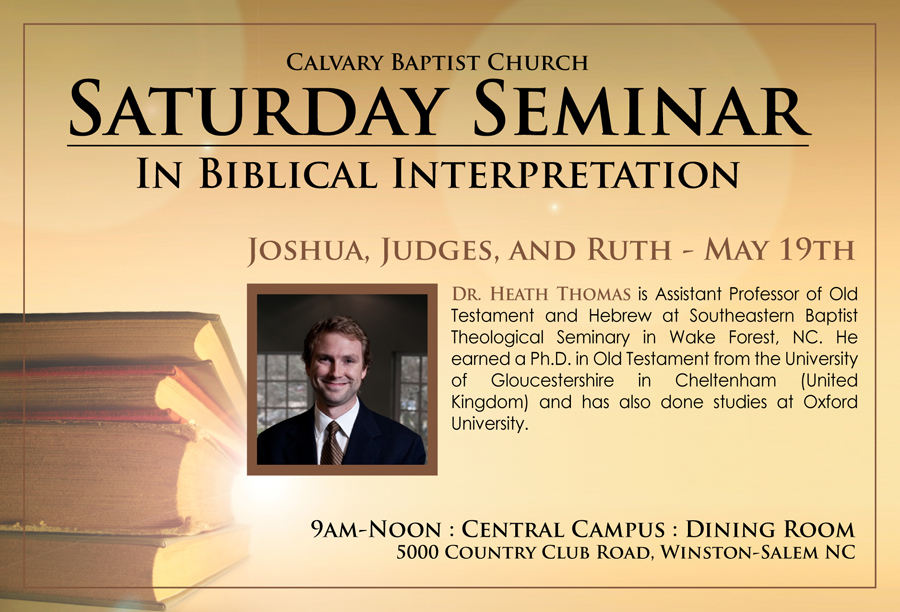
Saturday Seminar on May 19th with Dr. Heath Thomas – Joshua, Judges, and Ruth

– Click Here to register for the Saturday Seminar –

It’s time for another Saturday Seminar at Calvary! If you are a Bible Fellowship teacher, part of a Bible Fellowship teaching team, or just love to study the bible, you will not want to miss this training opportunity to learn from one of our Southeastern Baptist Theological  Seminary professors! Dr. Heath Thomas will be at Calvary on Saturday, May 19th from 9am-12noon. Dr. Thomas will be walking us through Joshua, Judges, and Ruth.

Dr. Heath Thomas is Assistant Professor of Old Testament and Hebrew at Southeastern Baptist Theological Seminary in Wake Forest, NC. He earned a Ph.D. in Old Testament from the University of Gloucestershire in Cheltenham (United Kingdom) and has also done studies at Oxford University.

– Click Here to register for the Saturday Seminar –

The “ethos” of The Lord’s Supper

Dr. Russell Moore offers some good thoughts on the “ethos” of the Lord’s Supper in the book Understanding Four Views on the Lord’s Supper.

The sign aspect of the Lord’s Supper is often obscured in contemporary churches — and not only in those who hold to the Zwinglian/Baptist view of the Supper as a memorial meal. Often this has as much to do with the ethos of the Supper as with any teaching regarding it. Often Lord’s Supper services are characterized by a funereal atmosphere, complete with somber, droning organ music as the ministers or deacons distribute the elements to the congregation. The congregation is sometimes led to believe (if for no other reason than the omission of pastoral teaching) that the point of the meal is to screw up one’s face and try to feel sorry for Jesus. This is often accompanied by a psychological attempt to meditate on the physical pain of Jesus’ sufferings — an emphasis that is markedly understated in the biblical text itself. In order to recover a biblical model of the Lord’s Supper, churches need not tacitly accept a sacramental understanding of the “real presence of Christ” in the elements of bread and wine.

Instead, they must recapture the vision of the eschatological messianic banquet — and seek to recover the joyfulness and triumph of this event within their own churches. This would mean that the Lord’s Supper would be characterized by even more celebrative singing, and even laughter, than the rest of the service. The congregation would be taught to understand that the Supper is a victory lap — announcing the triumph of Christ over the powers of sin, death, and Satan. At the same time, the Supper would maintain the gravity of the moment, as the congregation recognizes that it is performing a sign of God’s freeing us from slavery through Christ — a sign of a new covenant that addresses not only other believers but God himself, the unseen demonic rulers, and even unbelievers who might marvel from outside at the meaning we find in this ancient rite. (33)

Reflections on Shepherding and Leadership

Not too long ago I finished reading Timothy Laniak’s book Shepherds After My Own Heart: Pastoral Traditions and Leadership in the Bible, which is part of the New Studies in Biblical Theology series edited by D.A. Carson. Here are some reading reflections based on this excellent volume.

The Power of Shepherding Imagery

The meaning of the metaphor of shepherd, from which we get our word pastor, is important for understanding the reality of pastoral ministry. Laniak argues that shepherd is the primary metaphor by which the biblical authors conceptualized leadership. The ancient cultural realities of animal husbandry make it clear that the primary roles of a shepherd were to provide, protect, and guide. The distinct imagery of ancient shepherding practices should elicit experiential reflection and emblazon imagery that shapes pastoral ministry. What Laniak does is provide us with a biblical theology of shepherding that is metaphor-dependent and metaphor-rich.  This is important, namely because “metaphors make use of concrete or physical realities to describe less tangible realities…human thought tends towards an economy of explanatory images.” He continues by arguing that “we cultivate mental categories that preserve as much information as possible with as little effort as possible.”[1] In other words, metaphors invite both comprehension and apprehension. Laniak notes that:

  1. Comprehension: Emphasizes the cognitive aspects of interpretation
  2. Apprehension: Emphasizes the existential aspects of interpretation

“Shepherd is a felicitous metaphor for human leadership because both occupations have a comparable variety of diverse tasks that are constantly negotiated…Shepherds had to combine broad competencies in animal husbandry with capacities for scouting, defense and negotiation.”[2] The beautiful thing about metaphor is that it carries us beyond the literal meaning of shepherd and instructs us on the nature of pastoral leadership. In this sense, the vehicle of metaphor affects the way shepherd leadership is understood. There is a connection made at a deeper level, and though the details and particulars are left behind the essence of shepherd leadership remains and resonates within our imagination. Therefore, the metaphor of shepherd instructs and shapes us as pastors by way of deep emotive insight.

The Importance of Nourishing the Flock

The nourishment and protection of the flock is one of the most powerful applications we can gleam from the shepherding metaphor. Laniak argues that ‘the good shepherd knows where to find pastures that are not only lush but safe enough for his flocks to rest in peace…it is the skilled shepherd who knows the environment well enough to provide for his animals needs with compromising their security…The wilderness is a confusing environment[15]. Left to themselves, the sheep inevitably go astray.”[16]

One of the most pressing challenges for any shepherd is to provide nourishment (water, food, rest) for their flocks in harsh environments, environments that withheld essential elements for life and flourishing. A good shepherd watches their flock. Eating and drinking bring nourishment. Rest is a function of being well provided for. Rest also points to a state of security that comes from the shepherd’s protective presence. The idea of provision by way of nourishment and protection is carried forward in the context of theology in pastoral ministry. Consider Jesus words to Peter in chapter 21 of the gospel of John, “feed my sheep”. And in Acts 20 Paul charges the Ephesian elders to protect the flock from those who would twist doctrine. It seems that the picture that Laniak provides is apt: “the image of a gathered flock lying down in green pastures”[17], imagery of satisfaction and safety.[18] Satisfaction comes from the nourishment provided by the whole counsel of God, and safety comes from shepherds who pay careful attention to the lives and doctrine of the flock. The church is to be a community of rest, a place for the weary to refresh from the wilderness of everyday life.  The call is clear for pastors to nourish the people God has placed in your care.

The Necessity of Leading and Protecting the Flock

Psalm 23 is one of the most recognizable Psalms that utilizes the shepherding metaphor. In this Psalm David reflects on the confidence one can find in the good shepherds care, even in times of deep darkness. Reflecting on this psalm Laniak notes that “even in the deadly shadows that fall at dusk in the desert’s canyons there is safety in his presence. Though easily frightened by nature, this trusting sheep will move through the shadows without fear.”[19] The language of the psalm provides us imagery of the two simple but versatile tools that ancient shepherds carried to face unexpected challenges within and outside of his flock.

  1. The Rod: This defense instrument allowed the shepherd to be ready for any predator. This short club was a crude weapon used to beat cumin[20], as a weapon in battle[21], it was also the shepherd’s implement used for counting a flock at night as the flock passes under it.[22]
  2. The Staff: This was the instrument that the shepherd used to nudge wandering sheep back in line, is was a source of comfort because it was used for picking off branches, snagging a trapped animal with the crook, or redirecting misbehaving members of the herd. The staff became a symbol for the protective presence of the shepherd.[23]

Laniak notes that “these two rods may represent the two functions of a shepherd: protector from external threats and peacekeeper among the flocks”.[24] Pastoral ministry calls for gentile assistance, direction, rescue, and encouragement among the flock of God. Pastors are also called to defend the flock from outside threats and even discipline the flock to avoid dangers from within. Both instruments represent the weight of authority that a shepherd carries among the flock. The fruits of this authority are security and comfort among the flock because of a good shepherds care and discipline.

Shepherds Know their Flock

In his devotional book While Shepherds Watch Their Flocks, Tim Laniak comments on the importance of knowing and naming the flock. “Naming is a powerful, tangible expression of the shepherds intimate bond that begins at birth and grows through an animal’s tenure with a flock. Once you begin to fathom how many times an animal may have been counted, checked, carried, nursed back to health, rescued, protected, milked, and shorn, it dawns on you why Bedouin always say, ‘They are family’.”[25]

According to Laniak “responsible shepherds know every member of their flocks in terms of their birth circumstances, history of health, eating habits and other idiosyncrasies. It is not uncommon to name each goat and sheep and to call them by name[26]. One of the most striking characteristics of the shepherd-flock relationship is that control over the flock is exercised simply by the sound of the shepherd’s voice or whistle[27]. This provides a rich depiction of Jesus’ words in John 10:27, “My sheep hear my voice, and I know them, and they follow me.” As for pastoral ministry, this imagery does give some credence to the old adage “people don’t care how much you know until they know how much you care.” To know someone requires time and care. Isaiah provides a good picture of a caring shepherd in 40:11. Explaining how God shepherds his people the prophet writes “He will tend his flock like a shepherd; he will gather the lambs in his arms; he will carry them in his bosom, and gently lead those that are with young”. The imagery is powerful and emotive. This type of care would be expressed in the life of the church through pastoral visitation, counseling, and ministry in times of sickness and grief. “Shepherds who love their sheep notice when their sheep are hurting and seek to be with them to care for them.”[28]

Continue reading “Reflections on Shepherding and Leadership”

Pastors…Read and Get Out of Your Office!

A good word from Pittsburgh Theological Seminary’s Andrew Purves from The Crucifixion of Ministry.

“Get out of your offices and get into your studies. Quit playing office manager and program director, quit staffing committees, and even right now recommit yourselves to what you were ordained to do, namely the ministry of Word and sacraments. Pick up good theology books again: hard books, classical texts, great theologians. Claim the energy and time to study for days and days at a time. Disappear for long hours because you are reading Athanasius on the person of Jesus Christ or Wesley on sanctification or Augustine on the Trinity or Calvin on the Christian life or Andrew Murray on the priesthood of Christ. Then you will have something to say that’s worth hearing” (44).