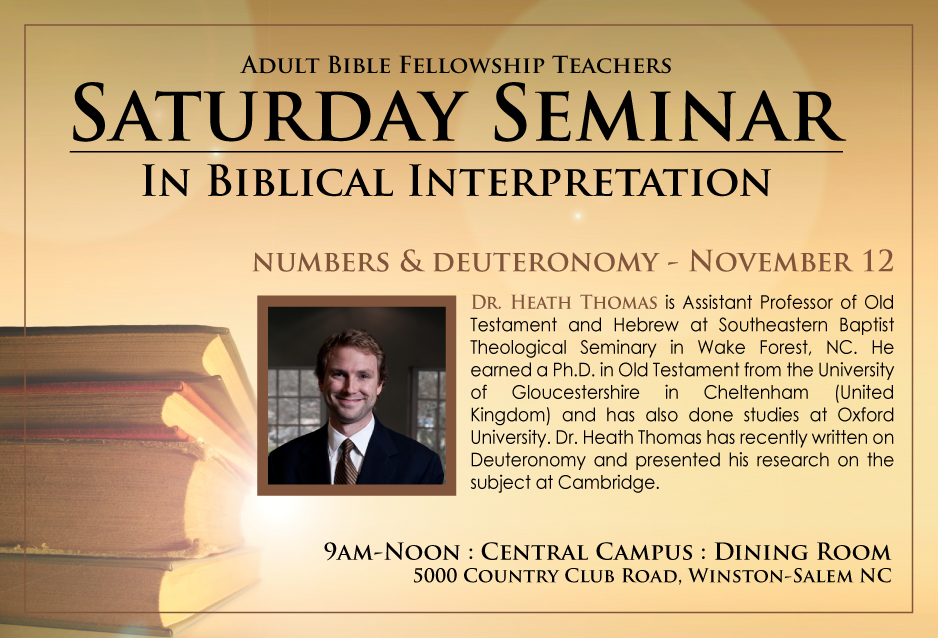
Saturday Seminar on Numbers and Deuteronomy with Dr. Heath Thomas

– Click Here to register for the Saturday Seminar –

It’s time for another Saturday Seminar at Calvary! If you are a Bible Fellowship teacher, part of a Bible Fellowship teaching team, or just love to study the bible, you will not want to miss this training opportunity to learn from one of our Southeastern Baptist Theological  Seminary professors! Dr. Heath Thomas will be at Calvary on Saturday, November 12th from 9am-12noon. Dr. Thomas will be walking us through Numbers and Deuteronomy.

Dr. Heath Thomas is Assistant Professor of Old Testament and Hebrew at Southeastern Baptist Theological Seminary in Wake Forest, NC. He earned a Ph.D. in Old Testament from the University of Gloucestershire in Cheltenham (United Kingdom) and has also done studies at Oxford University.

– Click Here to register for the Saturday Seminar –

Is The Law Still Binding On The Christian?

Is the law still binding on the Christian? This is a question that many Christian’s ponder. And for good reason. In my studies I recently returned to a little book by John Stott titled Men Made New. This exposition of Romans 5-7 was first published in 1966 and is now out of print. I am not sure how I got a copy of it, but I am glad I did. In it Stott makes some helpful comments on this issue concerning the law of Moses.

He begins by stating that there are three possible attitudes to the law of God (attitudes that Tim Keller has popularized in the last few years). Attitudes represented first by the legalist, second by the libertine (or antinomian), and thirdly by the law-abiding believer. The first two represent the those who are not living in line with the gospel. The legalist is one who is in bondage to the law, one who imagines that their relationship to God depends on obedience. The libertine is one who rejects the law all together. But the law-abiding believer holds a proper balance, recognizing that while the law is not a means to salvation it should be delighted in as an expression of the will of God. Stott writes;

Is the law still binding on the Christian? The answer to that is “No!” and ‘Yes!’ ‘No’ in the sense that our acceptance before God does not depend on it. Christ in his death fully met the demands of the law, so we are delivered from it [as a means of salvation]. It no longer has any claims on us [to condemn us for sin]. It is no longer our lord. ‘Yes’ in the sense… we still serve… But the motive and means of our service have altered. Why do we serve? Not because the law is our master and we have to, but because Christ is our husband and we want to. Not because obedience to the law leads to salvation, but because salvation leads to obedience to the law. The law says, ‘Do this and you will live’. The gospel says, ‘You live, so do this.’ How do we serve? Not in oldness of letter, but in the newness of spirit. That is, not by obedience to an external code, but by surrender to an indwelling Spirit. (65-66)

This does not mean that the written law of God in the Holy Scriptures is not binding on us, but rather that we obey in a new motivation and in a new framework. Our motivation to obey is a response to God’s grace, and our framework is that we are accepted on the basis of Christ’s fulfilling the law, not ours. Now, undoubtedly this is a very simplistic answer and there are many nuances to this issue. But, in the spirit of simplicity and general attitude towards the law – I think we can learn much from this quote.

Theology Matters

People often imagine that it is possible to have a personal relationship with God apart from theology. In fact, some Christians assume that knowing doctrine and practical living are competing interests. The modern dichotomy between doctrine and life, theology and discipleship, knowing and doing, theory and practice has had disastrous consequences in the life of the church and its witness in the world.[1]

Theology matters. Theology matters because we need to know God. In fact, if you are a Christian, if you claim to know God – you are a theologian. Once you start to try to make sense of God, the Scriptures, and life, you are doing theology. So, all Christians are theologians in some sense or another. But as Graeme Goldsworthy points out, “some are more able theologians than others”.[2] The need is to be a good theologian, for your personal good, your evangelistic effectiveness[3], and your edification of others.[4]

Knowing God shapes the way we think and live. What you believe about God —what he is like, what he wants from you, affects every single part of your life. Theology matters because if we get it wrong its possible to build your life on a misconception of reality. That would be a tragedy. Theology matters because the Christian faith is not just a cultural tradition or an ethical code. Theology is not an abstract intellectual concept or an empty theory. Theology matters because God is real, and he has acted in our world, and his actions have meaning today and for all eternity.

The discipline of theology can never take the place of God himself, but we can’t know him and relate to him in the right way without theology. This is because theology, true biblical theology, tells us not only who God is, and what He has done, but also what it means to us. There’s nothing more precious than knowing the living God. Southern baptist theologian J. L. Dagg once wrote the following words:

 The study of religious truth ought to be undertaken…from a sense of duty, and with a view to the improvement of the heart.  When learned, it ought to be laid on the shelf, not as an object of speculation, but it should be deposited deep in the heart, where its sanctifying power ought to be felt.  To study theology, for the purpose of gratifying curiosity, or preparing for a profession, is an abuse and profanation of what ought to be regarded as most holy.[5]

Our goal is to know God, but that knowledge should be romantic, it should melt our hearts and lead to worship in response to who God is. Theology changes your life. Theology matters.

Continue reading “Theology Matters”

B.B. Warfield on the Centrality of the Gospel

There is a lot of talk right now, good talk, making sure that Christians understand that one never moves beyond the gospel after conversion. Princeton theologian B.B. Warfield once wrote a wonderfully clear statement on the centrality of the gospel for all of life:

There is nothing in us or done by us, at any stage of our earthly development, because of which we are acceptable to God. We must always be accepted for Christ’s sake, or we cannot ever be accepted at all…This is not true of us only when we believe. It is just as true after we have believed. It will continue to be true as long as we live. Our need of Christ does not cease with our believing; nor does the nature of our relation to Him or to God through Him ever alter, no matter what our attainments in Christian graces or our achievements in behavior may be. It is always on His “blood and righteousness” alone that we can rest.

“Miserable-Sinner Christianity in the Hands of the Rationalists”, The Works of Benjamin B. Warfield, vol. 7, 113ff.

In Honor of My Pastor: To Al Gilbert as he transitions to the North American Mission Board

This week at Calvary Baptist Church it was announced that our senior pastor, Al Gilbert, has accepted a position at the North American Mission Board under the leadership of Kevin Ezell. Al will begin his assignment with NAMB in mid-September as the Executive Director of Love Loud, the evangelism arm of the North American Mission Board. Essentially Al will help multiply ministries like our “Love Winston-Salem” initiative and our refugee ministry, and other mercy ministries to neglected neighbors throughout churches in North America. (Click here for the official announcement from NAMB)

North American Mission Board

It is bittersweet to see Al transition, but as I have told him already – for what its worth, I think it’s the right move. When I came to Calvary as a seminary student in the Calvary School of Pastoral Leadership, Pastor Al and Pastor Will Toburen immediately pulled me in and began investing in my life. These two men have a very special place in my own heart and in the heart of many in our church. They have both shaped my own life and ministry in ways they may never fully know. As for Pastor Al specifically, I view him as a “father figure” in the ministry. Al’s belief in me, his loving support, and his timely challenges have been formative and affirming – something that every young pastor needs and few have the opportunity to receive.

So I offer these thoughts in honor of my pastor and friend Al Gilbert, for what he has meant to me personally in the 5 years that I have been at Calvary. I also offer these thoughts to encourage him in this exciting, yet emotional time of transition.

First, as I reflect on our relationship over the past few years I am very appreciative of Al’s friendship. There have been times where I have come to him vulnerable about personal struggles, there have been many times where we have had good belly laughs, there have been times where we have had disagreements, times when we have shared fellowship over a meal, and there have been times when we have cried together. I can say that in all those situations I have always walked away knowing that Al loved me, cares for my soul, and wanted to see the best for me. Or as he has often joked, “God loves you, and I have a wonderful plan for your life.” Our relationship is something that I will treasure, and make every effort to continue.

Second, as Paul was to Timothy – Al has been to me and many of us young pastors through the years. Al has placed us in leadership positions, “platformed” us, and given us chances to grow into our ministry roles. For his belief in preparing the next generation I am deeply grateful. Personally, both Al and Will have walked with me through some important times in my own life. They both performed my wedding ceremony, lead my ordination service, and have become not only great mentors but great friends. As Al transitions it will be different not seeing him on a regular basis, but I look forward to how God is going to use him in the life of our convention.

Third, as for Al’s hobby as an amateur linguist – I smile. Al has invented at least one word that I know of – “supronomy” (You can ask him what it means, it’s a play off of one of J.I. Packer’s lines in a book.) It’s not officially recognized as an actual word yet, but many of us use it as if it was. We joke with Al about his love of words. But there is an important side of it also. There are some “ministry shaping” words that are imprinted on my mind because of Al – “panta ta ethnos”, “ethos” (If I can think of one just one more “e”…). I have taken Al’s quips, comments, and antidotes to heart, even when they are alliterated or corny. Sorry Al, I had to say it.

Forth, in his ministry at Calvary, Al has truly emphasized missions and multiplication in a way that has “lengthened and strengthened” us as a church. Under Al’s leadership and support our international mission efforts, our local mission efforts, our efforts to start new campuses have become part of the Calvary “DNA”. Many of us have heard Pastor Al’s benchmark sermon on God’s plan for proclaiming Christ to all peoples, a sermon that I once overheard Al Mohler recite “point for point” years after he heard it preached. The three points are simple, memorable, and provide a concise picture of Al’s love for seeing the people of God reach others for Jesus. The “ABC’s of the Great Commission” are – A is for “All peoples”, B is for “Blessing”, C is for “Church”. God has a heart for all peoples. We are blessed to be a blessing to others. Lastly, God has the church for his mission. I have lovingly picked on Al for making the points follow the “ABC” pattern, but at the heart of this memorable message is a love for God, and a passion for the church to be on mission – something that Al does not take lightly! Check out his chapter “The Big Picture of the Great Commission” in the book The Great Commission Resurgence. The point is this; I haven’t ever doubted Al’s passion for seeing the church on mission. I have often heard him pray, and teach us as a church to pray, “Lord, I will go anywhere, any time for your glory…and, if it’s not me, it would be a great honor if you would send my children.”

Lastly, Al is a true Southern Baptist statesman. He loves and believes in the Southern Baptist Convention. He has served as a pastor (of small, medium, and large churches – size matters to some people…), he has served at the International Mission Board, he has served on various committee’s in the SBC, delivered the Convention Sermon, and joyfully served on the Great Commission Resurgence Task Force. These things are all good, but they don’t define Al. Behind all of those great opportunities is a man that truly believes in the efforts of Southern Baptist churches. As a young pastor in the SBC I have learned to see the value of our cooperative efforts – even though I think we have much to work on – because of Al’s willingness to teach me about the SBC, and by taking me along with him to meetings, conventions, events, conferences, meals, and other engagements. This is something other SBC pastors need to put into practice with their younger associates.

These are just some personal thoughts, it helps me process. It is with both tears and a smile that I write this post. Confident that he has prepared our church for this moment by investing in many of us and by sharing his leadership. I have no doubts about the future of Calvary, all things will be well. I firmly believe in the sovereignty of God to bring about his perfect will. We pray for wisdom as we move forward. (You can also pray for our staff) As for Al, he will bring unique experience and perspective to NAMB, and I think he will do a great job. Plus, he already owns plenty of sweater vests, which I hear is the favorite attire of President Ezell.

All joking aside – I rejoice over this opportunity for my pastor. So, one final thought to Al. Pastor, this bittersweet for me. The most important thing for you to hear is that I love you, and will be praying for you as you transition. I’ll be praying that God give you favor as you seek encourage churches to see God’s heart for the neglected neighbor, as you challenge our existing networks, and cast vision to see the gospel spread in North America.

Reading Romans as Homiletics Instruction

I just started reading Paul Achtemeier’s commentary on Romans in the Interpretation series. Keeping in line with the aim of the series Achtemeier writes for the teaching and preaching needs of the church. So most of the commentary is focused on hermeneutical reflection and insight rather than technical historical-grammatical specifics. I have found it quite refreshing, a good complement to the more technical works of say, Moo and Schreiner.

Achtemeier argues that the central theme of Romans is “the plan of God [in] pursuing to extend his gracious lordship to all peoples by his act in Christ.”[1] The author contends that the literary structure of Romans follows the movement of history, a history that God is guiding to its goal, with doctrinal statements and expositions included as a way of making sense of that movement. Therefore, the first 11 chapters of Romans follow the history between God and his creation, while the last chapters apply to the life of the Christian community the insights gained from this account of the sweep of God’s redemptive dealing with his rebellious creatures.

In the introduction Achtemeier makes a wonderful point of application for teachers, an implication of Paul’s placing the more direct ethical commands at the end of the letter after he has rehearsed the story of redemptive history. Namely, application without first showing the power and beauty of the gospel is pointless!

It will do no good to urge someone under the power of sin to “try harder.” If, as Paul makes clear in [Romans] chapter 7, for example, a human being “under Adam” is incapable of freeing himself or herself from sin, then all “trying harder” can do is to drive that person further into sin. If every act is under the control of sin, more action will simply mean more sin. Ethical commands therefore are pointless for someone in whom the power of sin has not been broken. That is why the law intensifies sin: it cannot break sin’s power, so all it does is encourage acts which remain under the power of sin.

Only after the power of sin is broken, and that means only after the lordship of God has been restored [which was lost in the fall of man] – and it has been with Christ’s death and our baptism into it – does it make sense to give admonitions on how one is to live so as to avoid sin. It is for that reason that Paul does not begin with his ethical admonitions, he ends with them.[2]

Now, many of us read this and think – yes, of course, this is nothing new. But then again, it is a good reminder. We often talk about proclaiming the gospel, but do we make a conscious effort to structure our teaching to mirror the gospel itself? It seems that in the very structure of Romans the Apostle Paul is presenting us with a liturgy for gospel structured teaching.

Saturday Seminar on Romans with Dr. Steve McKinion


To sign up for the seminar click here.

On August 27th we will have our 3rd Saturday Seminar in Biblical Interpretation on the book of Romans with Dr. Steve McKinion from Southeastern Baptist Theological Seminary, where he serves as a Associate Professor of Theology and Patristic Studies. Here is a little background information on Dr. McKinion from his personal website.

He finished his BA at Mississippi College, his MA at the University of Mobile, and his PhD at the University of Aberdeen, Scotland, where he studied patristics with Iain Torrance. At age 27, after completing his PhD, he became a professor at Southeastern Baptist Theological Seminary, where he has taught since. He has also been a Visiting Professor at the University of Mobile, The Southern Baptist Theological Seminary, and Trinity Evangelical Divinity School. Steve has also helped lead several church launches, and is currently leading a new church startup in Raleigh called New Covenant Fellowship. Writing has been a big part of his life.  In addition to the articles, dictionary entries, and books he has in print, he is currently completing two major projects: the Isaiah volume in the Reformation Commentary on Scripture with IVP, and Invitation to Historical Theology with Kregel.

Dr. McKinion has already published the books Life and Practice in the Early Church, A Commentary on Isaiah 1-39 in the Ancient Christian Commentary on Scripture Series, and Words, Imagery, and the Mystery of Christ: A Reconstruction of Cyril of Alexandria’s Christology.

See his personal website at – http://www.stevemckinion.com/

Living with Dual Citizenship – Matthew 22:15-22

– To Watch Sermon Video Click Here –

The very word patriotism comes from the word patriarch; and we all acknowledge that each of us have a connection to a “father land.” This has with it identification to a particular kinship, a kinship that has worked, and sometimes fought to sustain and protect the family. I believe that just as one honors father and mother one should also honor where God has placed you. My great grandfather served in World War I, my grandfather served in World War II as a helmsmen on a Navy ship.

Obviously, these men did not battle the other side because they hated the individual men in front of them, they simply loved the men behind them.[3] They stood for their fellow Americans and stood against the ideals that the enemy represented. When I hear the Patriotic songs and pledge allegiance to the flag that represents our “father land”, it stirs deep within me , because I know the cost of our freedom. We should be all deeply grateful for the freedom that we benefit from every day of our lives. When I think about my family history, and American history, I recognize that I am dependent on others, brave men and women who have given their lives for our freedom. I want to affirm that. Today, I am talking about our citizenship, I am talking about the day to day, broad strokes of living in our country.

But I think all of us who are Christians would acknowledge that there is tension in living as dual citizens. The apostle Paul tells us that “our citizenship is in heaven, and from it we await a Savior, the Lord Jesus Christ.”[4] But at the same time we love our country and desire proper patriotism. The apostle Peter tells us that we are “sojourners, exiles”[5] just passing through. This is our temporary home. So what is proper patriotism? What does it mean to live as Dual Citizens? How are we supposed to think and act as citizens of the Kingdom of God, while at the same time being citizens in the Kingdom of Man?

In an effort to be transparent with you, this is a very heavy message. It is a message I have struggled to write. It is a message that has weighed heavy on my heart. Emotionally I have been very burdened by this topic of dual citizenship. What are the church people going to hear me say? Am I saying to little, am I saying too much? So my prayer is that Jesus words will guide this sermon in a very balanced way. I think that Jesus words in Matthew chapter 22, verses 15-22 are very appropriate for this topic.

Then the Pharisees went and plotted how to entangle him in his words. 16 And they sent their disciples to him, along with the Herodians, saying, “Teacher, we know that you are true and teach the way of God truthfully, and you do not care about anyone’s opinion, for you are not swayed by appearances. 17 Tell us, then, what you think. Is it lawful to pay taxes to Caesar, or not?” 18 But Jesus, aware of their malice, said, “Why put me to the test, you hypocrites? 19 Show me the coin for the tax.” And they brought him a denarius. 20 And Jesus said to them, “Whose likeness and inscription is this?” 21 They said, “Caesar’s.” Then he said to them, “Therefore render to Caesar the things that are Caesar’s, and to God the things that are God’s.” 22 When they heard it, they marveled. And they left him and went away.

This is a fascinating encounter between Jesus and a group of questioners, who by most accounts were strange “bed-fellows” in the kingdom of man.

  1. The Pharisees were anti-Rome – Were supremely loyal to their religious establishment. Pharisees did not favor taxes to Caesar for religious reasons[6], it intruded on their dominion.
  2. The Herodians[7] were pro-Rome – Were supremely loyal to the Herod, and thus the Roman government. Herodians favored taxes to Caesar because it provided their livelihood and expanded their dominion. The Herodian dynasty was dependent on Roman rule.

So why would these two groups join together in attempting to trap Jesus with a question about taxes to Caesar? Well, the goal was to get him to say something that might prove to be incriminating.[8] The trap was simple, in their minds there were two possible outcomes to this situation; either Jesus is “pro-Rome” or “anti-Rome.” Politically speaking, the only two options were either “complete devotion to civil government” or “complete devotion to the God of Israel.” If Jesus were to say;

  1. It is unlawful to pay taxes to Caesar – The Herodians would charge Jesus with advocating resistance, for inciting a political rebellion. The Pharisees would have been partial to this answer because this would make Jesus a threat to Rome. Many of the Israelites were waiting for a messiah, a political savior to deliver them from Rome.
  2. It is lawful to pay taxes to Caesar –The Pharisees would charge that Jesus was advocating a compromise with Rome. The Herodians would have been partial to this answer, because Jesus would no longer be a threat. The Israelites viewed these taxes as a painful reminder of Roman occupation, a potent symbol of political subjection.[9] For many Israelites loyalty to Caesar was disloyalty to God, because the coin was a symbol of the pagan Roman religion, the imperial cult.[10]

Essentially, both sides were waiting for Jesus to come out from behind “the smoke” and reveal himself as a political messiah or political revolutionary. But there is something deeper going on here.

Dual Citizenship Requires us to Resist Political Simplicity

“Teacher, we know that you are true and teach the way of God truthfully, and you do not care about anyone’s opinion, for you are not swayed by appearances. Tell us, then, what you think. Is it lawful to pay taxes to Caesar, or not?”

From the very outset the questioners acknowledge that Jesus is not afraid of Caesar, nor anyone else for that matter, so they ask him “Is it lawful to pay taxes to Caesar, or not?” The wording “is it lawful” is important here. They are asking that Jesus interpret what the Torah, the law of God, says on “paying taxes to Caesar”. Essentially, they are asking what does morality require? Should one pay the taxes and, politically speaking, forfeit ones complete devotion to God? Or not pay the taxes and forfeit ones civil responsibility to the state? In their minds it would either be blasphemy or insurrection.

Jesus took the initiative away from the questioners and asked them to bring out the coin that this tax would have been paid with. What he does is shift the discussion from politics to the deeper issue of devotion.[11]

Show me the coin for the tax.” And they brought him a denarius. 20 And Jesus said to them, “Whose likeness and inscription is this?” 21 They said, “Caesar’s.”

See, this coin (denarius[12]), would have the head of the Caesar on one side, with the Latin inscription “Caesar, Son of the Divine.” On the other side it would have read “high priest”.[13][14] To the religious establishment of the day this coin proclaimed that Caesar was a “god”. Furthermore, this coin was a painful reminder of the Roman government’s occupation and rule.

So on one level, the listeners expected Jesus to signal that he was in favor of a revolt against the civil government or the establishment of a new political order. But Jesus knew that the question was much deeper political allegiance, “Jesus, are you pro government or not?” Although they wanted a simple “yes” or “no” answer, Jesus does not give them a simple answer and leave it at that.[15] And even though he did not give them a simple “yes” or “no”, he didn’t avoid or dodge the question either; he answered, but with a caveat that forces them to think, forces us to think.

One of the wisdom themes in the Bible teaches to answer fools according to their folly,[16] to both answer a fool and, at the same time not answer a fool. The principle is that one needs to discern between situations that the Bible requires as a moral absolute and situations where the Bible only gives us guidance, but ultimately allows us to use wisdom according to the particular situation. The Bible doesn’t always give us pat-answers to life. Christianity is a complex relationship, not a mathematical equation.

Now, what do we do in most matters of wisdom? When it’s not so “black and white.” We usually give other people room to disagree; we don’t demand that they agree with us. We often try to winsomely convince them. But we realize that they aren’t necessarily evil or wrong for disagreeing. Right?

But, Jesus opponents presented the question as if it were one way or the other, with no room to apply wisdom. They had specific ideologies, primary devotions, that blinded them to only see the question that way. This is the problem when we idealize things; it often blinds us to our own folly. [17] Remember that the primary issue here is not principally about politics but about devotion. Think about how addictive it can be to place ones ultimate hope in government and politics. Devotion to a can be exhilarating. The problem with us is that when we are devoted to something we often idealize it, are our convictions towards that thing reach the same level as biblical truth. We do this today in American politics, do we not?

  1. Political Parties: Do we not idealize certain parties within government? When idealize one party, we tend to demonize the other. This leads to shouting matches and uncharitable attitudes. But I think many of us, if we were honest with ourselves, would acknowledge that no one political party can capture all of the Christian social/ethical points. There is no political party that is a perfect encapsulation of Jesus values. Both political conservatives and political liberals get certain things wrong.[18]
  2. Passing Civil Laws: Consider this question. “Is it right or wrong to pass tax cuts?” What does Christian morality require? Well, other than the fact that we all want tax breaks, we also realize that it depends on a number of factors that require great wisdom. We recognize that some citizens will benefit and some will be hurt. So, what is the most loving thing to do? These are not always yes or no questions, it is never that simple.

There are certain moral commands in the Bible that we as Christians must stand firm on. But on issues of wisdom we need to resist this type of political simplicity. Jesus is not promoting an a-political attitude, passivity, or some form of escapism. That is far from what he is doing, in fact – Jesus answer to the questioners affirms the good intention and purpose of civil government, and calls for us to be good citizens. Jesus is simply calling for a proper patriotism.

Dual Citizenship Requires Proper Activism

Let’s go back to that coin. Jesus holds it up and asks the crowd, “whose image is this?”, and “whose inscription?” Inevitably they respond “it is Caesars”. Then Jesus says, “Well, if it has Caesars image on it, it belongs to him, so give it back[19] [to him].”[20][21]

Jesus pithy words here lay down the basis for the proper relationship between God’s people and human government. In fact, it is upon this answer that most discussion on the relationship between civil government and the kingdom of God has been based ever since. In calling the people to “render to Caesar the things that are Caesar’s” Jesus acknowledges Caesars temporary rights as he carries out his God given function in politics and government[22] for the good of civilization.

We took Solomon to the pool a few days ago and it brought back memories of my own childhood when my mom would take my sister and I to the local YMCA. When she did that, and when we jumped into the pool, my mom, in some sense, was entrusting our care to the life guards. They are there to watch over the children in the pool. When a kid begins acting up, or playing in a way that is hazardous or dangerous to themselves or others what does the life guard do? They blow the whistle and make them sit out for a few minutes. So while you are in the pool you are temporarily entrusted to the jurisdiction of the life guards.

When we look at the big picture of redemptive history we see that civil government is a temporary, post-fall, common grace institution given by God for the administration of justice and to restrain evil.[23] The Apostle Paul argues this same notion in his letter to the Romans, chapter 13. On the surface level Jesus shows that Caesar has rights while he is responsible for the framework in which all of our common life is lived – to provide and protect. . In God’s plan for history civil government is a legitimate establishment. I don’t think anyone of us would disagree with that.

Let me add one caveat, this is where the issue of wisdom comes into play. Human history affirms that there are times when leaders of human government demand what God forbids. This is when Caesar demands the honor that only God deserves. In these cases I think there is cause for civil disobedience under the authority of King Jesus. We will leave that as it is, because we do not live under the totalitarian leadership of someone demanding that we do what God has restricted. If I were preaching this message in another land, a land where the government was not allowing Christians to live a quiet and peaceful life[24], this point would be applicable and worth consideration. The point is simple, rendering to Caesar what he deserves, in some situations calls for respectful resistance.

Just as those that are entrusted to watch over the citizens, citizenship itself comes with obligations and believers in Jesus Christ must wisely recognize this and act accordingly while living in the kingdom of man. Jesus affirms that one must recognize and hold in balance that “it is possible to pay ones dues to [government] and to God, to be both a dutiful citizen and a loyal servant of God.”[25] Paying dues to government is different than total heart allegiance.

The question is then, how do we do this with wisdom? How shall we live as citizens of the kingdom of God, and yet simultaneously live as citizens in this world, in this country, in this city? I believe that on one level when Jesus calls us to render to Caesar what is his, he is calling us away from political passivity and calling us to a certain type, a proper type of activism.

The Christian worldview makes it clear that our ultimate concern is for others to experience the beauty of God by the proclamation of the gospel of grace, and we yearn for God’s will to be done on earth as it is in heaven. So that all things will be as they should! But we look around our world and see that it is filled with “mixed passions, mixed allegiances, and compromised principles…Unlike God’s kingdom, the citizens of this world demonstrate deadly patterns of disobedience and revolt against the kingship of God.”[26] Why? Because of this our world is broken and deteriorating.

Yet, while this world is passing away, it is not ultimately unimportant. We should not forfeit our responsibility to love its citizens. We bear great responsibility in this world to work for the good, for justice, and peace. When Scripture instructs us to love God and love neighbor as ourselves we are given a clear mandate for the proper engagement in this world. Did Jesus not say that this is the essence of the law? So when you ponder the question “what is the most lawful thing to do?” we are essentially seeking to answer what must I do to love God and neighbor properly. I think Albert Mohler says this wonderfully when he says that:

Love of neighbor for the sake of loving God is a profound political philosophy that strikes a balance between the disobedience of political disengagement and the idolatry of politics as our main priority.[27]

Love of neighbor for the sake of loving God is the hedge against either political idealism or political escapism. As the people of God, we should as Jeremiah 29:7 teaches us, “seek the welfare of the Kingdom of Man”. As individuals we need to get involved government and politics, but do it critically with wisdom with an understanding that neither civil religion nor civil government will obtain a utopia.

Civil government, political alliances, and arrangements are, by definition, temporary and conditional.[28] There is an inherent complexity and tension between the kingdom of God and the civil governance of man. We serve as ambassadors in the kingdom of man.[29] An ambassador is one who recognizes and honors the kingdom it represents and also recognizes and honors the place where it is.

There is sensitivity to where you are, but also recognition of who you are – you are a citizen of God’s eternal kingdom.[30] The ‘ambassador’ mindset brings balance to the dual citizenship dilemma. This helps us understand why;

  1. To those who wanted to overthrow the civil government, Jesus demanded that they render to Caesar what belongs to him.
  2. To those who wanted to absolutize the civil government, Jesus told them to render to God what is God’s.

Politics and civil government was not Jesus primary concern. See, Jesus had a greater agenda, a greater campaign, and I think in understanding it we will be able to fully see what is happening in this passage. So while dual citizenship requires proper activism, it also requires allegiance to King Jesus.

Dual Citizenship Requires Allegiance to King Jesus

Consider again, Jesus question “whose image is on this coin?” from a theological perspective. We have already affirmed that on one level, to go ahead and ‘render to Caesar’, give back to Caesar what has his image on it. God has appointed people, however unfit, as authorities in this world. But remember, there is a deeper theological meaning here that we must not miss. Being familiar with the biblical narrative should draw ones attention to the language of “image” in Genesis, where we see that all human beings are created in the ‘image of God’.[31][32] So when Jesus says:

Render to Caesar the things that are Caesar’s, and to God the things that are God’s.

There is a sense irony here in this paradoxical statement. The coin bears Caesars image, but humanity bears God’s image. Jesus is saying that God always trumps Caesar because all things are God’s. See, one may be obligated to pay taxes to Caesar, but everything, all that we are and have comes under God’s dominion and kingship. So, “whatever civil obligations Jesus followers might have, they must be understood within the context of their responsibilities to God.”[33] Therefore, fulfilling civic duties does not necessarily jeopardize our devotion to God.

So, when the questioners come to Jesus and essentially ask him if he is a political revolutionary – he says no. And he is not. But at the same time, he is. It is here that we understand the deepest meaning of Jesus answer to the question. The questioners are essentially asking, Jesus, are you who you say you are? Are you really a revolutionary or are you full of hot air?

Walking around claiming that the kingdom of God is at hand was fighting talk![34] So what is going on here? While Jesus was not a political or religious revolutionary in the sense that the questioners expected, he was a revolutionary in the greater sense. What his listeners did not understand was that the real revolution would not come through the non-payment of taxes or the establishment of a new political order. See, every political revolution inside the kingdom of man is not really a revolution in the truest sense; it’s simply rearranging the furniture.[35]

Remember, Jesus kingdom is not of this world.[36] It does not operate in the same way the kingdom of man operates. The good news of the gospel is that Jesus is giving us a real revolution! And once you taste the goodness of the King and see the beauty of his rule, you will gladly bow the knee and submit to his dominion.

  1. Earthly rulers build kingdoms through conquest, by gaining power over the poor and oppressed. But Jesus builds his kingdom through grace, by giving his power to the poor and oppressed.[37]
  2. Earthly rulers are established by recognition or election by the masses, Jesus rule is established by being rejected and executed because of the masses.

The Herodians and the Pharisees did not understand what Jesus was doing. He was doing something that government and politics cannot do. Think about it, putting Jesus to death launched his revolution. Jesus resurrection inaugurated his Kingdom.

The major problems in our world are not political, they can’t be fixed by government or law — they’re spiritual. In any given situation your, and my, essential problem has to do with sin. We don’t need government overhaul or political reformation, we need redemption.[38] As C.S. Lewis once quipped: “You cannot make men good by law: [but] without good men you cannot have a good society.”[39] Jesus kingdom spread by gospel transformation, creating new men, and a new society of men.

When we understand this we can have a balanced view of government and accept that we cannot legislate new hearts; government cannot create a new society. Our hearts are idol factories.[40] Think about it, if our ultimate hope is tied to the security of America, an ideology of a specific political party, or in the power of our government or nation – we will always be let down. It is so terribly easy to exalt politics as the means by which we attempt to usher in the redemptive kingdom of God in this world.[41]

  1. If our hope is in these things, then when we receive a blow, or are attacked, it crushes us and leads us to despair and paranoia.
  2. If our hope is in a particular party, ideology, or even in the outcome of a certain political decision then we tend to demonize the opponents and resort to unloving debates and tactics to gain power.
  3. But, it is also easy to despise politics as insignificant or unworthy of Christians. But this is not proper either.

The heart issue, the problem of man is that we cannot properly render to God what is God’s. If we are really changed by the Gospel, then we are changed so that we can work with others we disagree with for the greater good. Ultimately the enemy is not the one for whom we disagree with politically, the enemy is inside. If we resort to power plays and demonizing those whom we disagree with, then we know we aren’t living in line with Christ’s kingdom which drives us to serve our enemies.

We need to come to Jesus, who deals with our deepest sin, and continues to deal with our sin.[42] See, once we catch a vision of the beauty of God’s rule and his kingdom everything changes even our view our civil responsibility and how we do politics. We look around and seek to use wisdom as we are “salt and light.”[43] Our devotion becomes less about politics and more about people.

  1. We don’t desire power for ourselves; we desire to do what is most loving for others.
  2. We don’t only seek to identify the problems in society, we work with others (even those whom we disagree) to find the solution.
  3. We don’t condemn the weak and oppressed; we come alongside them, invite them in, and love them.
  4. We don’t run from the evil in our cities, we run in and settle, we seek the welfare of our cities.

Let me put it another way. We don’t just seek to enact laws that uphold our family values; we take it a step further and lovingly pursue those who don’t uphold those values. We don’t just place our hope in legislating against things like homosexual union, we also reach out to them and seek gospel transformation in their lives. We don’t just seek to make abortion illegal, we reach out to those mothers and walk with them, help them find ways to raise those children, we even adopt those children.

Our citizenship, our allegiance to Christ and the Kingdom of God calls us to more, to go above and beyond as we live in the Kingdom of Man.[44] Any simplistic Christian response to politics, the claim that we should not be involved, the claim that we should take back our country for Jesus, is simply inadequate. As citizens of two kingdoms we need to search the Scriptures, pray diligently, and hold each other accountable to live with great wisdom, as we wait for our king to come back and place things how they ought to be. Let me close with this.

Conclusion

Perhaps you have heard the story.[45] In 1914 something amazing happened in December along the Western front during World War 1. During the weeks leading up to Christmas parties of German and British soldiers began exchanging Christmas songs across the trenches. Essentially, they were battling each other with season’s greetings, at some points individual soldiers walked across enemy lines bearing Christmas gifts. On Christmas eve and Christmas day both sides agreed to a truce, an unofficial cease fire. These enemy war units ventured into what they called “no mans land”, neutral territory, to share their rations of food and sing Christmas carols together.

Imagine that, 10,000 troops coming together, individual Christians, enemies in the kingdom of man, but brothers in the kingdom of God, coming together under the banner of Christmas, under the banner of Christ. What a beautiful picture of the power of the gospel. What a beautiful picture of what’s to come when Christ consummates his kingdom and sits down on the throne as King of Kings and Lord of Lords.

But we are not there yet, we still live in a broken world. Until that day may we seek to live with wisdom as we “render to Caesar what is Caesars, and render to God what is God’s.”

Our hope is not in government or politics[46] but in the power of the Gospel of Jesus Christ. Government, Politics, and law do not change men fundamentally, the gospel does.

Continue reading “Living with Dual Citizenship – Matthew 22:15-22”

The Lord’s Prayer – Matthew 6:9-13

This is an edited manuscript of a sermon that I preached at Calvary Baptist Church, West Campus. To watch the video click here.

Introduction

I believe that the experience of relationships, connecting with others, is central to fulfilling our deepest desires as human beings.

I remember the first time I met Laura. She walked into the bible fellowship home group that I had joined, and when I saw her I was “done”. I wanted to know who this woman was. So, that morning we did the usual, we shared prayer requests; we studied Scripture together, and closed in time to make it to the worship service at back at the building. I admit that I did not pay much attention that morning because I was plotting, strategizing, how I would talk to this woman. As everyone was gathering their things to leave I noticed that her walk into the kitchen. I thought to myself, “this is my chance!” So I quickly grabbed a piece of paper out of my Bible, balled it up and headed to the kitchen to throw it away. I walked in and there we were, just she and I. I tossed my paper into the trash can (the reason I was in there) and introduced myself.

  • Hi, my name is Matt.
  • Hey, I am Laura.
  • I froze. My mind went blank.
  • There was an awkward silence.
  • Then Laura said, well…it was nice to meet you and walked out.
  • I blew it.

Not only am I not smooth. But, I had nothing to talk about. Why would I? I didn’t know her and she didn’t know me. There was no relationship to provide the grounds for a conversation.

What Does This Have To Do With Prayer?

Laura and I have now been married for over three years. Now that we have a true relationship it is much easier to talk. In fact it happens naturally. I don’t need develop a mini production involving strategies with “balls of paper” to talk with her. The same is probably true of your spouses, family, and friends. I think this is instructive for our prayer lives. As I have studied prayer I keep coming across the same definition for prayer, “prayer is simply talking to God.” Well, we all talk, right? We all communicate. But., why do we talk? We talk because we want to connect. We want to share our problems, joys, pains, concerns, and celebrations with others. In the situations of life we seek to understand our world by “talking” to others. I think this is important for understanding prayer. Consider this question.

What is really going on inside of you when you sit down with someone you know and love dearly, and talk about the things going on in your life?

What really happens when we share with those we know and love? I think what happens is that we find the desire for relationship, to connect, being met at its most basic level. There is fulfillment and great comfort in knowing that we have someone else is there to listen, to celebrate with, to comfort us and help carry our burdens. Well, this is just like prayer. But here’s the thing. That deeper desire to experience relationship, to connect will never be fulfilled in our human relationships. Other people, even the ones we love and trust most are mere shadows, though they are true shadows, that point us to our inner desire to connect with our Father, God. When it comes to our relationships, it is inevitable that others will eventually let you down in some way or another.

But there is one who will never let us down. And that is our heavenly Father. Yet, if you are like me you probably find it hard to pray. Even worse, you have probably found that, after beginning to pray you find that your mind wanders and you forget that you were praying altogether. Now, in my experience it seems that most of the books and teachings on prayer focus on defective practices or discipline. The effect of these examples it usually that you walk away with a desire to try harder and be more discipled, but it is usually short lived. Let me propose to you that the power of, and passion for prayer comes in loving and knowing God as Father. I believe that “the more aware we become of the one to whom we pray, the more we are drawn to seek his face”[1].[2]

This is where I think most books and teachings on prayer fail us. They focus on the techniques or discipline of prayer, but this is where the Lord’s Prayer is so beautiful. First and foremost, in the Lord’s Prayer, Jesus is revealing who Father God really is to his disciples, to us. So, if you are not already there, I encourage you to turn to Matthew chapter 6, where we will primarily focus in on verses 9-13.

The Context of The Lord’s Prayer

The Lord’s Prayer is found in the middle of Jesus’ “Sermon on the Mount.” Jesus has gathered his followers and is showing them, by teaching, what it looks like to live in the presence and power of God’s kingdom. This sermon is given in the context of Jesus condemning the religious leaders of the day who did everything, even prayer, out of prideful and selfish motivation. Jesus gives two examples, in chapter 6, of ‘vain’ prayer often practiced by those religious leaders.

  1. vv. 5-6: Grandiose Attention Seeking Prayer – these religious men “had it all together”, were self dependant and they liked to flaunt it.
  2. vv.7-8: Thoughtless Repetitious Prayer – these prayers were used as some type of magical incantation to manipulate God to get what you want.[3]

In either case, their motivation in prayer shows their independence from God and is using God as a means build on their own self interest. But, then you come to verse 9, where Jesus introduces the “Lord’s Prayer” by saying: “this [then] is how you should pray”. See verses 9-13:

Our Father in heaven,
Hallowed be your name.
Your kingdom come,
Your will be done,
On earth as it is in heaven.
Give us this day our daily bread,
And forgive us our debts,
As we also have forgiven our debtors.
And lead us not into temptation,
But deliver us from evil.

  1. We pray to a Holy God who is also our Loving Father (v. 9)

Foundational to all prayer is that there is a God who reveals himself personally to creation so that we can know Him. I find it interesting that in verse 9 Jesus calls us to focus in on attributes of God that seem, in contrast to each other, like they don’t fit together. Jesus not only teaches the disciples to address God as father, but also as holy, and in heaven.

  1. That God ‘is in heaven’ speaks of his transcendence or independence. From his position of transcendence he acts upon the world as one who is distinct from it.[4] Unlike us, since we are dependant creatures, He is completely independent of creation. To be candid, God does not need us. He is the creator and sustainer of life.
  1. God’s holiness communicates his absolute and unique excellence above all of creation. He is pure and without sin, absolutely perfect. When Jesus teaches us to pray ‘hallowed be your name’, he is declaring that God is indeed Holy, but is also showing us that our desire should be recognize and acknowledge God’s holiness and the reverence that is due to his name. [5]

Jesus, at once, paints this picture of God as being “in heaven” (distant from us), and “holy” (separate from us), and at the same time he is a “Father.” Do you see tension there? In many ways this tension is worked out in the story of God’s people through the Old Testament. After Adam and Eve were exiled out of Eden, their descendants were always wandering and looking for provision and protection. They often turned to idols, but when those failed, they always came back desiring to be reunited with God the Father, and live under his care. However, while they wanted God to be near, they also knew that they could not endure his nearness because of their sin.[6] This continues all throughout Israel’s history. This is why you hear the Psalmist cry in one Psalm, “be near O God,[7] yet then in another: “show mercy, O God…For I know my transgressions.[8] If we are honest, many of us fear being near to God – mainly, because we love our sin so much. But we also recognize that when God is absent there is disaster, just like when God removed his presence from the Israelites. Enter Jesus.

Jesus comes and claims to be the solution to this paradox. He claims to be the resolution to the tension between God’s holiness and nearness. Early in the gospel accounts we read that Jesus addressed God as his own, actual, Father in an affectionate and very intimate way (as Abba[9]). He even claimed that “he and the Father are one.”[10] And something significant happens here in the Lord ’s Prayer. Jesus declares that the disciples are to address the Holy God of Heaven as their own true father. We have to imagine that for those listening, calling God father might seem extremely presumptuous or uncomfortably personal. So what is Jesus doing here? If prayer is talking to God, then in prayer we address God as a person. In revealing his name, as Father, to men, particularly sinful men, God shows the wonder of his grace.[11] Remember that in ancient culture someone’s name was bound up with the qualities associated with that person. When God tells his people that he is to be addressed personally as Father He is making himself extremely accessible, he allows the connection, and provides a foundation for a deep relationship.

Some of us have been blessed to have good loving fathers, some of us have come from broken homes where the father was absent or continually failed the family. Even though we live in a broken world, God still uses broken images as shadows to point us to himself, the perfect father. See, the very fact we know that earthly fathers do not live up to the expectation of “father” confirms this. Fathers are supposed to be the ones who willfully protect, provide, and lovingly nurture their children. I believe these are things that all of us desire in the deepest way, even as adults, we desire God as Father. So, let’s return to the two aspects of God revealed in the first line of the prayer, namely that God is, on the one hand, transcendent and holy, but on the other hand a father. Let’s look at the problem, and the solution.

  1. The Problem: God is pure and undefiled. Yet we are sinners. We are sinful, and this is a curse that is deeply embedded in the human heart. When our first parents, Adam and Eve, rebelled they rejected the Father’s love and declared their independence. Essentially, they orphaned the entire human race. They cut us off from the life sustaining protection and provision of our heavenly father. So that’s the problem.
  1. The Solution: So, how do we find our way home? This is the good news of the gospel! We have an older brother, Jesus, who came to bring us back to the father at the cost of his own life.

What gives us even more hope is knowing that it was God who sent him, his only Son. The good news is that God has not left us as orphans.[12] When Jesus says, “no one comes to the Father except through me.” He is proclaiming that it is only through him that we have the right to call God father! And, Galatians 4 teaches us that when we believe in Jesus Christ, we are adopted into God’s family.[13] Even more, we not only become God’s children legally, but we receive the Spirit in order to experience our sonship. What does this sonship entail? What does it look like?

  1. We pray to a Sovereign God who’s Perfect Will for His creation is Good. (v. 10)

For many of us our childhood is a distant memory. But imagine with me for a second the freedom of summer when you are a small child. When I reflect on my own childhood summers, I remember a time of being carefree, unburdened, playful, relaxed, etc. Doesn’t the very thought of it bring a smile to your face? I look back and some of the things I enjoyed in those days. It was the he silly things like running through the sprinkler, enjoying the beautiful colors of the sky during bike rides at dusk, playing and building in the woods with my closest friends, enjoying the cool wind during a nap on the lawn; that gave me the sense of summer’s freedom. Now, if I reflect on ‘why’ I was able to enjoy these summers so freely, I open up the picture to understand what was really going on there. My dad worked and provided for our family. That doesn’t seem very profound does it? Well, let me put it another way.

  1. I had a Father who assumed the cares of the world so that would not have to.
  2. It was because of my Fathers loving provision that I could live burden free.

I think this is the type of romantic notion that we should have about God’s kingdom. The biblical theme of God’s kingdom can be described as “God’s people living in relationship with God and enjoying his provision.”[14] This is the Eden paradise that was lost. In a very real sense, experiencing the Father’s love and provision is experiencing life in his kingdom. This notion of our father’s love is terribly inviting isn’t it? When we pray for “God’s kingdom to come” and for “God’s will to be done”, we hope and trust that these kingdom realities are indeed going to be. To pray that “God’s will be done on earth as it is in heaven” is also to long for connecting with what is now being experienced in the presence of God the Father in heaven. Consider the inter-Trinitarian experience that the God enjoys now: comforting peace, true freedom, everlasting fulfillment, perfect joy, deep intimacy, perfect love. Many of us look at our lives and the world around us now and long for these things. We see the effects of sin (personal and collective), of living in a fallen world (broken systems, chaotic environment) on a daily basis. As Christians we know this world is broken because our rebellion has driven us away from our Father, and many of us still feel far from home. Perhaps you feel homesick as you read Revelation 21.

Behold the dwelling place of God is with man. He will dwell with them, and they will be his people, and God himself will be with them as their God.  He will wipe away every tear from their eyes, and death shall be no more, neither shall there be mourning, nor crying, nor pain anymore, for the former things have passed away. And he who was seated on the throne said, “Behold, I am making all things new.” Also he said, “Write this down, for these words are trustworthy and true.”

Do you not long for this? Do you not long to be at home, under the care of the loving Father God? This brings us back to the good news of the gospel. When Jesus began His ministry he declared that “the time is fulfilled, and the kingdom of God is at hand, repent and believe in the gospel.”[15] Jesus said “come to me, all who labor and are heavy laden, and I will give you rest.”[16] Peter also urged us to “cast all of our anxieties on him, because he cares for us.”[17] See, God sent Jesus to carry the burden of our sin on the cross, and when Jesus walked out of the grave –defeating sin and death – God’s everlasting kingdom was ushered in. When we come to Jesus as our only hope, he brings us into God’s family, his kingdom, where he provides all that we truly need. This is the good news; Jesus carried the burden of sin so that you could enjoy the eternal freedom of summer in God’s family, under the good Father’s provision.

Learn to trust that your Father is sovereign over all things and that in his timing he will bring to consummation the kingdom that Jesus ushered in. Even though you may find you situation hard at this moment, when you back up and consider the kingdom, you see that your Father’s perfect will is good. For the here and now, we are not just left to dream of home. We are not left abandoned, just longing to be in the presence of God the Father later. In Prayer, we are able to go there now. In prayer we are able to find comfort in the arms of our Father as we wait for Jesus to come “and make all things new.”

  1. We pray to a Trustworthy God who Forgives and Sustains us. (vv.11-13)

As many of you know Laura and I have an 18 month old son, Solomon. As his father I have experienced his helplessness, and understand that he is fully dependant on me as his “Da-Da”. I work to provide a him a house and to put food on the table. We child proofed the house to protect him from hurting himself. We choose to buy food that gives him the proper nourishment. We prepare (well, Laura) prepares breakfast, lunch, and dinner so that eating will be enjoyable and fulfilling. We dress him, we bathe him, we change his diapers, and we change his diapers. The list goes on. Our son Solomon is pretty good at being helpless. Well of course, he is a baby; he has needs that he cannot meet himself. And as his father I love him, find joy in, and desire to provide for, protect, and nurture him. I love it when he comes running to me in joy and in tears because when he does that I know that he loves, trusts, and depends on me. This is very instructive for the last section of the Lord’s Prayer. In fact, I would like you to consider the last few verses as a model for the way that we, his children, should approach our loving Father. Essentially, what Jesus is saying here is that we should come to the Father as helpless children, dependant for daily needs, for forgiveness, and for protection from temptation and evil.[18]

Think about it, “to ask for bread is to acknowledge[19] our dependence on God for routine daily[20] provision.[21] In a similar sense, we see this with Israel in the Old Testament, right? When Israel was exiled and journeyed to the Promised Land they had to learned first hand that ‘man does not live by bread alone, but by every word that comes from he mouth of the Lord.’ (Deut. 8:3) See, God provided manna from heaven to meet their daily needs and Jesus teaching to pray ‘give us this day our daily bread’ has the same idea to it. We must come to God as helpless children in need of daily provision. I need to come to God in the same way that Solomon comes to me with his empty “bup” and asks for more juice. When he comes to me hungry and needing something to eat. He trusts that I have it and that I am going to give it to him. Remember Jesus words:

Which one of you, if his son asks him for bread, will give him a stone? Or if he asks for a fish, will give him a serpent? If you then, who are evil, know how to give good gifts to your children, how much more will your Father who is in heaven give good things to those who ask him![22]

Think about the need of forgiveness. Before we can approach Holy God as Father, we need forgiveness. The Bible is clear that this is our first and most serious need, to be reconciled to the Father. And the only one who can do that is God himself![23] And he did by sending his only son. Seeing the beauty of the gospel comes in understanding that we do not merit forgiveness, but it is a gift from the heavenly Father. C.S. Lewis once wrote that “Christ did not die for men because they were intrinsically worth dying for, but because he is intrinsically love, and therefore loves infinitely.”[24]

When Solomon runs into my arms he comes as he is. Sometimes he comes messy, sometimes he comes crying, sometimes he comes laughing, and sometimes he comes because he simply misses me and wants me to hold him. But no matter how he comes, I always accept him in love as my son. This is how the gospel works. Because of Jesus, you are forever accepted into Gods arms. When we come to God through Christ, we come as helpless children in need of love and forgiveness. And when we receive it, it melts our hearts and changes us forever. It changes everything. Let me pause here and say this. Some of us need to forgive others. To withhold forgiveness from someone, after you have been forgiven by God, is essentially elevating our selves above the God of the universe. See, once our eyes have been opened to see the enormity of our offense against God, [and at the same time his acceptance and grace] the injuries which others have done to us should appear, by comparison, extremely trifling.”[25] Over and over we see our need for our loving Father, which shows us how helpless we are.

We also come to the Father knowing our inability to persevere without him sustaining us.[26] “There are two great assumptions in this” last petition to protect us from temptation and evil; “our trust in God and our distrust of ourselves.”[27] Admitting these two things requires a childlike humility that recognizes our weakness, helplessness, and dependence on him. We can trust our father, we can trust that he will protect us from being led into any testing that our faith will not be able to survive, we can trust that he will rescue us from evil. And while we pray in faith we, at the same time, acknowledging that he has promised to do so. Just as we read in Paul’s letter to the Corinthians:

God is faithful, and he will not let you be tempted beyond your ability, but with the temptation he will also provide the way of escape, that you may be able to endure it.[28]

You see, I baby proofed the house before Solomon arrived so that he would not hurt himself. We bought gates and outlet plugs so that he would not even have the option to do anything that would seriously hurt himself. Beyond that, we also keep an eye on him so that if he does indeed fall or get hurt on his own accord, we are right there. He does not necessarily know all these things, but he trusts me and that allows him to live freely under our care, and come to us as he is. I think there is much wisdom in reflecting on ‘baby Solomon.’ He knows that he is a baby, he knows that he is dependant, and in many ways helpless. Now, if you know that you cannot do life on your own, then prayer makes complete sense.[29] Does it not?

Closing Thoughts

  1. Simply Talk To Your Father

There is no technique or ‘secret’ to an effective prayer life.[30] This may be one of the most freeing truths. You don’t have to ‘put on a production to come to God.’ He knows you, and sees right through all pretense like he saw through Adam and Eve’s fig leaves in the garden. When you come to God, you come naked, with all your shame. In Hebrews we read that Jesus is the High Priest of our confession[31], who stands in the presence of the Father to intercede on our behalf.[32] And as Hebrews 4:17 tells us:

Let us then with confidence draw near to the throne of grace, that we may receive mercy and find grace to help in time of need.

As a child of God you have complete access to the Father through Jesus. You have true intimacy, based not on your own goodness, but on the goodness of Jesus – therefore, the relationship is never in question. Prayer is simply the medium which we come talk to God. So talk to your father in an “uncensored manner, expressing the real you and the thoughts you would not dare utter to others.”[33] We are to come without pretense, like little children, just as we are. Come to God expressing what’s on your mind, that’s what little children do. I think if we truly understand that God wants you to come to him empty-handed, weary, heavy-laden – we will run to his arms more often than not.

  1. Get To Know Your Father

John Calvin argued that believers are in perpetual conflict with their own unbelief.[34] I think he is right. I think that the main reason we have a hard time with prayer is because we really don’t believe that:

  1. We pray to a Holy God who is also our Loving Father
  2. We pray to a Sovereign God who’s Perfect Will for His creation is Good
  3. We pray to a Trustworthy God who Forgives’ and Sustains us

I am talking about deep down belief, not lip service. See, what you feel deep in your soul depends on what you believe to be reality. Let me give you an example. It is one thing for me to tell you that there is a hungry, 8 foot tall, black bear outside your door. It’s another thing for you to actually believe me. As soon as you truly believe, it changes your posture, it changes your emotions, it changes how you act. If it is true that what you feel deep in your soul depends on what you believe, then I call you to believe these truths about prayer, and let them change (fuel and motivate) your prayer life. Get to know your God. Meditate on the truths of this prayer until your heart leaps in worship. Think about what it means for God to be Father, for God to forgive you, for God to sustain and protect you. Get to know him, enjoy him, after all he is a person. I believe that the experience of relationships, connecting with others, is central to fulfilling our deepest desires as human beings.

God fulfills that deep desire in a way that not one else can when we talk to him.

Continue reading “The Lord’s Prayer – Matthew 6:9-13”

On the Proper Administrator and Setting for Baptism

The Proper Administrator for Baptism[1]

There is no explicit instruction or prescription as to who may administer the ordinance of baptism.[2] Some argue that it should only be the pastor. Some argue that it can be any pastor on staff. Some argue that it should be any church leader. Some would argue that it should be those who led them to Christ. Some would argue that any Christian can baptize someone. From the outset there seems to be nothing wrong with these arguments scripturally since we hold to a belief in the priesthood of all believers.[3] But one the other hand, none of these beliefs are required by the biblical testimony. Beyond that, “neither by explicit instruction nor by example[4] does the bible teach that a particular administrator is essential for a true, valid baptism.”[5] Baptist theologian John Hammett contends that “there is no theological reason why someone must be ordained[6] to administer the ordinances, but it does seem prudent and orderly. At the same time we view the ordinances as entrusted to the church, not to its leaders.”[7] It does seem prudent, for the sake of order[8], to have someone perform the baptism that well represents[9] the congregation as a whole.[10]

The Proper Setting for Baptism[11]

The administration of the ordinances belongs to the local churches. Baptism serves as the initiatory right of a new believer since it is connected “with ones initiation into the universal, invisible church as well as the local, visible church.”[12] Baptism is an act that is to be celebrated by the assembled church[13] rather than a solitary observance on the part of individuals.[14] Baptisms are normally to be conducted in the assembly which the person will be joining seeing that the congregation is responsible[15] for affirming initially that the individual to be baptized understands the gospel of Jesus Christ. If the responsibility for a new believer rests in with the congregation its seems appropriate that the baptism itself would take place in the presence of the gathered congregation for celebration and mutual encouragement.[16] For this reason Dr. Hammett writes that the ordinances are not appropriate exercises for “an individual family, a home bible study, or a youth group. They may be celebrated outside of church buildings, but their [the ordinances] meaning can be fully expressed only when there are celebrated by the body of believers in the church.”[17]