Christ Motivates a Sacrificial Life

Wax Header

This was first posted at The Gospel Project‘s site in the atonement series. 

It has been a long day at the office, and the drive home drags on as the weight of unfinished tasks rest on your shoulders. As soon as you walk through the door the couch is calling your name, but your spouse asks if you could do a few things around the house before you relax.

You just sat down to read a book on the back porch, and the phone rings. You sigh as you see that it’s your friend who lives life under the dark clouds of negativity. Every time life’s storms wreak havoc on his emotional stability you are the first person he reaches out to and every conversation drains the life out of you.

Once again, you find yourself at an elderly family member’s house doing odd jobs and random chores. For some reason, every time something breaks, goes missing, lets out an odd sound or smell, you are the one she calls. As one task multiplies into several, you see your Saturday plans pass by.

Requests like these often cut in to your plans and desires, don’t they? Why do people burden you with wishes that you do not want to carry? If we are honest, more often than not, serving others can feel more like a drudged duty than a delight. And your desire to push everyone away and find solitude easily turns to guilt. After all, it seems like those who request the most of our attention are usually our nearest and dearest neighbors. To make matters more difficult, as a Christian you are called to love your neighbor in the same way that you love yourself. These are the moments when theology meets life.

What, if anything, will compel you and I to sacrificially love those around us? There is only one answer for the Christian. The gospel of Jesus Christ. The Bible teaches that the sacrificial life and death of Jesus not only provides salvation, impels us towards sanctification, but also inspires us to reflect God’s sacrificial love to others (2 Cor. 5:14, Rom. 8:35-39). However, there are moments when sacrificial love for others is the farthest thing from our hearts.

Let us be reminded of the words of Jesus, the greatest display of love is found in laying down one’s life for his friends (John 15:13). Specifically, it’s not “losing” one’s life; it’s “laying it down.” That’s a proactive statement. There is a sense in which Jesus is saying, “Choose sacrifice”. What motivates our loving sacrifice? His sacrificial life and death of love on our behalf motivates our loving sacrifice for others (Eph. 5:1-2; Phil. 2:3-8).

The apostle Peter exhorted the church: “For to this you have been called, because Christ also suffered for you, leaving you an example, so that you might follow in his steps (1 Peter 2:21).” In other words, the compelling beauty of Christ’s sacrificial example dissolves our indifference to the need of others. So, when you see how Christ has loved you, it will melt your heart and transform how you love others (2 Cor. 5:14).

The application of the gospel to our indifference to the need of others is simple. It is in those moments when we do not feel like loving others that our commitment to, and thankfulness for, Christ’s sacrificial love shines. Don’t kid yourself, the very nature of loving sacrificially makes it abundantly clear that we will not always be happy about it, even in those moments when it’s needed most. As followers of Christ we are called to forfeit our self-centered desires in favor of serving others.

When we repent of our indifference towards others and refocus on the gospel, our hearts will be softened toward others as we serve and Christ will turn our duty into delight. Very simply, the gospel will change our heart toward others so that we desire to love them sacrificially as an opportunity to reflect the love of God. There is great joy in serving others! Not only does it honor and reflect Christ, it is also a tangible way of loving our neighbors.

For Christ’s love compels us, since we have reached this conclusion: If One died for all, then all died.  And He died for all so that those who live should no longer live for themselves, but for the One who died for them and was raised. – 2 Corinthians 5:14-15 (HCSB)
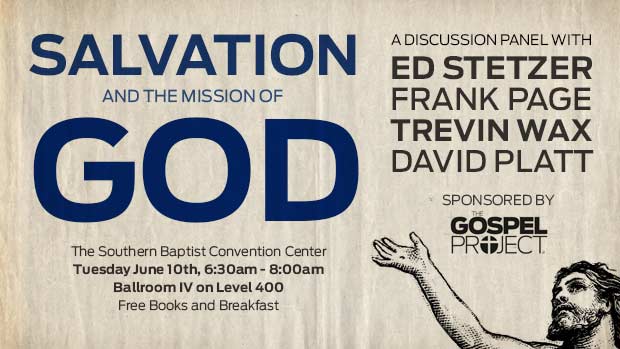

SBC Panel Discussion on “Salvation and the Mission of God”

tgpbreakfast_620x3491

Sign Up Here!

  • Does one’s belief on the extent of the atonement affect their understanding of mission and the offer of the gospel?
  • Can two Christians disagree on soteriology and partner in ministry?
  • Does the order of salvation affect how one does evangelism?
  • When it comes to the theological particulars of salvation, what is the difference between compromise and cooperation?

Join us at The Southern Baptist Convention to hear Ed StetzerFrank PageDavid Platt, and Trevin Wax discuss the topics of salvation and mission. Only 500 seats available, so sign up now!

  • Date: Tuesday, June 10th
  • Time: 6:30am – 8:00am (Be there at 6:15am!)
  • Place: The Baltimore Convention Center
  • Location: Ballroom IV on Level 400
  • Free breakfast and books

Each attendee will receive a bag of free books including:

We look forward to seeing you at The Southern Baptist Convention. Sign up for the breakfast here. 

The ERLC Leadership Summit

leadsummitBANNER

The Ethics & Religious Liberty Commission of the Southern Baptist Convention will host the first annual ERLC Leadership Summit April 21-23 in Nashville, Tenn. The inaugural Summit’s theme is “The Gospel and Human Sexuality.” It will equip pastors, church leaders and lay people to speak to these critical issues in their congregations.

Speakers include ERLC President, Russell D. Moore; J.D. Greear, Pastor of The Summit Church in Raleigh, N.C.; and Trillia Newbell, ERLC’s Consultant for Women’s Initiatives. Keynote addresses, panels and breakout sessions will focus on how the gospel shapes a person’s sexual identity, redeems sexual desire and sets free people held captive by sin.

“So many of the questions that pastors grapple with today deal with situations that would not even have been possible a generation ago,” Moore said.

“As technology advances and the culture changes, the questions that we have to grapple with are often increasingly complex. At the ERLC Leadership Summit, we’ll talk about these questions, and how we can be be faithful in ministry, gospel-focused in engagement and Christ-shaped spiritual warriors in the ways we seek to wrestle with the principalities and powers of this age.”

The main sessions will be live-streamed on erlc.com. Follow the conversation on Twitter by following @ERLC, @ERLCPressRoom and #erlclive. A complete schedule of events and speaker information can be found online.

Evangelism as Captivating with the Gospel

open-bibles

I recently wrote this article for Facts & Trends magazine on The Power of Story: Captivated by the Gospel.

Do you remember the last time you heard a good story? 

It’s easy to become captivated by a compelling narrative or a fascinating myth. Stories are instruments of powerful mnemonic and formative capability.

From movies to novels or warm conversations over dinner, stories can capture our imagination and shape the way we think about the world like nothing else can. We love stories.

And like children sitting on the edge of a bed awaiting their parents to read a beloved bedtime book, we long to be told a good story. But more importantly, we want to be part of a good story.

Stories help us make sense of where we find ourselves, what has gone wrong with things, and what can be done about it. Stories shape and narrate how we view ourselves. These narratives speak to a deep longing in our hearts, opening the doors of possibility to things that could be.

However, most of the narratives that captivate the imaginations of children are nothing more than fanciful myths.

Sadly, the same can be said of the worldviews that narrate the worlds of most adults. The burning question that each of us must ask is, who gets to narrate my world?

The true story of the whole world

As Christians, we understand all people are confronted by a host of master narratives that compete with, and often contradict, the gospel of Jesus Christ. We also believe God has revealed the true story of the whole world. The story of Christ is, as C.S. Lewis put it, “the true myth.”

In many ways, the Bible presents redemptive history as a four-part drama—creation, fall, redemption, restoration. In that drama, Jesus isn’t part of the story; He is the point of the story.

Evangelism is sharing the greatest story ever told, namely, the story of redemption through Jesus Christ.

In order to make sense of our lives, we depend on narratives that provide us a broader framework of meaning.

I believe Alasdair MacIntyre was correct in After Virtue, when he wrote: “I can only answer the question ‘What am I to do?’ if I can answer the prior question ‘Of what story or stories do I find myself a part?’”

This principle is extremely important for evangelism. Not only do we need to understand the true story of the whole world, we also need to understand how to read the story of those we talk with. What narrative shapes their worldview, outlook and self-image?

Reading their story, sharing Christ’s story 

Too often our evangelism efforts are driven by one-sided, canned presentations. How often do we listen to those we are sharing with in order to present the gospel to them with wisdom and care?

What if our efforts in sharing the good news were less about putting people in evangelistic headlocks until they make a decision and more about capturing their imagination with the beautiful gospel?

We believe the story of Jesus’ life and work is directly related to the story of our world, and to the personal stories of everyone we meet.

When we share the gospel with others, do we ever stop to wonder if they are able to perceive how the gospel is good news for them? How does Jesus’ story enter their story?

What people need to know is not only what the gospel is, but also what the gospel does. We need to show them the beauty of the gospel and pray that God would open their eyes to see it.

In his book Unbelievable Gospel, Jonathan Dodson suggests that using gospel metaphors at the prompting of the Holy Spirit is a more effective way to aim at the heart of the listener.

In other words, apply the gospel to their story.

  • To those searching for acceptance in all the wrong places, we can point them to perfect acceptance in the gospel of justification.
  • To those searching for fulfilling relationships, we can point them to profound, personal union with Christ.
  • To those who struggle with tolerance, we can show them the uniqueness of Christ in the gospel of redemption.
  • To those who fear disapproval or demand the applause of others, we can share the gospel of adoption, which offers an enduring approval and produces humble confidence.
  • To anyone longing for a new start, there is the hope of new creation.

Tell His story

This is not changing the message of the gospel, but aiming that message to hit people at their deepest needs.

The gospel story is the only story that will help your family, friends, coworkers and neighbors make sense of the world they find themselves in, what has gone wrong with it, and what has been done about it.

As those who are captivated by God’s story, let us go as storytellers and captivate others with the grace of God found in Jesus Christ.

Sin and death may be part of the story, but we know where the story ends. Paradise may be lost, but in Christ we are headed for peace and satisfaction forever after.

The gospel story is good news. Do you remember the last time you told this great story?

Free Theology Books for Kindle

Old-Books-header

Here is a list of classic theology books for free on Kindle. HT Justin Holcomb.

St. Aquinas

Martin Luther

John Calvin
Jonathan Edwards
D. L. Moody
William Wilberforce
John Bunyan
R. A. Torrey

G. K. Chesterton

David Platt on “Heaven is for Real”

There are many books circulating the market right now that claim to recount visits to heaven – and millions of people are reading them.What should we make of these supposed “post-death experience” stories?

In this video David Platt argues that if we want to know what heaven is really like, we should read the Bible, not fanciful accounts of near death experiences. (HT J.A. Medders)

Justin Taylor notes the MacArthur book that Platt is quoting from: The Glory of Heaven: The Truth about Heaven, Angels, and Eternal Life (2nd edition, Crossway, 2013).

Taylor also references a podcast by John Piper, in which he argues against such books from Isaiah 8:19 (And when they say to you, “Inquire of the mediums and the necromancers who chirp and mutter,” should not a people inquire of their God? Should they inquire of the dead on behalf of the living?)

God’s beef with necromancy [form of magic involving communication with the deceased] is that it belittles the sufficiency of his communication. Why would you inquire of the dead to find out what you want to know instead of inquiring of me? And if they say: Well, I have inquired of you and you didn’t tell me what I want to know. He would say: Well, that is your problem. I have told you what you need to know. You don’t need to know about such and such if I haven’t told you. And, in fact, if you go trying to inquire about such and such that I haven’t told you, you are dishonoring me. So that is the nature of the argument. And, therefore, I think the prohibition of séances and necromancy applies to this kind of thing and people ought to stop writing those books.

The Gospel and Our Adoption in Christ

In February I had the privilege of preaching at my home church, Hickory Grove Baptist Church in Charlotte, NC. My sermon was titled “The Gospel and Our Adoption in Christ”, and was based on Galatians 4:1-7.

You can also download the audio from iTunes here.

T4G Panel on “Group Ministry in the Local Church”

tgp_gminlocalchurch_851x315

Groups are a big part of local church ministry. Whether they come in the form of discipleship groups, accountability groups, Sunday School, or home groups, it’s clear that evangelicals believe groups matter.

For this reason, The Gospel Project is excited about hosting a discussion panel on Group Ministry in the Local Church at Together for the Gospel on Wednesday, April 9th in the zero dollar book store from 2:00-2:40. Our panelists will include:

During the discussion our panelists will explore the theological foundations (why) and practical applications (how) of group ministry. We’ll be tackling issues like:

  • How do you integrate a group philosophy into your church’s overall theological vision for ministry?
  • Should groups be on campus or off campus?
  • How do you raise and train new leaders for groups?
  • Should groups monologue or dialogue?
  • How do you connect the spiritual disciplines into the structure of your groups?
  • How do you multiply groups?
  • Should groups have an outward or inward focus?
  • How do you cast vision for groups from the pulpit?
  • Should groups primarily gather to study the Bible or focus on fellowship?

According to the research behind Transformational Groups, the majority of church attenders don’t believe groups are that important to the church. However, a survey among Protestant pastors, 76% agree (32% strongly) that groups are the primary network to mobilize their church and its work. Why is there such a discrepancy between the church leaders and their members? Join us for the panel discussion as we explore the answers.

Charles Spurgeon’s “The Carrot and The Horse”

Charles Spurgeon once told a story, of a king a farmer and a noblemen:

“Once upon a time there was a king who ruled over everything in a land. One day there was a gardener who grew an enormous carrot. He took it to his king and said, “My lord, this is the greatest carrot I’ve ever grown or ever will grow; therefore, I want to present it to you as a token of my love and respect for you.” The king was touched and discerned the man’s heart, so as he turned to go, the king said, “Wait! You are clearly a good steward of the earth. I want to give a plot of land to you freely as a gift, so you can garden it all.” The gardener was amazed and delighted and went home rejoicing.

But there was a nobleman at the king’s court who overheard all this, and he said, “My! If that is what you get for a carrot, what if you gave the king something better?” The next day the nobleman came before the king, and he was leading a handsome black stallion. He bowed low and said, “My lord, I breed horses, and this is the greatest horse I’ve ever bred or ever will; therefore, I want to present it to you as a token of my love and respect for you.” But the king discerned his heart and said, “Thank you,” and took the horse and simply dismissed him.

The nobleman was perplexed, so the king said, “Let me explain. That gardener was giving me the carrot, but you were giving yourself the horse.”

How often do you and I approach God presenting our good deeds with the heart of the nobleman, rather than giving love filled worship in response to our good King with the heart of the gardener?

The Moral Influence of The Cross

Wax Header

This post first appeared at Trevin Wax‘s blog in his Theology of the Atonement series.

The spring study of The Gospel Project for Adults and Students leads participants through the “Atonement Thread,” which helps people put the Bible together to see how the theme of atonement runs from Genesis to Revelation.

The Moral Influence of the Atonement

Discussions concerning the atoning work of Christ have, for the most part, been relegated to the purpose and extent of Christ’s sacrifice, and rightly so. After all, our evangelical faith holds this doctrine of penal substitution at the center of what we believe about the atoning work of Christ (1 Cor. 15:32 Cor. 5:21Col. 2:14).

Even so, there is another aspect of the atonement of Christ often overshadowed by our wonderfully cross-centered theology. If we are seeking a truly comprehensive and robust survey of that wonderful cross, the moral influence of the cross is a necessary companion to the atonement conversation.

The Cross Moves Us

When I survey the wondrous cross
On which the Prince of Glory died,
My richest gain I count but loss,
…And pour contempt on all my pride.
Love so amazing, so divine,
Demands my soul, my life, my all.

This portion of Isaac Watt’s 1700′s hymn “When I Survey the Wondrous Cross” has regained popularity in recent years and illustrates this doctrine well. The words focus on the emotive effect of the cross on the observer. Before we go any further, it may be prudent to address a few concerns many of you may have already begun to consider.

1. Does the theory of the moral influence of atonement necessarily lead to legalism?

No, and we must be careful not to react legalistically to anything that holds Christ up as an example. As John Stott reminds us, the way to holiness is not by imitation of Christ, but through union with Christ.

How do we express union with Christ? We would all acknowledge that to some degree, worshipping the Lord through a holy lifestyle is a part of that equation, especially if we take seriously Paul’s words in Romans 12:1-2.

2. Isn’t the moral influence theory of the atonement the bastion of mainline liberal theology?  

Well, it is, unless the moral influence of the cross is rooted in the purpose of the atonement. Leon Morris has rightly argued that by itself the moral example of the cross is inadequate, but this does not render it untrue. In every instance where Christ’s death is presented as an example to be followed, one can also find his substitutionary sacrifice as the foundation and motivation for that example close by. We cannot disconnect the two.

The Bible teaches that the sacrifice of Jesus not only provides salvation, but also impels us towards sanctification, inspiring us to reflect God’s love to others (2 Cor. 5:14Rom. 8:35-39).

Did Jesus not tell His disciples that the greatest display of love is found in laying down one’s life for his friends (John 15:13)? The motivating power of His sacrifice is seen on the cross. Jesus’ obedience to God and His petition that God would forgive those who crucified Him moved one of the criminals on the cross beside him to believe (Luke 23:39-43Mark 15:39).

Likewise, Paul argues that the death of Christ not only provides the way of salvation, but also provides the supreme demonstration of love (Rom. 5:8). For this reason, he called the church to imitate Jesus’ love and compassion and adopt an attitude of unselfish concern for others (Eph. 5:1-2Phil. 2:3-8).

Peter also exhorted the church: “For to this you have been called, because Christ also suffered for you, leaving you an example, so that you might follow in his steps (1 Peter 2:21).” Christ serves as the example of love and perseverance for the church when they suffer unjustly.

The Supreme Example

Jesus Christ is the supreme model of Christian discipleship, the ethical exemplar of the Christian life (1 Cor. 11:1Heb. 12:2). The compelling force of Christ’s sacrificial example is one answer to indifference and inaction in our broken world. Once we truly grasp what Christ did on our behalf, we will be compelled to live our lives in a way that reflects his self-sacrifice for all others (2 Cor. 5:14).

The cross of Christ not only atones for sin; it also provides a gripping vision that demands our souls, our lives, and our all.