Free Easter Resources: For Personal Devotion or Lesson Preparation

Here’s one for all you procrastinators. My hope is that this post will serve you, your family, and your church in making much of King Jesus this Easter.

The Gospel Project

The writers of The Gospel Project have provided a lesson on The Resurrection and Exaltation of King Jesus. Below are the PDF versions of this session in both Adult and Student Leader Guide and Personal Study Guide.

Gospel Centered Discipleship

Jonathan Dodson and Brad Watson have written an excellent free e-book titled Raised: Doubting the Resurrection. The authors write: “We wrote this book out of our love for skeptics and respect for the questions they help us ask. We also write as believers who oscillate in real belief in the resurrected Christ. We hope it proves to be an insightful, stirring reflection on the resurrection.” You can download it below.

Desiring God

Desiring God has provided eight biblical devotions to prepare for Easter. 

They have also provided definitions for some words of the season

  1. Holiday: From a combination of two Old English words, halig + daeg—holy day; day set apart for special religious observance.
  2. Lent: From an Old English word related to lengthen. It meant springtime, when the days are lengthening. Now we use it to refer to the days between Ash Wednesday and Easter.
  3. Ash Wednesday: In the Bible, ashes are a sign of mourning, an appropriate symbol as we think of our part in the death of our Lord.
  4. Maundy Thursday: The night when we look back to the Lord’s Last Supper gets its name from the Latin word mandatum—commandment, remembering Jesus’ words to the Apostles during the Last Supper, “A new commandment I give to you, that you love one another: just as I have loved you, you also are to love one another” (John 13:34).
  5. Good Friday: This worst day in history is also good because of the reconciliation that comes through the cross.

Tim Keller

A few years ago Tim Keller wrote an article for Relevant Magazine on the Resurrection. In the article Keller writes:

Jesus had risen, just as He told them He would. After a criminal does his time in jail and fully satisfies the sentence, the law has no more claim on him and he walks out free. Jesus Christ came to pay the penalty for our sins. That was an infinite sentence, but He must have satisfied it fully, because on Easter Sunday He walked out free. The resurrection was God’s way of stamping PAID IN FULL right across history so that nobody could miss it.

Keller also wrote an article titled The Resurrection and Christian Mission, in which he argues:

Christians move out into a violent world as agents of peace, into a broken world as agents of reconciliation, into a needy world as servants of the poor. We do so knowing that it is God’s will to eventually end all war and division, all poverty and injustice. The resurrection of Christ assures us that God will redeem not just souls but bodies, and will bring about a new heavens and new earth. As the risen Christ, he stands not just with us in our present time, but he waits at the end of history to heal and renew everything. That is his promise. Therefore, we will not fear.

We the Priesthood of All Believers!

I doubt many people missed the election of the pope recently. It was a worldwide event. The papacy is one of the most enduring institutions in the world. Most Protestants have some vague idea concerning the function of the pope. Essentially, the pope has supreme spiritual authority over the Roman Catholic Church. He controls doctrine, and his decisions often impact societies and governments all over the world. Diversion from this doctrine and practice is one of the reasons for the Protestant reformation. And while Protestants may not affirm such powerful positions like the papacy by profession, many affirm such positions of power in practice – especially on the level of the local church.

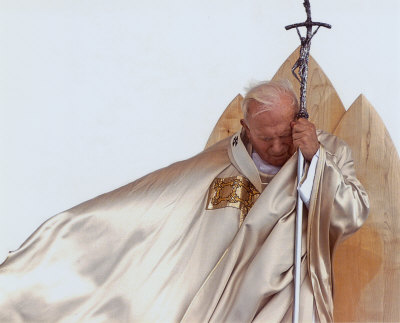
pope-john-paul-ii-1920-2005In the Middle-Ages priesthood was limited to, and regulated by, the clergy. One of the marks of the reformation was Martin Luther’s call for “the priesthood of all believers”. Timothy George has called this doctrine one of Luther’s greatest contributions to the Protestant Church. Luther argued that “all Christians are truly of the spiritual estate, and there is among them no difference except that of office (Open Letter to the Christian Nobility).” Luther was not arguing for leaderless anarchy in local churches (offices imply order), but was stressing the equal access and spiritual importance that each believer has with God through their grace given relationship in Jesus Christ.

The priesthood of all believers has been especially important to Baptist church life since it forms the basis for Congregationalism. I am a Baptist. As a Baptist I am partial to Congregationalism. In God’s Word, the people of God are referred to as “a holy priesthood”, “a royal priesthood”, and “a kingdom of priests” (1 Peter 2:5, 9; Revelation 1:6, 5:10). As a Baptist I believe that all true believers are priests and have equal access to God the Father through our high priest Jesus Christ (Read the book of Hebrews). Moreover, no one person or group should have supreme and unchecked spiritual authority within a local church as if they and they alone can hear from God.

There is not one person in the church, or group of persons in the church, that have a closer connection to God over and above their brothers and sisters in Christ. All believers have priestly access to the heavenly sanctuary and need no other mediator but Jesus Christ. Yet some Protestant churches, while professing to priesthood of all believers, ignore this precious doctrine in practice. And some Protestant leaders even parade their “unique” relationship with God, lording it over others in their church family.

Holding to the priesthood of all believers also implies that all “believer-priest church members are able and responsible to help the church find God’s direction for its life”[1]. While pastors may be set apart to lead through the teaching of the Word, and certain leaders may be set apart to make decisions, the entire congregation should humbly shoulder the responsibility of acting as the final court to recognize, respond, affirm, and even challenge the direction of its leaders if necessary. The church is the body of Christ, and Jesus Christ is the only head. The church should function as a body.

So why do some leaders take it upon themselves to wield supreme (and some times negligent) spiritual authority within local congregations? Why do some leaders over-spiritualize decisions in order to trump everyone else in their congregation? Why do some leaders talk as if they, and they alone, receive and impart special divine revelation to their people? I am not sure. There could be many reasons. I admit, I have implied this “power” before as a pastor, and repent. Implying papal-like authority is the easy way out when it comes to leadership. Its a way to avoid the often messy life of church community.

Most Protestant leaders would never bluntly admit any of these things. But, many leaders within Protestant churches communicate these ideas by implication. The saddest thing is that such papal attitudes within Protestant leadership ranks pronounces lower spiritual status of everyone else in the congregation. How did we arrive at Evangelical Catholicism within local church leadership? May we repent and seek to uphold the priesthood of all believers!


[1] John Hammett, Biblical Foundations for Baptist Churches, 46.

Jesus The Coming King!

I have been reading What Happens After I Die? by Michael Allen Rogers. My review of this book will be published at The Gospel Coalition website in the near future. I will not expound on the many benefits of this book here, but I do want to point you to a particular section that I found encouraging and challenging.

In his chapter titled The Final Heaven Inaugurated, Rogers expounds on the momentous event of Christ’s final return. He writes;

No eye on earth will miss this! All the splendor, honor, and authority presently belonging to Jesus as Lord will be supernaturally visible to the entire world. Christ will not display more glory than he already has, but finally all mankind will see what is true about him as he now is. Every eye will see him and every knee will bow to him…When he appears, the present dimension will be ripped away, and Christ will be manifest to all eyes throughout the earth (See Matt. 24:27).

He continues:

Tragically for many, that recognition of Jesus lordship will come too late. They will recognize him as Lord without adoring him by faith. But for those who greet him with settled faith, this hour means a transformation of everything. God’s great saving work will be concluded in us and all around us. Enemies of Christ will be banished entirely from his presence, and his loving subjects will step forward to be invested as knights and ladies of his eternal court, enfolded into the brightness of his kingly splendor (pg.130).

What a wonderful picture of what is to come for the children of God! What a terrible picture of what is to come for those who reject Christ’s kingship. Oh that we would long for those around us to intimately know and lovingly adore Jesus as their savior, king, and treasure!

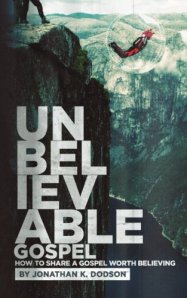
Unbelievable Gospel by Jonathan Dodson

Francis Schaeffer was once asked what he would say if he had an hour to share the gospel with someone. He responded by saying: “I will spend the first fifty-five minutes asking questions and finding out what is troubling their heart and mind, and then in the last five minutes will share something of the truth. (18-19)”

DodsonThis quote is refreshing to those of us who grew up in the age of canned gospel presentations. Many of us have been trained to put others in evangelistic headlocks and wait for them to tap out with a decision to follow Christ. This is why many readers will find Jonathan Dodson’s Unbelievable Gospel refreshing. Dodson does a good job of balancing gospel truth with patient proclamation.

According to Dodson, an “…evangelist isn’t someone who coughs up information about Jesus or proselytizes people…an evangelist is someone who communicates the gospel of Jesus with patience and wisdom. (18)” Like Schaeffer modeled, the work of an evangelist includes listening patiently in order to wisely show others why the gospel is actually worth believing.

“How is the gospel good news to those we evangelize? Evangelicals are proficient at rehearsing the information of the gospel but we often lack the ability to situate the gospel in the lives of others. (9)”

When we share the gospel with others do we wonder if they are able to perceive how the gospel is good news for them? What people need to know is not only what the gospel is, but also what the gospel does. We need to show how Jesus is better! Dodson suggest that using gospel metaphors at the prompting of the Holy Spirit is a more effective way to aim at the heart of the listener. In other words, use the gospel for how we share the gospel. Here are some examples:

  • To those searching for acceptance in all the wrong places, we can point them to perfect acceptance in the gospel of justification.
  • To those searching for fulfilling relationships, we can point them to profound, personal union with Christ.
  • To those who struggle with tolerance, we can show them the uniqueness of Christ in the gospel of redemption.
  • To those who fear disapproval or demand the applause of others, we can share the gospel of adoption, which offers an enduring approval and produces humble confidence.
  • To anyone longing for a new start, there is the hope of new creation.

Moreover, Dodson argues that Gospel theology should drive evangelistic methodology. People do not want to hear a memorized presentation, they want to know how the gospel is good news to them. So the gospel is not only the evangelistic message but also provides an evangelistic method. In other words, the gospel also informs how we share the good news.

  • Instead of preachy self-righteousness, we can point people to Christ’s righteousness, which is based on his performance not ours.
  • Instead of impersonal evangelism, we can share the hope of Jesus from our personal union with Christ.
  • Instead of being intolerant, we can lovingly tolerate the differences between religions while also communicating the unique redeeming work of Christ.
  • Instead of using right answers to gain approval or applause, we can share an enduring approval that comes through faith in the Father who adopts through the Son.
  • Instead of sharing a shallow gospel of information, we can communicate the deep transformative gospel of new creation.

The premise of this book is simple. Dodson observes that people often find the gospel unbelievable and reasons that two groups of Christians contribute to this unbelief.

  • The first group shares a gospel that is preachy, impersonal, intolerant, condescending, or shallow—mediocre news at best. We may mention who Jesus is, even what he has done, without lifting a finger to delve into the doubts and struggles people face.
  • The second group remains silent hoping their actions will remedy evangelistic concerns. The problem, however, is that the “good news” must be heard.

Dodson offers a better way. Using the concept of gospel metaphors, illustrated with real life stories, Dodson suggests that we listen to others in order to share a gospel worth believing. This concise book is a very welcome addition to the category of evangelism. Pick up your copy here.

Jesus in Exodus

The story of Matthew 1-2 finds its roots in the Old Testament stories we heard as children in Sunday School. We all know the story line of the book of Exodus. In the first pages we find that while in Egypt Israel had been “fruitful and multiplied”, echoing God’s call to Adam and Eve. Israel became so many that Pharaoh became fearful and enslaved, even killed the sons, of all these people known as “God’s son” (Exodus 4:22-23).

But God raised up a deliverer by the name of Moses who called for Israel’s release. When Pharaoh refused to release Israel from slavery, God threatened to execute judgment on every first born son in Egypt. Keeping to His covenant love, God instructs the Israelites to spread the blood of a spotless lamb over their doorpost so they will be graciously spared from death. God judged Egypt, and He also delivered Israel out of slavery with His servant Moses leading the way.

It is interesting that here in Matthew we find that Jesus, God’s Son is immediately seen as a threat to Herod. Like Pharaoh, Herod became so fearful that he also executed all the male children in Bethlehem and the surrounding regions trying to kill God’s Son. But God called Joseph to flee and take Jesus into Egypt for safety. And once Herod died, Joseph is instructed to bring Jesus “out of the land of Egypt” echoing Hosea 2:15.

What you see is that Jesus is whispered in the Exodus account. Furthermore, if you are seeking Jesus, every story in the Old Testament points to Him. Jesus, God’s Son, is even more than the true and greater Israel. Jesus is also the spotless lamb whose blood is spread over our hearts to spare us from death (1 Peter 1:18-20). Jesus is the true and greater Moses who delivers us out of slavery to sin. This is the Good News, foreshadowed long ago in the book of Exodus.

Devotions in Hosea

Hosea 1-3

Hosea is a story of marital brokenness and redeeming love. On one level it is a story about a married couple, Hosea and his unfaithful wife, Gomer. Yet the marriage of Hosea and Gomer is much more; it is a parable of God’s relationship with his people.

Often we read these passages in the Old Testament and we are horrified at the despicable morality of people like Gomer. We are even shocked by the continual spiritual adultery of Israel in light of God’s persistent grace. As we are swept into the narrative of the story something begins to swell deep within our souls, a cry for justice. “Shouldn’t Hosea abandon Gomer?” “Shouldn’t Israel be cast from God’s presence?”

But something different happens. Hosea pursues his wife like God allures His people. In 3:1-5 Hosea reflects the relentless love of God by purchasing his estranged and adulterous wife off the slave block and restoring their relationship. What a breath-taking picture of the gospel of Jesus Christ.

According to the Bible all people are sinful, rebellious and adulterers. We don’t deserve God’s mercy. Like Gomer and Israel, it would be just for God to crush us in judgment. But what does God do? God pursues us and makes us “His people” and shows us His mercy.

Continue reading “Devotions in Hosea”

The Beauty and Fragility of Human Life

Orthodox, protestant, evangelical, conservative Christians must value human life, from conception until death. Genesis 1:26-31 informs us that God intimately created humans in His likeness, male and female. We see that humanity is set apart and crowned with authority over the earth and its creatures, a position of honor and responsibility.

Theologian John Hammett rightly argues that creation in the image of God is the basis for human dignity and that killing a human or to even curse one is an affront to and an attack upon the living God. The utterly depraved and unimaginably horrible actions of the gunman in Newtown, Conn., are still relatively close as I write this.

embryoWe know that all human beings are, as Psalm 139 describes, knitted together in their mother’s womb. The God of the universe has His loving eyes on every single one of us and always has even when we were “unformed substance,” to use modern language “an embryo.” But we also understand that we live in an entirely broken world.

Almost every night on the news Americans are brought to the precipice of life and forced to look down at our seemingly hopeless plight because of sin. However, as Christians we run to the cross, where the truly innocent God-man gave his life in our place, for our sin, to make all things new.

And while death is a perpetual reminder of our fragile humanity, we have a greater and eternal hope. That one day Christ will return. And in that day He will wipe away every tear from our eyes, and death shall be no more (Revelation 21).

The Beauty, Truth, and Goodness of The Cross

Evangelical Christians prize truth and goodness. It seems like we write and talk about what is true and good often. We should. But, what ever happened to beauty? For the ancient philosophers and theologians beauty was always considered in relation to truth and goodness. If something was true, it was also good and beautiful. For something to be good, it also had to be beautiful and true.

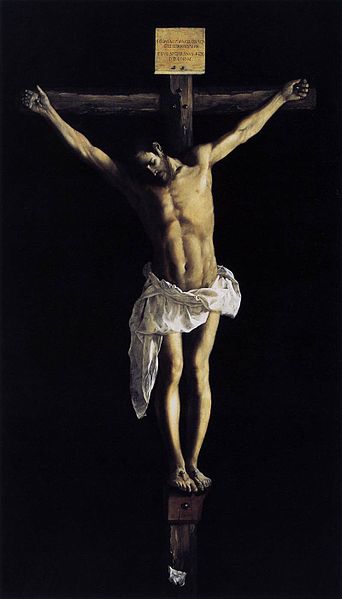
The CrossFor many of our theological forefathers, compartmentalizing these great transcendental realities would deconstruct the majesty of the whole. Yet we rarely talk about beauty anymore. For us, beauty is no longer in concert with truth and goodness. So its always refreshing when I find a theologian who explores all three.

Drawing from the writing of Hans Urs von Balthasar, specifically The Glory of the Lord: A Theological Aesthetic, theologian Dr. Stephen Garrett makes a wonderful observation relating the transcendental realities of beauty, truth, and goodness to the work of Jesus Christ and the cross.

“[Beauty] seen through the One who is beauty, truth, and goodness, reveals an intertwined and interpenetrating triad that should not be compartmentalized.  To separate beauty, truth, and goodness results in distortion and misunderstanding not only of the triad but also of Christ himself. 

  • To see the act of Christ on the cross as merely beautiful is to turn towards sentimentality. 
  • To see the act of Christ on the cross as merely good is to understand Christ as a good moral example incapable of transforming humanity. 
  • To see the act of Christ on the cross as merely true is to reduce Christ to a brute unattractive historical fact that has no relevance for our lives. 

To keep beauty, truth, and goodness together however lifts up Christ’s act of love on the cross in order to draw humanity to himself so that they may live a virtuous life full of meaning.  Beauty understood then in concert with truth and goodness works to glorify and make God known yet when separated from them disparages Christian worship, wisdom, and witness.”

According to Garrett, the reasons for retaining an interconnected relationship between beauty, truth, and goodness are significant. The dangers of separating them are massive.

G.K. Chesterton: The Lunacy of Believing Too Much in Oneself

I revisited G. K. Chesterton’s Orthodoxy the other day while traveling and was reminded of his splendid indictment against the lunacy of believing too much in oneself. This is still a problem in our society today. His prophetic words ring true. He wrote;

chesterton

“Once I remember walking with a prosperous publisher, who made a remark which I had often heard before; it is, indeed, almost a motto of the modern world. Yet I had heard it once too often, and I saw suddenly that there was nothing in it. The publisher said of somebody, “That man will get on; he believes in himself.”…I said to him, “Shall I tell you where the men are who believe most in themselves? For I can tell you. I know of men who believe in themselves more colossally than Napoleon or Caesar. I know where flames the fixed star of certainty and success. I can guide you to the thrones of the Super-men. The men who really believe in themselves are all in lunatic asylums.” He said mildly that there were a good many men after all who believed in themselves and who were not in lunatic asylums.”

Chesterton then quipped, consider the actors who cannot act and still believe in themselves. See, according to Chesterton complete self-confidence is not only a sin; complete self-confidence is also a weakness. It is a blindness. It is hysterical. In response to Chesterton’s comments his walking partner responded;

“Well, if a man is not to believe in himself, in what is he to believe?”

Devotions in Jonah

These devotions were recently published as a series in The Biblical Recorder.

Jonah 1-2

Most likely you know the story of Jonah from Sunday School. The first few chapters describe Jonah’s call from God to go and cry out against the great and evil city of Nineveh. Instead of obeying God’s call, Jonah traveled downward in the opposite direction of Nineveh toward Tarshish and away from the presence of God.

While Jonah was on a ship full of pagan sailors headed for Tarshish, God hurled a great wind at the sea. The storm was so strong that the boat was close to breaking apart. The pagans called out to their gods and begged Jonah to call out to his God with the hope that He would save them from death.

It is revealed that Jonah’s disobedience had brought about this judgment of God in the form of a storm. Finally, the pagan sailors hurled Jonah into the sea and the storm stopped. While this story is already amazing it also points to something even more magnificent, namely, the gospel of Jesus Christ. If we read this story through the lens of Jesus we see that the saving of pagans through the sacrifice of Jonah points to the salvation of all nations through the death of Christ (1 John 2:2). Moreover, Jonah’s rescue from death points to the resurrection of Christ from the dead (Matthew 12:40). In a certain sense, Jesus is like Jonah in that He hurled himself into the storm of God’s wrath so that we could be brought in to safety.

Continue reading “Devotions in Jonah”