C.S. Lewis on “Making a Decision for Salvation”

On May 7th of 1963 C.S. Lewis was interviewed by Sherwood E. Wirt of the Billy Graham Evangelistic Association. I found this particular part of the interview interesting.

Wirt: In your book Surprised by Joy you remark that you were brought into the Faith kicking and struggling and resentful, with eyes darting in every direction looking for an escape. You suggest that you were compelled, as it were, to become a Christian. Do you feel that you made a decision at the time of your conversion?

Lewis: I would not put it that way. What I wrote in Surprised by Joy was that ‘before God closed in on me, I was in fact offered what now appears a moment of wholly free choice.’ But I feel my decision was not so important. I was the object rather than the subject in this affair. I was decided upon. I was glad afterwards at the way it came out, but at the moment what I heard was God saying, ‘Put down your gun and we’ll talk’.

Wirt: That sounds to me as if you came to a very definite point of decision.

Lewis: Well, I would say that the most deeply compelled action is also the freest action. By that I mean, no part of you is outside the action. It is a paradox. I expressed it in Surprised by Joy by saying that I chose, yet it really did not seem possible to do the opposite.

You can read the whole interview here.

“The Glory of God in Jesus” a Book Study in The Epistle to the Hebrews

Starting next week I will begin teaching a book study through the book of Hebrews at Calvary West on Wednesday Nights from 6:30-8:00. We will not only move through the text of Hebrews, but we will also look at principles for reading, understanding, and applying God’s word (hermeneutics).

I have often been moved to worship as I have studied this wonderful letter. This written sermon is one of the most elegant literary works in the New Testament. The author brilliantly weaves a tapestry of “texts and themes” from the Old Testament to show how Christ is the definitive revelation of God. Again and again he shows us how all things point to the supremacy of Jesus!

Here is the schedule for the course:

January 19th: Introduction: God’s Final Word Spoken in Jesus (1:1-4)
January 26th: The Position of Jesus in Relation to Angels (1:5-2:18)
February 2nd: Focus on Jesus, Warning against Unbelief and Promise of Rest (3:1-4:13)
February 9th: Since We Have Jesus, Let Us Hold Fast (4:14-16)
February 16th: Jesus the Great High Priest, Part 1 (5:1-6:20)
February 23rd: Jesus the Great High Priest, Part 2 (7:1-28)
March 2nd: The Superior Offering of Jesus, Part 1 (8:1-13)
March 9th: The Superior Offering of Jesus, Part 2 (9:1-28)
March 16th: The Superior Offering of Jesus, Part 3 (10:1-18)
March 23rd: Since We Have Jesus, Let Us Draw Near (10:19-25)
March 30th: A Call to Preference and Faith, Part 1 (10:26-39)
April 6th: A Call to Preference and Faith, Part 2 (11:1-40)
April 13th: Conclusion: A Call to Preference and Faith, Part 3 (12:1-13:25)

If you plan on coming I encourage you to begin reading through Hebrews. Also, take some time to read through this Introduction to Hebrews that I have provided below:

An Introduction to Hebrews by Matt Capps

If you would like extra material to help with further study I would encourage you to consider purchasing the following Bible Study helps:

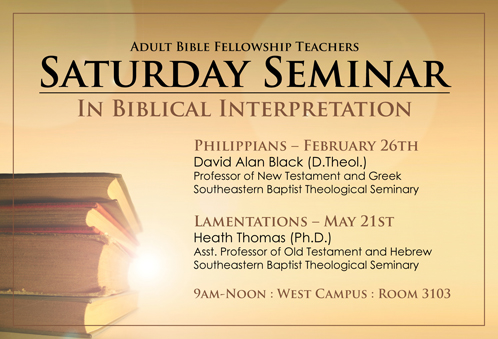
Dr. David Alan Black and Dr. Heath Thomas at Calvary Baptist Church

Sign Up Here

If you are a Bible Fellowship teacher, part of a Bible Fellowship teaching team, or even thinking about teaching, you will not want to miss this training opportunity to learn from two world class seminary professors! I am looking forward to having these two professors come and open God’s word with us.

Dr. David Black is Professor of New Testament and Greek at Southeastern Baptist Theological Seminary in Wake Forest, NC. He holds the D.Theol. in New Testament from the University of Basel (Switzerland) and has done additional studies in Germany and Israel. Dr. Black is considered a leading authority on linguistics and New Testament Interpretation. He has written over 100 articles and authored or edited over 20 books. Dr. Black is well known for his passion in teaching (watch here).

Dr. Heath Thomas is Assistant Professor of Old Testament and Hebrew at Southeastern Baptist Theological Seminary in Wake Forest, NC. He earned a Ph.D. in Old Testament from the University of Gloucestershire in Cheltenham (United Kingdom) and has also done studies at Oxford University. Dr. Heath Thomas has recently published a commentary on The Message and Meaning of the Book of Lamentations.

Coming soon will be an online registration form…


I found this post by Dr. Black on his blog:

I’ve been asked to do a 3-hour teachers’ workshop on Saturday, February 26, at Calvary Baptist Church in Winston-Salem, NC. What fun that will be! My assignment is to walk the teachers through the book of Philippians, which they will be teaching in their classes beginning in March. Exegeting a New Testament epistle is like working on a giant jigsaw puzzle of an ancient walled city in Europe. Just when you think you’ve figured out how to put together the walls, the ramparts, the towers, and the homes you encounter a blue, cloudless sky. The cry, “I got it”, is the final act of triumph. I’ll never forget the day I completed my essay on the discourse structure of Philippians (later published in Novum Testamentum). It was one of those “ah-ha!” moments the likes of which I shall never forget. I suspect that those who believe that “joy” is the theme of this New Testament book will be sorely disappointed with my essay. But as I read the epistle, I was forced to conclude that joy is at best the byproduct of something much more important.

I have said that this invitation is from a local church that is preparing its teachers to teach well and accurately. I cannot think of a better way to integrate seminary and church. Nor can I think of a single faculty member at SEBTS who would not be willing to place his or her expertise in the service of the church in such fashion.

We look forward to having both of you here! You can read an interview that Dr. Black did with Dr. Thomas here.

D. Martyn Lloyd Jones on “Seeking Happiness”

This past Sunday Will Toburen read this wonderful quote from D. Martyn Lloyd Jones in his sermon while commenting on Matthew 5:6. I wanted to share it here:

“There are large numbers of people in the Christian Church who seem to spend the whole of their life seeking something which they can never find, seeking for some kind of happiness and blessedness.  They go around from meeting to meeting, and convention to convention, always hoping they are going to get this wonderful thing, this experience that is going to fill them with joy, and flood them with some ecstasy.  They see that other people have had it, but they themselves do not seem to get it…Now that is not surprising.  We are not meant to hunger and thirst after experiences; we are not meant to hunger and thirst after blessedness.  If we want to be truly happy and blessed we must hunger and thirst after righteousness.  We must not put blessedness or happiness or experience in the first place.”

From Studies in the Sermon on the Mount, page 64.

As believers in Christ let us be thankful that He is our righteousness, and we are credited His perfect righteousness when we repent of our sinfulness and trust in Him as our only hope. With His righteousness comes the blessedness and happiness that humanity longs for.

A Christmas Devotional from Luke 2:1-20

Luke 2:1-20

In those days Caesar Augustus issued a decree that a census should be taken of the entire Roman world. (This was the first census that took place while Quirinius was governor of Syria.) And everyone went to their own town to register.

In those days it would appear that Augustus was the sovereign ruler of the entire known inhabited world. Imagine the power that one like that had – we are told that many under his rule would have viewed him as a divine king. Understandable, He established a Roman Empire that reigned throughout the world.

But here, for Joseph, Mary, and Israel as a whole, the alien intrusion and decree of a census was a reminder that they were a conquered people. Since Augustus had pronounced a census, all people travelled from here and there to fulfill his burdensome desire.

So Joseph also went up from the town of Nazareth in Galilee to Judea, to Bethlehem the town of David, because he belonged to the house and line of [King] David. He went there to register with Mary, who was pledged to be married to him and was expecting a child.

While they were there, the time came for the baby to be born, and she gave birth to her firstborn, a son. She wrapped him in cloths and placed him in a manger, because there was no guest room available for them.

Joseph and Mary arrive in Bethlehem before the delivery of Mary’s baby. While in Bethlehem they had trouble, in fact, they could not find lodging. Perhaps the village was over crowded with travelers for the census. But when the time finally came for Mary to give birth they had to find shelter. So they were directed to an animal stall where they could use a feeding trough to place their child in. Odd, unlikely – Never before has a King had such a lowly beginning, born in a animal stable, placed in a feeding trough, in an obscure village.

And there were shepherds living out in the fields nearby, keeping watch over their flocks at night. An angel of the Lord appeared to them, and the glory of the Lord shone around them, and they were terrified. But the angel said to them, “Do not be afraid. I bring you good news that will cause great joy for all the people. Today in the town of David a Savior has been born to you; he is the Messiah, the Lord. This will be a sign to you: You will find a baby wrapped in cloths and lying in a manger.”

Suddenly a great company of the heavenly host appeared with the angel, praising God and saying,

“Glory to God in the highest heaven,
and on earth peace to those on whom his favor rests.”

When the angels had left them and gone into heaven, the shepherds said to one another, “Let’s go to Bethlehem and see this thing that has happened, which the Lord has told us about.”

So they hurried off and found Mary and Joseph, and the baby, who was lying in the manger. When they had seen him, they spread the word concerning what had been told them about this child, and all who heard it were amazed at what the shepherds said to them. But Mary treasured up all these things and pondered them in her heart. The shepherds returned, glorifying and praising God for all the things they had heard and seen, which were just as they had been told.

In the narrative we move from an event, to a response. The narrative begins with the world ruler announcing a degree from his high and lofty throne. It is interesting how God works – on one level it was a man’s schemes (Augustus) who brought Joseph and Mary to Bethlehem – but it was God working though Augustus, Joseph, and Mary who orchestrated the whole event of Christ’s birth in order to fulfill what had been spoken of in the Prophets.

As we reach the point in the story where we see people responding to the event of Christ’s birth, who does God choose to reveal this great news to? God announces this glorious message to poor shepherds – to peasants, the outcasts of society. Reflecting on the narrative of the Shepherds provides a good opportunity for us to stop and consider what God has done in Christ.

1. In Christ we have been moved from ‘darkness’ into ‘light.’

Just as the Shepherds had moved from the dark coldness of night into the brilliant light of God’s glory (2:8-9), so to do we get to experience the warm and loving presence of God’s Spirit in our hearts by the grace of Jesus Christ our King when we repent of our sin and place our faith in Him.

Think about it, God’s glory was manifest around them. An angel spoke directly to them. They were surrounded by thousands of angels proclaiming that “peace on earth has come to those in whom God is pleased.” This is the meeting place of heaven with earth, of divine with man, here with the outcasts of society.

See, the good news comes to peasants, to outsiders, to the lowly. These are to ones who are lifted up to see the glory of God in his Son Jesus – our Savior, Messiah, and Lord. The wealth of this angelic pronouncement stands in stark contrast to the poverty of the shepherds.

2. In Christ we can move from ‘great fear’ to ‘great joy.’

In the narrative, the Shepherds trade their “great fear” in for “great joy” (2:9-10). The great joy is a response the good news that another ruler has been born, one who is loving and just, one whose dominion and power will be everlasting. And this Kingdom did not come in power through military force, through fearful conquering. Christ’s Kingdom came in power through loving sacrifice.

According to the angelic messengers, this is good news “for all the people”, peace has come on earth in Jesus the Messiah (2:10, 14). Yet, we all understand that this world is broken and confused; we understand that all of us are wrecked sinners. We are all spiritual peasants with nothing worthy to offer a Holy God. So how can this be good news for all people?

As we continue to read the Scriptures we find this King who was born in a stable growing up and offering His own life as a ransom for peasants like you and I. When we repent of our sin and trust in Jesus the King we will be saved. When this happens we have no reason to fear any longer, there is no more condemnation! See, He is a good King who gives us what we do not deserve out of His own good pleasure. His salvation moves us from the darkness of sin into the glorious light of his righteousness! His salvation moves us from being outcast peasants in fear to experiencing the riches of joy in fellowship with God!

This season is not only a reminder of Christ’s birth, but a call to look forward when He will come again. One day our King will return and all things will be made new. We will experience His glory and presence free from the poverty of our sinful natures, free from the brokenness of this world. I don’t know about you but I long for that day. And Christ’s birth announcement is a proclamation that our God reins, that His kingdom has been established. Those of us who have placed our trust in this King can proclaim with the Shepherds, with the Angels, that there is a rich wholeness in His salvation:

“Glory to God in the highest heaven,
and on earth peace to those on whom his favor rests.”

Merry Christmas!
Resources for Reading the Bible

Last week a friend of mine gave me an advanced copy of “Read the Bible for Life” by George H. Guthrie. This book looks like an excellent resource for teaching people how to read, understand, and apply the Bible. It is written in a very conversational way for broad readability. Here is a video introducing the project:

I would also recommend a book titled “40 Questions about Interpreting the Bible” by Robert L. Plummer. I agree with Justin Taylor‘s assessment.

Dr. Plummer has managed to produce something pretty unique here. I’d recommend it for virtually all Christians: laypeople, parents, pastors, and professors. If I were teaching a Sunday School, college, or even seminary class, I’d make this required reading (though obviously the higher the level of class the more supplemental reading would be required).

I can see a lot of folks using this as a one-stop introductory resource on questions of text, canon, translation, inerrancy, Christ-centered interpretation, application, genre, etc. Pastors in particular: this is a very good resource for producing concise, excellent answers for most of the questions people ask about matters of the Bible.

Quite simply, this is the best introductory book on biblical interpretation I’ve yet seen. I highly recommend it.

Take up and read!

Understanding 1st and 2nd Kings

They “have cast their gods into the fire, for they were not gods, but the work of men’s hands, wood and stone. Therefore they were destroyed. So now, O Lord our God, save us, please, from his hand, that all the kingdoms of the earth may know that you, O Lord, are God alone.” – 2 Kings 19:18-19

The Purpose of Kings

“The books of Kings focus on the reliability of God’s word, showing that those who reject that word are judged, while those who rely on it are saved…God shows astonishing mercy by forgiving those who repent and delivering those who call on him, [nevertheless] his judgment falls.”[1] So Kings also serves as a defense of God’s justice to exile Israel and Judah after the covenant breaking.[2]

The Historical Background of Kings

“The books of Kings represent a selective history of Israel from the closing days of King David’s reign until the Babylonian conquest of Jerusalem.”[3]

Why use the word ‘selective history’? Well, a “coherent scheme for the chronology of the books of King’s has remained elusive”[4] for bible scholars, namely because Ancient history was written with a different purpose and structure. (see the section below titled How to Read Kings)

By way of chronology we can at least determine that the books of Kings follow the history of Israel for about 370 years, beginning with the transition of power from King David to his son King Solomon in the united kingdom, the exile of Northern Israel to the Assyria, the exile of the Southern Judah to Babylon, and ending with the release of Jehoiachin from prison during the Babylonian captivity. Simply put, “the Kings history surveys the Israelite ‘golden age’ of the united empire under King Solomon, the split of the monarchy during the reign of Rehoboam, and the ebb and flow of the political and religious fortunes of the divided kingdoms of Israel and Judah until their collapse.”[5]

How To Read Kings

We must see the books of Kings as Israel’s history in theologically driven narrative.

“The books of 1 and 2 Kings provide a theologically laden interpretation of the history of the Israelite monarchy from the death of King David until the end of the monarchy itself.”[6]

In the modern Western world we often think of ‘history’ as a linear progression of natural occurrences following a man oriented timeline. But for the people of the Ancient Near East, history was understood and organized in patterns of supernatural activity. Hill and Walton argue that “Israel’s historical narratives are motivated by theological concerns.[7] The purpose of the historical literature of the Bible is to show the ways in which the Lord has acted in history to fulfill his covenant promises and carry out his agenda.”[8] These narratives reveal that Israel’s God as the one true God who has a plan for history and who intervenes to ensure that the plan is executed. With this in mind, here are some tips for interpreting these books:

  1. Think of the books as theological teaching using history rather than merely linear historical records.
  2. Remember that the main focus of the literature is God and his covenants, not people or events.
  3. The historical ‘cause and effect’ is seen largely in terms of God’s actions rather than the actions of people.
  4. Rather than extracting character studies (“lessons from the life of…”) it would be wiser to look for patterns, themes, and motifs that reoccur throughout these books by way of compare and contrast as the primary point of the text.
  5. Think on how each story recorded in Kings direct us to the greater story of God’s redemptive history ultimately fulfilled in Christ first, thus allowing us to make proper application through Christ as a response to grace.

Central Theological Themes in Kings

Here are some of the major theological themes found throughout the books of Kings:

1. The One True God[9]

Provan argues that the “primary theological theme in Kings is Israel’s God as the true and only God.”[10] The Lord God of Israel is distinct and cannot be confused with the false gods worshiped inside and outside of Israel. False gods are futile and powerless, they are simply human creations. This is demonstrated clearly in God’s victory over false gods and their priests.[11]

2. Worship of God Alone[12]

Since there is only one true God, the God of Israel, he deserves exclusive worship. There are many examples of illegitimate worship throughout the books of Kings. Worship must not confuse God with other gods by way of over idolatry, worshiping images, or reflect any aspect of the cultic and foreign religions. There are implications of false worship that effect every aspect of life, in other words “worship and ethics are two sides of the same coin.”[13]

3. God’s Relation to His Covenant People

God’s covenant promises are at the heart of God’s grace towards his people. “God has entered into covenant with them, and their responsibility is to remain faithful to him and refuse the worship of foreign deities. Thus, God promises retribution- punishment for those who turn away from him and blessing to those who follow him. The two covenants most clearly discernable are those to the Patriarchs[14] and the covenant to David[15], which God upholds despite the disobedience of the people.[16] This is significant for understanding why Jehoiachin lives; God is still at work even though he has severely punished Israel and Judah.

4. Judgment and Grace[17]

God has brought his people into a covenant relationship and revealed to them how to live in relationship to him with the law. “As giver of the law which defines true worship and right thinking and behavior, the Lord also executes judgment upon”[18] the rebellious and destructive. This extends to all of God’s people – kings, prophets, Israelites, and Judeans. Now, there is no ‘neat’ formulaic correlation between sin and judgment, ultimately God is compassionate and extends grace and mercy where he is pleased to do so, withholding final judgment upon his people. God’s grace is found all over the books of Kings.

Jesus Christ – The True and Greater King

“God’s purpose in establishing Israel had been to bring blessing to the world through the people’s covenant faithfulness. [God] instituted the Davidic dynasty to lead the people in their faithfulness. [Yet] the history of Israel is full of tragedies.”[19]

The books of Kings relate to the history of the united and divided history of God’s people in their covenant failure. The narrative primarily focuses on the figures primarily responsible for covenant keeping in Israel – the kings and prophets.[20] See, “the history of the Hebrew nation is told through the lives of the Israelite and Judean Kings as representatives of the nation, because their fortunes as king and the plight of the people are entwined.”[21] In other words, the rebellion of the king brings divine retribution upon the people, while obedience of the king brings about God’s favor. Throughout the Kings to line of David, from which the messiah would come, is threatened. Yet, all is not lost; God will not fail in his purpose.

The closing verses of 2nd Kings seem to leave things hanging in difficult circumstances. The book concludes with Jehoiachin alive and well in exile in Babylon. Thus, both hope and God’s anointed remain and can be found…the promise of the Messiah is not lost.”[22] God’s people are left waiting, looking forward to the ideal King who will rule justly over God’s people. That one true King is Jesus Christ, “who is himself the righteous Son of David (Messiah) for whom Israel has been looking, and the one in whom all God’s promises are focused.”[23] What does this mean for the ‘main themes’ I listed above?

  1. Jesus is the one true God revealing His glory and purposes most fully.
  2. Jesus alone worshipped the Father perfectly and leads his people in true worship.
  3. Jesus lived in perfect harmony with God, in perfect covenant relationship, something we cannot do.
  4. Jesus consumed the just wrath of God against sin on the cross. He rose from the grave defeating sin and death, and graciously offers salvation to all who repent and turn to him.

Continue reading “Understanding 1st and 2nd Kings”

David Alan Black’s “Why Four Gospels?”

When people ask me what professors I enjoyed most at Southeastern Baptist Theological Seminary, David Black is always on the list. I had Dr. Black for Greek while working on my M.Div. Anyone who sits in his class quickly learns that he loves God’s word and loves to teach. (Which is evident in this video.)

Recently, Dr. Black has revised “Why Four Gospels?” , and it is being re-published by Energion. Dr. David Black earned his D.Theol. from the University of Basel, Switzerland. He serves as professor of New Testament and Greek at Southeastern Baptist Theological Seminary in Wake Forest, North Carolina. He is the author or editor of 16 books, including Learn to Read New Testament Greek, Interpreting the New Testament, and Rethinking the Synoptic Problem.

In Why Four Gospels? noted Greek and New Testament scholar David Alan Black, concisely and clearly presents the case for the early development of the gospels, beginning with Matthew, rather than Mark. But this is much more than a discussion of the order in which the gospels were written. Using both internal data from the gospels themselves and an exhaustive and careful examination of the statements of the early church fathers, Dr. Black places each gospel in the context of the early development of Christianity.

I look forward to reading this book. Dr. Black blogs here. One last thing…Dr. Black is a very eccentric person (in a good way). I personally think his beard is Beard Team USA worthy.

The Hypersocialized Generation

This is a fascinating talk by Dr. Albert Mohler, President of Southern Seminary, on “The Hypersocialized Generation.” This issue calls for reflective thought about the patterns of our lives.

You can also stream the video here directly from Dr. Mohler’s web-site.

A Call For Christians To Think!

In his book, The Scandal of the Evangelical Mind, Notre Dame Professor of American religious history, Mark Noll has said that, “the scandal of the evangelical mind is that there is not much of an evangelical mind.”[1]

His argument was simple. Christians need to make an effort to ‘think’ within the Biblical framework across the whole spectrum of learning including: economics, political science, literary criticism, imaginative writing, historical inquiry, philosophical studies, linguistics, the sciences, social theory, and the arts. This call to ‘think’ should be heeded seriously by Christians who are seeking to live as a faithful presence in the world. R.C. Sproul has argued that “we live in what may be the most anti- intellectual period in the history of Western civilization.”[2]

Noll appropriately concludes, “Jesus Christ demands from evangelicals a more responsible intellectual existence.”[3] All other mental disciplines aside, this call for responsible thinking among Christians should be applied to God’s word first and foremost. God has revealed himself in a book. Understanding, interpreting, and applying this book requires rigorous thinking. If we do not labor to think through God’s word we will misinterpret it and lead others astray.

The Bible is clear about the importance of Christian thinking. Proverbs tells us “if you call out for insight and raise your voice for understanding, if you seek it like silver and search for it as for hidden treasures, then you will understand the fear of the Lord and find the knowledge of God.” (Proverbs 2:3-5) Paul carries this thought into the New Testament when he urges Timothy to “think over what I say, for the Lord will give you understanding in everything.” (2 Timothy 2:7) The command is clear – Think!

Living as fallen people we must acknowledge that we experience the effects of sin on our minds. However, even as we acknowledge this hard truth, we must not be discouraged for there is hope in the gospel. The gospel is the power of God for salvation (Romans 1:16), and this salvation includes the renewal of the mind (Romans 12:2). Goldsworthy aptly comments:

“The gospel achieves noetic (see footnote[4]) salvation for us through the perfect mind of Christ our Savior. This is part of his righteous make-up as the perfect human being. His is the human mind in perfect relationship with mind of God. To be justified includes our noetic salvation…our noetic sanctification is the fruit of our justification in Christ. It is the gradual formation within us of what we have in Christ through faith.”[5]

We must acknowledge that as fallen people we have the tendency to swing the ‘pendulum of thinking’ between two extremes: anti-intellectualism and over-intellectualism. In the most general terms, anti-intellectualism tends to pit feeling over thinking while over-intellectualism tends to exalt the life of the mind as an end in itself. But the gospel provides a third way of the mind. We are humble enough to realize that we do not have a perfect mind, and confident enough to know that the renewing of our minds is an ongoing process by which our thinking is being conformed more and more to the truth as it is in Christ.

Just like any other aspect of sanctification, we are called to have an active role in obedience. This is why the Scriptures call us to be sober-minded, to gird up the loins of our thinking, to be ready, to be alert, to be watchful, to have our eyes open. Albert Mohler goes as far to argue that this is our calling as Christians…we are to be a community of the open-eyed, the intellectually alert, the brokenhearted, the resolutely hopeful.”[6] We are called to be a thinking people.

We understand that our hope and salvation does not rest in our intellectual abilities. We must avoid the pride of over-intellectualism. But, the Christians who argue that ‘thinking’ should be left to others. Forgive my ‘lack of tact’, but your anti-intellectualism is unbiblical. John Piper has recently reminded us that “glorifying God with our minds and hearts is not either-or, but both-and. Focusing on the life of the mind will help you know God better, love Him more, and care for the world.”[7]

Yet, if Noll and many others are right[8], evangelical Christians seem to fit the description of anti-intellectuals more than the opposite. When it comes to thinking about, and through, God’s word, if we don’t think clearly we may find ourselves on the verge of slaughtering the gospel, if we haven’t already. Christians, Tolle! Lege.[9]

Continue reading “A Call For Christians To Think!”