In this video, Sally Lloyd-Jones discusses parenting children into the Christian worldview story.
Jones is a New York Times bestselling children’s book writer. Her books include The Jesus Storybook Bible and Thoughts To Make Your Heart Sing.
In this video, Sally Lloyd-Jones discusses parenting children into the Christian worldview story.
Jones is a New York Times bestselling children’s book writer. Her books include The Jesus Storybook Bible and Thoughts To Make Your Heart Sing.
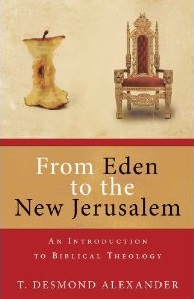 “God created the earth with the specific intention that it should be his dwelling place. To bring his project to completion, God initially bestowed on humanity a holy and royal status. As they filled the earth, human beings were to extend God’s temple kingdom throughout the world. However, the successful completion of this divine project was tragically endangered when Adam and Eve, in an act of wilful arrogance, heeded the serpent rather than the divine Creator. Adam and Eve’s disobedience introduced major obstacles to the fulfillment of God’s plan for the earth. Rather than extending the temple of God throughout the earth through holy service, humanity defiled the world through their unrighteous behavior. Having been delegated authority to rule, they now use this authority inappropriately; unrestrained human dominion brings violence to the earth rather than peace.”
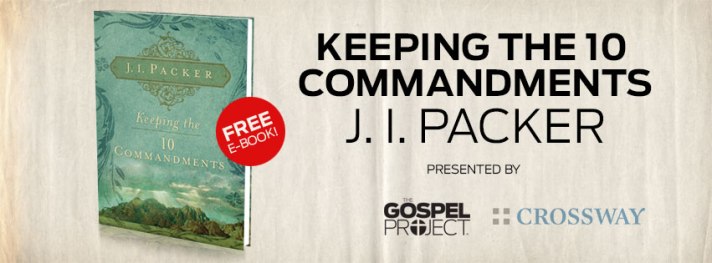
We are excited about the newest release of The Gospel Project! Our adult/student summer study, titled God’s Way, explores the Ten Commandments from a Christ-centered perspective. The writers for God’s Way include Trevin Wax, Mike Cosper, Rey De Armas, and J.D. Greear. These are 13 sessions that you will not want to miss.
In conjunction with the launch of God’s Way, The Gospel Project and Crossway have teamed up to offer J.I Packer’s book Keeping The Ten Commandments free. Here are a few words about the book.
 “They’re often mistakenly considered God’s “rules”- his outdated list of do’s and don’ts that add up to a guilt-ridden, legalistic way of life. But as beloved author and Bible scholar J. I. Packer probes the purpose and true meaning of the Ten Commandments, you’ll discover that these precepts can aptly be called God’s blueprint for life. They contain the wisdom and priorities everyone needs for relational, spiritual, and societal blessing-and it’s all coming from a loving heavenly Father who wants the best for his children.
Not only does Packer deliver these truths in brief, readable segments, but he includes discussion questions and ideas for further study at the end of each chapter. This book will challenge you to view the commandments with new eyes and help you to understand-perhaps for the first time-the health, hope, and heritage you’re offered there.”
The Gospel Project strives to provide solid additional resources that enrich your study as you move through our material. This free Crossway eBook will only be available for a limited time, so download it now and pass the info on to your friends.
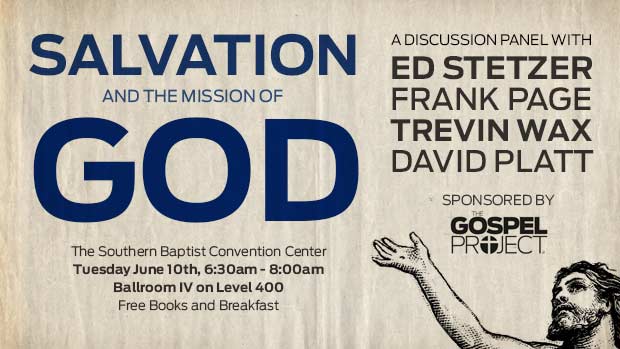
Join us at The Southern Baptist Convention to hear Ed Stetzer, Frank Page, David Platt, and Trevin Wax discuss the topics of salvation and mission. Only 500 seats available, so sign up now!
Each attendee will receive a bag of free books including:
We look forward to seeing you at The Southern Baptist Convention. Sign up for the breakfast here.

Here is a list of classic theology books for free on Kindle. HT Justin Holcomb.
St. Aquinas
Martin Luther
G. K. Chesterton
There are many books circulating the market right now that claim to recount visits to heaven – and millions of people are reading them.What should we make of these supposed “post-death experience” stories?
In this video David Platt argues that if we want to know what heaven is really like, we should read the Bible, not fanciful accounts of near death experiences. (HT J.A. Medders)
Justin Taylor notes the MacArthur book that Platt is quoting from: The Glory of Heaven: The Truth about Heaven, Angels, and Eternal Life (2nd edition, Crossway, 2013).
Taylor also references a podcast by John Piper, in which he argues against such books from Isaiah 8:19 (And when they say to you, “Inquire of the mediums and the necromancers who chirp and mutter,” should not a people inquire of their God? Should they inquire of the dead on behalf of the living?)
God’s beef with necromancy [form of magic involving communication with the deceased] is that it belittles the sufficiency of his communication. Why would you inquire of the dead to find out what you want to know instead of inquiring of me? And if they say: Well, I have inquired of you and you didn’t tell me what I want to know. He would say: Well, that is your problem. I have told you what you need to know. You don’t need to know about such and such if I haven’t told you. And, in fact, if you go trying to inquire about such and such that I haven’t told you, you are dishonoring me. So that is the nature of the argument. And, therefore, I think the prohibition of séances and necromancy applies to this kind of thing and people ought to stop writing those books.

Groups are a big part of local church ministry. Whether they come in the form of discipleship groups, accountability groups, Sunday School, or home groups, it’s clear that evangelicals believe groups matter.
For this reason, The Gospel Project is excited about hosting a discussion panel on Group Ministry in the Local Church at Together for the Gospel on Wednesday, April 9th in the zero dollar book store from 2:00-2:40. Our panelists will include:
During the discussion our panelists will explore the theological foundations (why) and practical applications (how) of group ministry. We’ll be tackling issues like:
According to the research behind Transformational Groups, the majority of church attenders don’t believe groups are that important to the church. However, a survey among Protestant pastors, 76% agree (32% strongly) that groups are the primary network to mobilize their church and its work. Why is there such a discrepancy between the church leaders and their members? Join us for the panel discussion as we explore the answers.
My friend Trillia Newbell has just released a book titled United: Captured by God’s Vision for Diversity. Trillia’s writings on issues of faith, family, and diversity have been published at Desiring God, True Woman, The Resurgence, The Gospel Coalition, and more.
 Trillia is currently the consultant on Women’s Initiatives for the Ethics and Religious Liberty Commission for the Southern Baptist Convention. Newbell is also the Lead Editor of Karis, the women’s channel for the Council on Biblical Manhood and Womanhood.
United is going to be a helpful book for the life of the church. Once you hear Trillia’s heart you will see why…
Is racism still a problem in this country in 2014?
To be honest, it’s easy to feel discouraged about where we’re at today, and—in those moments—I have to remind myself about the progress that has been made, most especially in broader society. We know that civil rights leaders of fifty years ago fought hard, risking life and limb, to overturn the “separate but equal” Jim Crow laws. Those leaders hoped that blacks and whites would enjoy life together and that blacks would no longer be subjected to discrimination and hate crimes. This was the dream for the entire nation. Martin Luther King Jr. famously shared his dream that “one day right there in Alabama little black boys and black girls will be able to join hands with little white boys and white girls as sisters and brothers.” America has clearly come a long way since the 1960s. Our public facilities, parks, pools, and educational facilities—once segregated—are now filled with a variety of ethnic groups enjoying the benefits of their liberties. Yet our churches too often remain separate but equal.
After so much progress in society, why does the church remain relatively unmoved?
 Perhaps we are all tired of the conversation about race. It doesn’t take much to recognize that our country continues to be divided along racial lines. Perhaps it seems that the country is moving toward unity, but it’s a façade—just check your local news. And though our society may want to move on, we can’t, and neither can or should the church. Maybe our churches remain segregated simply because it’s comfortable. There’s nothing malicious to it; we are just more comfortable with “our own.” But also, it might be because diversity and racial issues are scary. Talking about race and racial reconciliation can be downright terrifying. No one wants to offend, and in our politically correct society, who would blame you? If you say the wrong thing, ask the wrong question, or call someone by the wrong name, will they be angry? Are you black or African-American? Chinese or Asian? Hispanic, Latino, or Mexican? This is an explosive topic, and sometimes it seems that the wisest course of action is to avoid it at all costs.
You believe it’s vitally important to fight through the risks and the discomfort in order to fully live out the Gospel of Christ.
Yes. We can so clearly see throughout Scripture that God celebrates the diversity of His creation. He does not distinguish between races: He created man in His own image, sent His Son to save the world, and saves anyone who believes. God calls Christians to be imitators of Christ and to walk in love. If He doesn’t show partiality, neither should we. The problem with the current church model and experience for most of us is that while we affirm these truths with our lips, Sunday morning reveals a different story.
Your father played a big part in shaping your desire to embrace diversity.
Absolutely. I remember sitting on my Dad’s lap as a young girl while he told stories about being beaten for not standing to sing “Dixie” at a sporting event and about the torture and pain that many blacks experienced in the South. He’d end his sobering stories, which never failed to rile me up, by saying, “But, Trillia, we need to love everyone regardless of race or religion.” As a result, I grew up wanting to accept everyone, despite my own rejection at times. It was how my father raised me—to love those who hate you.
How did becoming a Christian shortly after high school change your perspective on identity?
What I discovered as I grew in my Christian faith was that my identity is not solely that I am a black female, nor is it dependent on what others think of me. My identity is in Christ. When I find my identity in Christ and not in outward appearance, there’s satisfaction. I’m satisfied in Him because He loves me. I finally understood that my identity is not my own—my identity isn’t about me. But it’s one thing to know this truth; it’s another to understand it and have opportunities to apply it. I am thankful that I have found those opportunities within my church and throughout my walk with Christ. Understanding that my identity is no longer in my blackness, what I do and don’t do, or how others view me has been incredibly freeing. This knowledge allows me to enjoy my relationship with Christ and my relationships with others. It has also provided me the opportunity to enjoy my identity as a black woman in a better way. Being black is a part of my identity. But it isn’t my entire identity.
What would you say is the clear benefit of diversity?
By building into diverse relationships, we display the reconciliation and redemption of Christ to a world that is broken and divided. True unity is found first through being reconciled to God and then to each
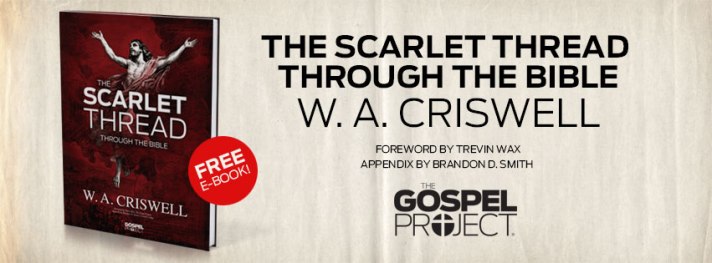
Download the free eBook The Scarlet Thread Though The Bible by W.A. Criswell as a gift from The Gospel Project.
There is a scarlet thread that runs throughout the Bible and it is the binding that holds the pages of the Scripture together. That great scarlet thread is redemption through Jesus Christ. In this book, Criswell traces the scarlet thread of redemption from the blood of covering after the fall in the Garden of Eden to the blood-washed multitude standing before the throne of God in eternity. The content of this eBook was originally delivered as a sermon by W. A. Criswell at First Baptist Church, Dallas, Texas. In his introductory remarks Dr. Criswell said:
 “The sermon is as if a man stood on the top of a great height and looked over the whole creation of God. As Moses stood on the top of Mount Pisgah and saw from afar the Promised Land, so this message tonight. We are standing as it were on a great and lofty eminence. And we are looking over the entire story of human history from its beginning in the eternity of the eternities, in the unknown distant ages of the ageless past, and as it reaches forward to the great incomparable consummation of the ages that are yet to come.”
To download the free eBook of The Scarlet Thread Through The Bible by W.A. Criswell, click here.
Al Mohler recently published a helpful article titled “Some Thoughts on the Reading of Books“. Dr. Mohler establishes good guidelines to energize your reading life.
1. Maintain regular reading projects. Mohler strategically reads in six main categories: Theology, Biblical Studies, Church Life, History, Cultural Studies, and Literature.
2. Work through major sections of Scripture. Mohler constantly reads works in biblical theology as well as exegetical studies as he works through books of the Bible.
3. Read all the titles written by some authors. “Identify some authors whose books demand your attention. Read all they have written and watch their minds at work and their thought in development.”
4. Get some big sets and read them through. “Set a project for yourself to read through the entire set…You will be surprised how far you will get in less time than you think.”
5. Allow yourself some fun reading, and learn how to enjoy reading by reading enjoyable books. Mohler allows some time each day, when possible, for enjoyable/recreational reading.
6. Write in your books; mark them up and make them yours. “Books are to be read and used, not collected and coddled…learn to have a conversation with the book, pen in hand.”
Read the whole thing here.
 Matt Capps