Charles Spurgeon on being Christ-centered

“Don’t you know, young man, that from every town and every village and every hamlet in England, wherever it may be, there is a road to London? So from every text of Scripture there is a road to Christ. And my dear brother, your business is, when you get to a text, to say, now, what is the road to Christ? I have never found a text that had not got a road to Christ in it, and if ever I do find one, I will go over hedge and ditch but I would get at my Master, for the sermon cannot do any good unless there is a savor of Christ in it.”

Lectures to My Students (Grand Rapids: Baker, 1975), 49.

Live Sent in 2014

https://vimeo.com/82925448

Here is the sermon that I preached at our church, The Fellowship at Two Rivers in Nashville TN on Sunday, December 29th.

Duck Dynasty, Freedom of Speech, and a Christian Response

11174One of the stars of Duck Dynasty has been suspended by the A&E Network following his recent comments on homosexuality. In a culture that values freedom of speech and religious liberty, this news is somewhat ironic. I’ll admit, Phil Robertson did not use the greater part of wisdom in how he said what he said. I would have nuanced the words just a little. However, the belief that homosexuality is sinful and that marriage is a covenant institution between and man and a woman is the historical Christian viewpoint. For our culture this is a problem.

As Christians we should not be surprised by this situation. There is no Christian moral majority in America. Moreover, we should not expect those outside the Church to agree with (or even understand) our views on marriage. How then shall we respond? Well, here are a few thoughtful posts that help us do just that.

A God-Centered Worldview (Blog Series)

tgp_blogheader_oct13-Copy

In correlation with the Winter Gospel Project adult and student study The Gospel Project team has lined up a great series of blog posts that will encourage you to dig deeper and reflect on some of the most important topics and issues facing Christians today.

Enjoy!

A Deeper Look at Spiritual Growth

Explore-God-static-banner

I recently wrote an article for Explore God titled “A Deeper Look at What the Bible Says About Spiritual Growth”. Explore God is a website that publishes credible content for people with spiritual questions and curiosities. Here is the conclusion to my article.

Richard Lovelace aptly observed that “self knowledge and self-fulfillment are considered to be the core of human achievement” when it comes to spiritual growth in contemporary religious and mainstream spirituality.41 He added, “The search for these goals has produced a lot of people who are at best self-preoccupied and at worst obnoxiously self-assertive.”42 That is, many routes to spiritual growth generate nervous self-concern or overabundant spiritual pride. But this need not be so. An honest assessment of one’s spiritual state and attempts at spiritual growth will lead to an awareness of one’s limits. While there may be many different spiritual paths today, the Christian gospel offers a uniquely satisfying road to spiritual growth.

Because Christian spiritual growth is focused and dependent on God’s gracethrough Jesus Christ, the gospel allows one to avoid self-occupation and insufferable self-assertion. Christians may avoid nervousness and pride in spiritual growth by returning to the good news of Jesus—namely, that they are secure in their spiritual status before God based on Jesus’ work alone, not their own. The gospel is the true foundation of spiritual growth. Rooted firmly in the gospel, spiritual growth proceeds through the power of the Holy Spirit, directed by prayerful Bible reading within the context of a robust church community.

I encourage you to read the whole thing here.

Pastors, Preach Through The Gospel Project This Winter…?

Why is planning your preaching important?

Sunday comes every week, which is 52 times a year. Preaching pastors know that one of the inevitable realities of ministry is that sermon preparation cannot be postponed. For this reason it is particularly important to plan a preaching schedule. While determining a preaching strategy requires thought and energy, it also allows you to organize and use their time more efficiently in weekly sermon preparation. When the schedule is set one doesn’t have to carry the weight of “what’s next?” from week to week. Taking time to plan extended pulpit work can provide the parameters you needs to prepare and preach more effectively. I tend to agree with Spurgeon who argued that habitually entering “… into the pulpit unprepared is unpardonable presumption (Lectures to My Students).”

I’ve heard some contend that planning a preaching schedule in advance could squelch the Holy Spirit. Their argument assumes that the Holy Spirit will only move “in the moment.” Mark Dever rightly opposes this assumption by writing that “… of course He does that sometimes [moves in the moment], but that’s not the only way He does it. The Holy Spirit also moves and directs months in advance when planning a preaching schedule (Preach: Theology Meets Practice).”

What is your plan for the winter?

M00050082There are many ways to approach series preparation. One is that you work through a book of the Bible and move chapter by chapter through that book, like “A Walk through Exodus.” Another is that you work systematically through a section of a book, like a series on “The Sermon on the Mount.” Or you can develop a series of sermons dealing with a particular topic or aspect of the Christian life and living. Let me first state that I am not a proponent of topical expository preaching, however I do think it has its place in preaching. One doesn’t want the felt needs of the congregation to drive the preaching schedule. John Stott once wrote, “… if we become exclusively preoccupied with answering the questions people are asking, we may overlook the fact that many of them often ask the wrong questions and need to be helped to ask the right ones (Between Two Worlds).”

With that said, it is important to address personal and cultural issues head on once and a while. Sermons ought to come from Scriptural texts, and it is important to answer cultural questions directly from a biblical framework. Honestly, developing a series on particular topics can be the most time consuming method of series planning. However, one approach to developing a topical series is to adapt an outline from a book or some other resource.

A Proposal for Preaching “A God-Centered Worldview”

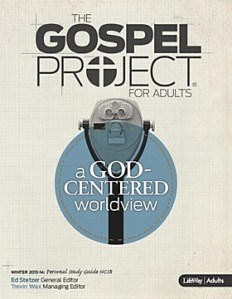
As the brand manager of The Gospel Project I am going to unashamedly encourage you to consider developing a series of sermons to coincide with the adult and student winter study of The Gospel Project: A God-Centered Worldview (Also see Leader Guide).

The first reason I propose this sermon series is that preaching alongside a curriculum sequence not only aligns preaching to small groups, it also allows the preachers to encourage small group participation, and permits for more thoughtful group discussion following the sermon since all of the participants have read about the topic. As for The Gospel Project’s winter study for adults and students, the units are broken up so that one can actually develop three series from the curriculum with four to five sermons in each. Here are some of the topics covered in The Gospel Projectwinter study. I have adapted the lesson titles to be sermon titles as if I were going to preach them myself.

A Biblical Worldview

  1. Does Having a Christian Worldview Matter? (Romans 12:1-2)
  2. What is the Difference Between Man-Centered vs. God-Centered Living? (Exodus 33:19-23, 34:5-9; 2 Corinthians 3:12-18)
  3. How Did We Get the Bible? (2 Timothy 3:16-17)
  4. Can We Trust the Bible? (Matthew 1:1-17; Luke 2:1-3, 3:23-38)
  5. Is Christianity Is Unique Among the Religions? (John 14:1-11)

The Big Questions

  1. Does Life Have Meaning Without God? (Ecclesiastes 3:16-20, 4:1-3; 1 Corinthians 15:12-19)
  2. Is The God of The Bible a Good God? (Deuteronomy 7:1-5; Matthew 15:21-28)
  3. Why Do We Suffer? (Job 1:20-22; 2 Corinthians 1:3-7; James 1:24)
  4. Is Hell Real or Necessary? (Exodus 9:13-17; Luke 16:19-31; Romans 10:11-17)

The Big Debates

  1. What is God’s View of Sex? (Genesis 2:8-9, 15-25; Luke 5:29-32; Romans 1:21-28)
  2. What is God’s View of Marriage? (Matthew 19:1-9; 1 Corinthians 7:1-9; Ephesians 5:22-33)
  3. Is Human Life Sacred? (Genesis 9:5-6; Jeremiah 1:5; Acts 22:1-5)
  4. Should We Care for Others and the World? (Genesis 9:8-17; Matthew 6:19-21, 24; 2 Corinthians 8:1-4)

The Preaching Plan as Evangelism and Discipleship Tool

The second reason I encourage you to consider adopting this preaching plan is that this particular study lends itself well to be used in evangelistic conversations and for directional discipleship. If you commit to this plan it enables you to publish a preaching schedule for your church in advance. A preaching schedule not only allows your people to read in advance, it also allows the Holy Spirit to begin working in their hearts beforehand. Therefore, the people gather with their own questions and insights, allowing for greater listening.

The preaching plan can also be used as a tool allowing your church members the opportunity to begin spiritual conversations on these topics with their family, friends, co-workers, and neighbors. If they have a non-Christian friend who might be interested to hear about a particular topic a natural invitation can be issued. As LifeWay Research has shown us, 67 percent of Americans say a personal invitation from a family member would be very or somewhat effective in getting them to visit a church. Also, 56 percent of Americans say a personal invitation from a friend or neighbor would be very or somewhat effective in getting them to visit a church. With provocative topics such as the ones listed above, I can only imagine that these statistics would be even higher.

Equip Your Church to Thoughtfully Engage the Public Square

The third reason I encourage you to consider adapting The Gospel Project lesson sequence for the winter is to train your church to thoughtfully engage the public square. In the last decade we have seen massive shifts in our culture, and not all Christians are equipped to respond to these changes form a particularly Christian perspective. A Christian worldview, perhaps its more precise to say a theistic worldview, could have been assumed 50 years ago, but that is not the case anymore. What was once culturally accepted is now rejected and even labeled as intolerant.

When asked how he prepared a Sunday sermon Karl Barth once said, “I take the Bible in one hand and the daily newspaper in the other.” Considering the content of today’s news, this quote is more timely than ever before. How would the members of your church engage the big questions and big debates of our time? Our churches need to be full of people who are grounded in the foundational doctrines that shape our identity as Christ followers. As Ed Stetzer argues in his editorial introduction to the winter material, “The big questions and big debates of our day find their answers not in the shifting views of the culture but in the steadfast, unchanging word of God.”

A Message on the Cross of Jesus Christ from Billy Graham

Ministry Grid: Training Made Simple

It’s finally here. Whether you have been waiting with baited breath or this is your first time hearing about it, Ministry Grid has launched. We are excited about this dynamic platform for training the church. We believe it will provide unprecedented opportunity for churches to develop leaders and servants in every area from the parking lot to the pulpit and are pleased to partner with them.

Ministry Grid bases their entire ministry on the vision of Ephesians 4:11-13:

“11 And he gave the apostles, the prophets, the evangelists, the shepherds[a] and teachers, 12 to equip the saints for the work of ministry, for building up the body of Christ, 13 until we all attain to the unity of the faith and of the knowledge of the Son of God, to mature manhood, to the measure of the stature of the fullness of Christ. . .”

Their vision is to see churches built up and equipped to do the work of the Kingdom, and they have provided a unique and unparalleled resource to do this.

 WHAT IS MINISTRY GRID?

Ministry Grid is a customizable platform designed to help churches develop all their leaders, no matter which area they serve in. Ministry Grid makes training leaders simple with content available to leaders anytime, anywhere, while giving pastors unprecedented control and insight into how their people learn. Launching with more than 1,500 training videos for pastors, staff, volunteer leaders, and every-day church goers, Ministry Grid covers, or will cover, every topic a church needs from the parking lot to the pulpit.

HOW DOES MINISTRY GRID WORK?

Ministry Grid’s Learning Management System enables your church to customize training to fit the unique needs and goals of your people. Select built-in tracks, choose from Ministry Grid’s 1,500+ video sessions, or add videos to create your own customized training. With tracking and administrative tools, Ministry Grid allows leaders to assess an individual or group’s skill level, assign training content, and view progress. It is accessible from computers, tablets, and smartphones with a native app that allows offline training, so users can train anywhere, at any time.

WHAT DOES A LEARNING MANAGEMENT SYSTEM DO?

While video training itself is not a new concept, it has historically lacked a way to manage and track a user’s progress. A Learning Management System like Ministry Grid’s allows you to assign content and track the progress of every person using Ministry Grid in your ministry or organization. Ministry Grid’s Learning Management System gives unprecedented insight into how training is taking place, allowing you to easily view a group at a glance or see an individual’s progress, provide accountability, and measure effectiveness. Ministry Grid comes with built-in training tracks and assessment tools that can be customized according to your needs. You can also build your own.

WHO CAN USE MINISTRY GRID?

Ministry Grid is for the entire church, with pricing based on your church’s average weekly attendance. Content is organized into four areas of development—pastoral, church staff, lay leader/volunteer, and personal development—with a wide range of topics videos averaging 15 minutes in length. Ministry Grid works with churches of any size, and because you can upload your own content, there’s no limit to how you can utilize the platform. Ministry Grid is also perfect for organizations and non-profits that are developing Christian leaders on matters relevant to their ministry.

WHAT MAKES THE MINISTRY GRID PLATFORM SO SIGNIFICANT?

Ministry Grid is unprecedented in terms of the quantity, quality, and range of training content available. Every aspect is customizable according to your church’s needs, including the ability to skin the site with your own colors, drop in your logo and church branding, and upload your own content. You may also choose from Ministry Grid’s 1,500+ video sessions or disable access to content not relevant to your assigned users. No other training platform comes close in its ability to perfectly fit your specific needs.

CAN I USE MINISTRY GRID ON MY MOBILE DEVICE?

Yes. Ministry Grid features apps for iOS devices and Kindle Fire. The mobile app allows people to watch training content on the go. You can even download content to your device to watch when offline, and connect your mobile device to a project—perfect for churches that do not have wi-fi access readily available. The Ministry Grid app is a free download, but requires a Ministry Grid subscription to use.

http://www.ministrygrid.com/

The Importance of Biblical Community

Eric Geiger writes:

“Small groups in the life of a local church community are invaluable. This is why the writer of Hebrews admonished the early church to “…encourage each other daily, while it is still called today.” God uses community to supernaturally mature his people over time. He has designed us to grow together as a body. In many ways, Christian sanctification is a group project.

At LifeWay, we partner with pastors, writers, and ministry leaders to develop Bible studies for groups. In recent years, we have introduced or re-introduced ongoing Bible studies that are built around distinct starting points. While all of our studies are rooted in Scripture and focused on Christ, by clarifying unique group starting points we are able to bring greater focus to each line of studies.

For groups that want to start with real life issues and apply the Bible to those issues, we offer Bible Studies for Life. For groups who want to start with the text and walk through books of the Bible, we offer Explore the Bible. For groups that want to begin with theology to understand how the themes of Scripture fit together and point to Jesus, we offer The Gospel Project.

God has used the intentionality and focus to allow us to serve more groups/classes. While we have a great history at LifeWay, our ongoing Bible studies were on a 29-year decline. But in the last 18 months, the decline has turned. The Lord has been so good and gracious to us. We are honored to be serving groups/classes in churches around the world with trustworthy content.

If you are interested in The Gospel Project, we offer ongoing studies released every few months OR you can use the new small group study series. Regardless, The Gospel Project provides you with solid biblical theology along with missionally-driven application for your small group context.”

What Is Our Problem With Hell?

tgp_blogheader_oct13-Copy

I recently wrote this blog post for The Gospel Project in a series on A God-Centered Worldview. You can see the whole series on A God-Centered Worldview here.

Where Did Hell Go?

We all know that one thing is for certain, all men die (Hebrews 9:27). While death is a certain reality, it is not something we regularly talk about with others. As for the topic of eternal destinies after death, those conversations are even more scarce. More specifically, consider the topic of hell. Who wants to talk about, even ponder, the reality of hell as portrayed in the Bible?

Not too long ago, I was traveling and decided to take a few books with me in preparation for writing this blog post. One of these volumes was a full book-length treatment on the topic of hell. I distinctly remember taking notable pause when reaching down into my bag in order to retrieve this book. The dust jacket not only had images of flames but also had the word “hell” in large embossed letters. In that moment I could imagine the thoughts of the other two passengers in the seats beside me if I began reading a book on eternal punishment as we were being hurled five hundred miles an hour through the air. Nothing says let’s have a delightful chat to those around you, or gives an indication as to where the conversation might go, like holding a book covered in images of hell fire.

Now, let me be clear. I believe in the reality of hell. The Bible is very clear on this issue. The point of my anecdote was simply to illustrate the palpable social stigma that is attached to this biblical doctrine in our post-Christian culture. It is a stigma that I am very aware of, as are many other Christians. It’s just not something we talk about. Notably, the reality of hell has been a fixture in Christian theology for over sixteen centuries, but at some point in the 1960’s hell disappeared. And more recently, the traditional view of the nature of hell has been challenged more than ever before.

What Is Hell According to the Bible?

Historically; Christians have held that after death, believers will either dwell with God in paradise, heaven, and eventually the new heavens and new earth or be cast out of God’s presence forever into a place called hell. Hell has been taught as involving eternal conscious torment of persons who have rejected the forgiveness of God through the atoning sacrifice of Christ Jesus. In the book Hell Under Fire;Christopher Morgan summarizes the three predominant pictures of hell we find in the New Testament.

  • Punishment is the chief description of hell in the New Testament (Matt. 25:31-46; 2 Thess. 1:5-10; Rev. 20:10-15). Summarizing these passages; Morgan concludes that the punishment of hell is just, consists of suffering, is conscious, and is eternal.
  • Destruction is also a central descriptor of hell in the Bible; in fact, this descriptor of hell is used by almost all of the New Testament writers (the exception seems to be Mark). In 2 Thessalonians 1:5-10; we find the most developed section of this theme, where Paul explains the eternal destruction of hell. For Paul, hell as destruction is best understood as utter loss, ruin, or waste.
  • Banishment is the last central picture Morgan explores dealing with the difficult doctrine of hell. The picture of hell as banishment is also found in almost every New Testament book, with the exceptions of James and Hebrews. Banishment carries with it the connotation of separation, exclusion, or being left outside. Mark 9:42-48 provides a clear example as believers are welcomed into the kingdom of God and the wicked are banished outside of it.

In summary, punishment and destruction stress the active side of hell, while banishment stresses the horror of hell by highlighting what a person is excluded from. As we’ve already stated, secular thought and modern sentiment certainly make it hard to talk about the reality of hell. Moreover, while many Christians may hold to the historic convictions of the Christian faith, they find it very hard to align their emotional response to the doctrine of hell with the biblical teaching on it.

What Is Our Problem with Hell?

Perhaps some have trouble with the doctrine of hell emotionally because, deep down, we may find ourselves posing defensive questions in response. The question that hides under most questions regarding hell is “Isn’t hell unfair?”

In one sense this question is probably related to the judicial idea that people are innocent until proven guilty. True, if people are truly good and innocent; then God has no right to judge or punish. However, the apostle Paul said that no one is righteous; all are guilty in sin and without excuse before God (Romans 1:10, 3:10-11, 5:12). Russell Moore notes that hell is an affront to a non-Christians sense of justice, “…since no person except through the conviction of the Spirit deems himself worthy of condemnation.”

Another assumption behind this question is that people are neutral, generally good, or even innocent of God’s judgment. I don’t think it is a far stretch to assume that many non-Christians and ill-informed religious people assume that heaven is the common destination of humanity, except for the worst and most cruel humans: murders, pedophiles, genocidal dictators, etc. The broad assumption is that hell is only for other people, namely, people worse than I am. Again, the Bible is clear that all are guilty in sin (Isaiah 64:6). Simply put, no human stands on neutral ground when it comes to eternity.

Sadly, there is little talk about hell because too many people ignore the reality of sin or estimate they have too little sin. To put it bluntly, it would be just for God not to save one person from the depths of hell. This is where the good news of the cross deals with the “problem” of justice. On the cross of Christ, God makes it possible to justify sinners at the cost of His son and remain a just God. On the cross; Jesus took upon Himself what we deserved (death) and paid the penalty for our sin and through His resurrection; freely offers what we do not deserve (forgiveness and eternal life with God).

For this reason we need to be willing to tell the whole gospel story, even if it is uncomfortable. As Tim Keller has said, “there is an ecological balance to Scriptural truth that must not be disturbed.” To preach the good news, we must warn people of the bad. Keller argues that if we play down difficult doctrines; we will find, to our shock, that we have gutted all of our pleasant beliefs too.

Conclusion

For some people the doctrine of hell is extreme, and they are right. Hell is extreme because sin is extreme. However, Jesus Christ endured the hell of the cross so those who believe in Him might escape it. Michael Rogers rightly states that “Hell alarms us as nothing else can about the awful weight and penalty of sin.” The doctrine of hell should weigh heavy on the Christian heart as the Spirit leads us to plead with those who are without Christ. Hell is a horror to the Christian conscience. We shouldn’t deny the reality of hell, nor should we sheepishly avoid it. If anything, the doctrine of hell calls us to bold yet winsome evangelism. If modern sentiment, social tolerance, and relational indifference held the final votes about the doctrine of hell, the Bible’s view of hell surely would find few defenders.