Devotions in Amos

These devotions were recently published as a series in The Biblical Recorder.

Amos 1-3

The book of Amos opens with the prophet delivering a series of oracles proclaiming that no one can escape the consequences of their actions – not Israel (2:6-6:16) or Israel’s neighbors (1:2-2:5). In these first chapters we see a brutally honest portrait of universal justice coming from the omniscient and all-powerful God of the universe. Amos 4 is crystal clear; God is the sovereign King over all creation.

When the prophet unseals God’s indictment against the guilty, one might expect to see judgment visiting the foreign pagan nations. But Amos, as Professor Heath Thomas argues, looks past the whitewash to expose the decay of God’s people underneath. Contrary to all external appearances God’s people were guilty and “ripe” for God’s judgment. Amos proclaims that God’s people cannot do anything right (3:10).

But the good news is that God comes to Israel with both judgment for sin and promises of restoration. Prof. Thomas says God’s judgment is not to irradiate but to reconcile. In a very real sense Israel’s salvation is found through their judgment. As we look back from this side of the cross we read Amos and see very clearly that the judgment and restoration of God’s people anticipates the crucifixion and resurrection of Christ. Jesus fully consumed the judgment of God for our sin so that we could be restored back to God.

The demand for righteousness was fulfilled in Jesus who did everything right! Because of Jesus’ imputed righteousness Christians stand not under God’s wrath, but in the safe shadow of Jesus’ cross. The universal justice of God that we experience in Amos 1-4 is still a haunting reality today, and salvific escape is found only in Jesus Christ (Gal. 3:13–14; Rom. 3:9–31). Unless there is true repentance, no one can escape the judgment of God.

Continue reading “Devotions in Amos”

Biblical Theology as a Bridge Discipline

Biblical Theology Diagram

What is biblical theology? In once sense, all good disciplined theological reflection on the Bible could be called “biblical theology”. However, there is also the discipline of biblical theology. I think Elmer Martens described the discipline of biblical theology well;

Biblical theology attempts to embrace the message of the Bible and to arrive at an intelligible coherence of the whole despite the great diversity of the parts. Or, to put it another way: Biblical theology investigates the themes presented in Scripture and defines their inter-relationships. Biblical theology is an attempt to get to the theological heart of the Bible.

Now, let me explain why I believe that the discipline of  biblical theology is of utmost importance. Most seminary students are required to complete courses in Old Testament, New Testament, and Systematic Theology. Many of these seminarians exit their studies with a good grasp of the two testaments on their own, and a good understanding of systematized theological subjects, but have a hard time putting it all together. To add to that problem, these seminarians graduate into pastoral ministry contexts and begin perpetuating a segmented understanding of the Bible throughout the Church.

Continue reading “Biblical Theology as a Bridge Discipline”

We are moving to Nashville, TN!

il_fullxfull.361604888_440s

After much prayer and wise counsel I accepted a position with LifeWay Church Resources in Nashville, TN. I will be joining the Church Resources Division as the Brand Manager and Strategist for The Gospel Project.

The Gospel Project is a Bible study resource that invites adults, students, and kids of all ages to dive deeply into God’s story of redemption through Jesus Christ. In every lesson, participants are immersed in the gospel and learn how when the gospel works on them, they become a part of the story, the very hands and feet in God’s gospel project.

This is a solid biblical resource for the church. I have linked to a few PDF’s from The Gospel Project website to give you a sense of the material.

There are a few particular elements of The Gospel Project that are unique when compared to other small group or Sunday school resources. First, the material delivers a combination of story, systematic and biblical theology, and missional application. Moreover, the material is always pointing to the gospel of Jesus Christ. Second, each session offers an in-depth study with discussion questions, focusing small groups and Sunday School classes toward a lifestyle of gospel-centered discipleship. Third, The Gospel Project is designed to unify an entire church under a single Christ-centered curriculum. Separate study plans for adults, students, and kids ensure the proper focus and depth for each age group.

Beyond the material, I also look forward to joining The Gospel Project team! LifeWay has assembled a stellar team of churchmen and theologians.

  • The Marketing Department is led by Jon Emery, from whom I have a lot to learn.
  • The Church Resources Division is led by Eric Geiger.
  • The Gospel Project is led by General Editor Ed Stetzer and Managing Editor Trevin Wax.
  • Our new neighbors will be Micah Fries and Jonathan Howe.

Pray for us as we make this transition to Nashville by mid-February. We will miss our church family at Calvary West dearly, but we believe this is a wonderful opportunity to minister to the universal church. Allow me to borrow the words of the Apostle Paul in regards to Calvary:

I thank my God in all my remembrance of you, always in every prayer of mine for you all making my prayer with joy, because of your partnership in the gospel from the first day until now. And I am sure of this, that he who began a good work in you will bring it to completion at the day of Jesus Christ.

“Jesus Christ the Eternal King” – Christ-Centered Reflections on Psalm 2

The Plans of the Nations (v. 1-3)

Imagine that you are standing in a grand ballroom with all of the great and powerful kings, presidents, dictators of the world. After all the pleasantries have been exchanged one leader steps out in front of the pack and takes his place at the podium. And because of his blessing from God this particular leader (and his nation) is in a position to rule and impose their will upon the others. It’s not hard to imagine the other representatives becoming restless and dissatisfied with the leadership and power of this leader among leaders. It also wouldn’t be hard to imagine that some of these leaders would gather together later on at a secluded place and begin to conspire against this leader of ways to gain their autonomous freedom and independence.

This is precisely the opening scene of Psalm 2, an international conspiracy against the authority of God and his anointed king. The conspirators in this case are the non-Israelite leaders and their peoples. Take notice of the sense of irony in the voice of the Psalmist.

Continue reading ““Jesus Christ the Eternal King” – Christ-Centered Reflections on Psalm 2″

Wednesdays at Calvary West

wed-at-west

We start a new semester of courses at Calvary West on Wednesday, January 9th. The Apostle Paul charged the leaders in the Ephesian church to “equip the saints for the work of ministry.” Our calling as leaders is to teach and train this local church for the work of the ministry. Wednesdays at West is not another program – but a theological and missional training ground.

According to the Bible the church is to be a learning-and teaching fellowship in which the passing on of the faith is central.Equipping the saints for the work of the ministry is central to our ministry here at Calvary West. And Wednesdays at West is a set apart time designed to ground and grow you in the gospel and its implications for doctrine, devotion, duty, and delight.

Our goal for Wednesdays at West is to train and equip you for fruitful personal ministry in the context of the church body, in the community, and the world. Every class that we offer is intended for a specific purpose and taught by someone that we have chosen for their expertise, trustworthiness, and passion for that particular area of interest. Here are a list of the intentional courses offered for adults.

THE GOSPEL
Pastor Will Toburen
Room 3207

Do you really understand the power of the gospel? Many people only see the gospel of Jesus Christ as the way one becomes a Christian. But the gospel is not just important for the beginning of the Christian life, it is important for all of the Christian life – you never get beyond the gospel. Join us as we study how the gospel of Jesus Christ relates to spiritual growth and everyday life.

THE STORY
Pastor Matt Capps
Room 3206

Would you like to have a good grasp on how different parts of the Bible fit together? Understanding the storyline of Scripture can be a daunting task. Let’s face it, the Bible consists of sixty-six books, in several genres, authored by forty people, over a 2,000 year period. But in John 5:39 Jesus proclaims that all Scripture is about Him! Join us as we explore stories, themes, and people in the Bible through the lens of Jesus Christ and learn how to navigate your way through God’s word.

CHRISTIAN MISSIONS
Pastor Steve Hardy
Room 3209

Why does the church engage in missions across the street and across the world? Pastor John Piper once said that “Missions exists because worship doesn’t.” And God wants worshipers from every tribe tongue and nation. In this course we will discuss the foundations, history, and strategies of missions. Why is this important? Jesus said “And this gospel of the kingdom will be proclaimed throughout the whole world as a testimony to all nations.” Come and hear what God is doing in the world and how you can join in on his mission.

DOCTRINE
Derrick Stiller and Todd Senter
Room 3208

Not every Christian is called to go to seminary, but there are certain matters of doctrine that every Christian must know. Our theology is important because it has massive implications on how we live in day to day life. We encourage you to join us as we study the great doctrines of the Christian faith with an aim to apply them to our lives. It doesn’t matter if you are a relatively new believer or an old saint, join the discussion to sharpen your faith.

HOW PEOPLE CHANGE
DVD Teacher: Dr. Timothy Lane and Dr. Paul Tripp
Discussion Leaders: Larry and Dr. Libby Wolosiewicz (Ph.D.)
Room 3304

How do Christ’s life, death, and resurrection bring lasting change in your life? Have you ever longed to experience the deep-down change that the gospel of Jesus Christ brings? During How People Change you will be given the tools to understand the basic principles of change according to God’s word.

Click here for a full brochure! 


Why Systematic Theology Texts Do Not Explore the Beauty of God…?

In reading for my thesis over the last year I have noticed that many systematic theology texts do not deal with the beauty of God sufficiently – usually as a sub category of another attribute. In fact, some do not treat it at all. I think Patrick Sherry has given one good reason for this in his book Spirit and Beauty.

“The question becomes even more difficult when it is said not only that God is beautiful but that he is beauty itself, the source of beauty in all other things. Of course similar problems arise with other divine attributes, like wisdom, power, and love. But the ordinary believer gets some handle on these other attributes by trying to discern the relevant divine actions, for instance God’s wise governance of the universe, His power manifested in natural phenomena or holiness, and his love shown in providence and especially, Christians say, in the life of Christ. In the case of beauty, however, it is difficult to find any corresponding actions other than God’s creation of beauty in the world.”[1]

Perhaps he is on to something. Nonetheless, (as he later argues) it seems that Christian scripture teaches that God is the ultimate source of perfection and beauty and that He values and offers himself as a beautiful gift to humanity.

Continue reading “Why Systematic Theology Texts Do Not Explore the Beauty of God…?”

The Ordinary Everyday Lives of the Israelites

“A cursory reading of the narratives of the Bible may leave one with the impression that life in Israel was a matter of miracles and spectacular events occurring six times a week and twice on the Sabbath. Someone has estimated, though I have never tried to verify this, that if we averaged out all the signs, wonders, and miraculous events recorded in the Bible over the period of Israel’s history, we would find evidence for one event about every thirty years…There must have been many Israelites who lived long lives without ever witnessing an event that was out of the ordinary. Meanwhile the life of faith went on.”

Graeme Goldsworthy, Preaching the Whole Bible as Christian Scripture, pg. 197

Dietrich Bonhoeffer: To the Psychologist we are Sick, but to the Christian we are Sinful

I am re-reading David Powlison’s book Seeing with New Eyes for my doctoral cohort on pastoral counseling coming up at the end of January. This book has profoundly impacted how I view pastoral ministry.  Powlison has helped transform how I approach teaching, counseling, and countless other pastoral opportunities. In the first few pages Powlison cites a quote by Dietrich Bonhoeffer that exposes what makes for a deep understanding of human nature.

The most experienced psychologist or observer of human nature knows infinitely less of the human heart than the simplest Christian who lives beneath the Cross of Jesus. The greatest psychological insight, ability, and experience cannot grasp one thing: what sin is. Worldly wisdom knows what distress and weakness and failure are, but it does not know the godlessness of man. And so it also does not know that man is destroyed only by his sin and can be healed only by forgiveness. Only the Christian knows this. In the presence of a psychiatrist I can only be a sick man; in the presence of a Christian brother I can dare to be a sinner. The psychiatrist must first search mt heart and yet he never plumbs its ultimate depth. The Christian brother knows when I come to him: here is a sinner like myself, a godless man who wants to confess and yearn for God’s forgiveness. The psychiatrist views me as if there were no God. The brother views me as I am before the judging and merciful God in the Cross of Jesus Christ.

– From Dietrich Bonhoeffer’s Life Together in the chapter on “Confession and Communion”

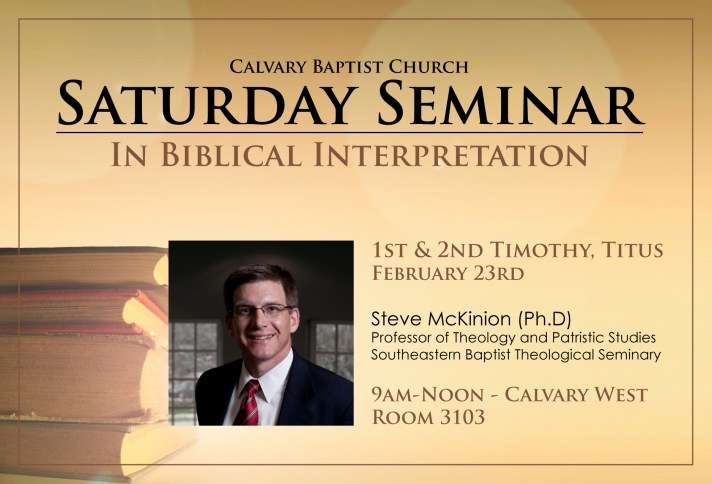
Saturday Seminar on 1st/2nd Timothy and Titus with Dr. Steve McKinion

Dr.McKinion

To sign up for this free training event please click on this link

On February 23rd we will have another Saturday Seminar in Biblical Interpretation on the 1st & 2nd Timothy and Titus with Dr. Steve McKinion fromSoutheastern Baptist Theological Seminary, where he serves as a Associate Professor of Theology and Patristic Studies. Here is a little background information on Dr. McKinion from his personal website.

He finished his BA at Mississippi College, his MA at the University of Mobile, and his PhD at the University of Aberdeen, Scotland, where he studied patristics with Iain Torrance. At age 27, after completing his PhD, he became a professor at Southeastern Baptist Theological Seminary, where he has taught since. He has also been a Visiting Professor at the University of Mobile, The Southern Baptist Theological Seminary, and Trinity Evangelical Divinity School. Steve has also helped lead several church launches, and is currently leading a new church startup in Raleigh called New Covenant Fellowship. Writing has been a big part of his life.  In addition to the articles, dictionary entries, and books he has in print, he is currently completing two major projects: the Isaiah volume in the Reformation Commentary on Scripture with IVP, and Invitation to Historical Theology with Kregel.

Dr. McKinion has already published the books Life and Practice in the Early Church, A Commentary on Isaiah 1-39 in the Ancient Christian Commentary on Scripture Series, and Words, Imagery, and the Mystery of Christ: A Reconstruction of Cyril of Alexandria’s Christology.

See his personal website at – http://www.stevemckinion.com/

To sign up for this free training event please click on this link

A Theological Reflection on Assurance and Perseverance: “How Do You Know That You Know?”

I thought about subtitling this post “how do you know that you know that you know in your heart of hearts that if you died tonight you would go to heaven“. I have actually heard the question of assurance posed that way by evangelists and pastors. Which is a ridiculous way to pose such an important and serious question. Assurance of salvation can be a very personal and emotional struggle for thoughtful followers of Christ. As a pastor, I often receive questions from people concerning their salvation. Questions like:

  • If I am a Christian, why don’t I feel like it sometimes?
  • If I am a Christian, why do I succumb to the same temptation over and over?
  • If I am a Christian, why does God feel so distant?
  • If I am a Christian, why do I wrestle with doubt?

Continue reading “A Theological Reflection on Assurance and Perseverance: “How Do You Know That You Know?””