Why is planning your preaching important?
Sunday comes every week, which is 52 times a year. Preaching pastors know that one of the inevitable realities of ministry is that sermon preparation cannot be postponed. For this reason it is particularly important to plan a preaching schedule. While determining a preaching strategy requires thought and energy, it also allows you to organize and use their time more efficiently in weekly sermon preparation. When the schedule is set one doesn’t have to carry the weight of “what’s next?” from week to week. Taking time to plan extended pulpit work can provide the parameters you needs to prepare and preach more effectively. I tend to agree with Spurgeon who argued that habitually entering “… into the pulpit unprepared is unpardonable presumption (Lectures to My Students).”
I’ve heard some contend that planning a preaching schedule in advance could squelch the Holy Spirit. Their argument assumes that the Holy Spirit will only move “in the moment.” Mark Dever rightly opposes this assumption by writing that “… of course He does that sometimes [moves in the moment], but that’s not the only way He does it. The Holy Spirit also moves and directs months in advance when planning a preaching schedule (Preach: Theology Meets Practice).”
What is your plan for the winter?
 There are many ways to approach series preparation. One is that you work through a book of the Bible and move chapter by chapter through that book, like “A Walk through Exodus.” Another is that you work systematically through a section of a book, like a series on “The Sermon on the Mount.” Or you can develop a series of sermons dealing with a particular topic or aspect of the Christian life and living. Let me first state that I am not a proponent of topical expository preaching, however I do think it has its place in preaching. One doesn’t want the felt needs of the congregation to drive the preaching schedule. John Stott once wrote, “… if we become exclusively preoccupied with answering the questions people are asking, we may overlook the fact that many of them often ask the wrong questions and need to be helped to ask the right ones (Between Two Worlds).”
With that said, it is important to address personal and cultural issues head on once and a while. Sermons ought to come from Scriptural texts, and it is important to answer cultural questions directly from a biblical framework. Honestly, developing a series on particular topics can be the most time consuming method of series planning. However, one approach to developing a topical series is to adapt an outline from a book or some other resource.
A Proposal for Preaching “A God-Centered Worldview”
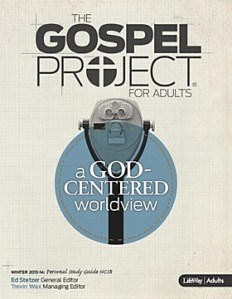
As the brand manager of The Gospel Project I am going to unashamedly encourage you to consider developing a series of sermons to coincide with the adult and student winter study of The Gospel Project: A God-Centered Worldview (Also see Leader Guide).
The first reason I propose this sermon series is that preaching alongside a curriculum sequence not only aligns preaching to small groups, it also allows the preachers to encourage small group participation, and permits for more thoughtful group discussion following the sermon since all of the participants have read about the topic. As for The Gospel Project’s winter study for adults and students, the units are broken up so that one can actually develop three series from the curriculum with four to five sermons in each. Here are some of the topics covered in The Gospel Projectwinter study. I have adapted the lesson titles to be sermon titles as if I were going to preach them myself.
A Biblical Worldview
- Does Having a Christian Worldview Matter? (Romans 12:1-2)
- What is the Difference Between Man-Centered vs. God-Centered Living? (Exodus 33:19-23, 34:5-9; 2 Corinthians 3:12-18)
- How Did We Get the Bible? (2 Timothy 3:16-17)
- Can We Trust the Bible? (Matthew 1:1-17; Luke 2:1-3, 3:23-38)
- Is Christianity Is Unique Among the Religions? (John 14:1-11)
The Big Questions
- Does Life Have Meaning Without God? (Ecclesiastes 3:16-20, 4:1-3; 1 Corinthians 15:12-19)
- Is The God of The Bible a Good God? (Deuteronomy 7:1-5; Matthew 15:21-28)
- Why Do We Suffer? (Job 1:20-22; 2 Corinthians 1:3-7; James 1:24)
- Is Hell Real or Necessary? (Exodus 9:13-17; Luke 16:19-31; Romans 10:11-17)
The Big Debates
- What is God’s View of Sex? (Genesis 2:8-9, 15-25; Luke 5:29-32; Romans 1:21-28)
- What is God’s View of Marriage? (Matthew 19:1-9; 1 Corinthians 7:1-9; Ephesians 5:22-33)
- Is Human Life Sacred? (Genesis 9:5-6; Jeremiah 1:5; Acts 22:1-5)
- Should We Care for Others and the World? (Genesis 9:8-17; Matthew 6:19-21, 24; 2 Corinthians 8:1-4)
The Preaching Plan as Evangelism and Discipleship Tool
The second reason I encourage you to consider adopting this preaching plan is that this particular study lends itself well to be used in evangelistic conversations and for directional discipleship. If you commit to this plan it enables you to publish a preaching schedule for your church in advance. A preaching schedule not only allows your people to read in advance, it also allows the Holy Spirit to begin working in their hearts beforehand. Therefore, the people gather with their own questions and insights, allowing for greater listening.
The preaching plan can also be used as a tool allowing your church members the opportunity to begin spiritual conversations on these topics with their family, friends, co-workers, and neighbors. If they have a non-Christian friend who might be interested to hear about a particular topic a natural invitation can be issued. As LifeWay Research has shown us, 67 percent of Americans say a personal invitation from a family member would be very or somewhat effective in getting them to visit a church. Also, 56 percent of Americans say a personal invitation from a friend or neighbor would be very or somewhat effective in getting them to visit a church. With provocative topics such as the ones listed above, I can only imagine that these statistics would be even higher.
Equip Your Church to Thoughtfully Engage the Public Square
The third reason I encourage you to consider adapting The Gospel Project lesson sequence for the winter is to train your church to thoughtfully engage the public square. In the last decade we have seen massive shifts in our culture, and not all Christians are equipped to respond to these changes form a particularly Christian perspective. A Christian worldview, perhaps its more precise to say a theistic worldview, could have been assumed 50 years ago, but that is not the case anymore. What was once culturally accepted is now rejected and even labeled as intolerant.
When asked how he prepared a Sunday sermon Karl Barth once said, “I take the Bible in one hand and the daily newspaper in the other.” Considering the content of today’s news, this quote is more timely than ever before. How would the members of your church engage the big questions and big debates of our time? Our churches need to be full of people who are grounded in the foundational doctrines that shape our identity as Christ followers. As Ed Stetzer argues in his editorial introduction to the winter material, “The big questions and big debates of our day find their answers not in the shifting views of the culture but in the steadfast, unchanging word of God.”





 Matt Capps