2008 General Election Voter Guide

The Family Policy Council has provided a good tool for thinking through the election.

“On November 4, 2008, North Carolina voters will go to the polls to elect individuals to represent them in federal, state and local government. In order to promote civic responsibility and to help voters better understand where the candidates stand on critically important issues, the North Carolina Family Policy Council is pleased to provide this impartial, nonpartisan 2008 General Election Voter Guide.”

To produce the Voter Guide, the Council sent questionnaires by certified mail to over 480 candidates during this election year. The candidates’ responses to the questionnaires are compiled on this website and may include additional comments and explanations provided by the candidates. In addition to viewing the candidate information on this website, you may also download a copy of the 16-page print version of the 2008 Voter Guide.

CLICK HERE to visit their web page.

The Politics of Jesus

This past weekend First Baptist Church of Durham NC held a conference titled ‘The Politics of Jesus: Timeless Answers to Today’s Questions. Below is the purpose of the seminar;

“This seminar is designed for pastors, church leaders, government and public policy leaders, medical ethicists and physicians, business and entrepreneurial leaders, members of the legal community, university students and members of the social services community to listen and interact with key evangelical leaders from around the nation on matters of culture, government, and politics. Issues which will be directly addressed include marriage, political activity by the church, Islamic theology, and racism.”

Among the participants were Dr. David Nelson and Dr. Nathan Finn from Southeastern Baptist Theological Seminary.

Owen Strachan of the Carl F. H. Henry Center for Theological Understanding at Trinity Evangelical Divinity School live-blogged the event. He has compiled his posts, including Strachan’s manuscript and Nelson’s notes, here. You may also listen to each message via podcast by going to the conference website.

Theology and Life Decisions

There is a inseparability in the pursuit of truth from the task of theology. If all truth is God’s truth, then all things must be informed by theology in one sense or another. Therefore, building a theological grid that will aid in the interpretation of the wisdom of the world is the task of every Christian. Just as Paul exhorts Timothy to be a steward of sound words and a guardian of doctrinal treasure (2 Timothy 1:13-14), so should we. Thus, our starting point is Biblical material and from here we see the need for organization of these materials, thus the exercise of systematic theology. Millard Erickson provides a helpful organizational chart in moving from Bible exegesis to building a theological system systematically (Pg. 70).

1.    Collection of Biblical Materials
2.    Unification of Biblical Materials
3.    Analysis of the Meaning of Biblical Teachings
4.    Examination of Historical Treatments *
5.    Consultation of other Cultural Perspectives.
6.    Identification of the Essence of the Doctrine.
7.    Illumination of Extrabiblical Sources.
8.    Contemporary Expression of the Doctrine.
9.    Development of a Central Interpretive Motif.
10.  Stratification of the Topics.

Moving through this process develops a systematic approach in developing a theology that is accurate to biblical teaching, and develops the theological framework which should inform us in all areas of thought. Theology informs proper practical application. From a proper theology comes a proper philosophy of life, and out of this philosophy comes practical everyday application. Therefore, proper theology forms the grid by which we interpret, and validate all life decisions.

*“The best way to guard a true interpretation of Scripture, the Reformers insisted, was neither to naively embrace the infallibility of tradition, or the infallibility of the individual, but to recognize the communal interpretation of Scripture. The best way to ensure faithfulness to the text is to read it together, not only with the churches of our own time and place, but with the wider ‘communion of saints’ down through the age.” Michael Horton

J.D. Greear on a ‘Motive Check for Ministers”

Today our church staff spent a few hours with J.D. Greear (not to be confused with T.D. Jakes…long story) at a retreat. J.D. is the pastor of The Summit Church in the Raleigh-Durham area of N.C. It was a really encouraging-challenging time for us as a staff, and me personally. J.D. shared God’s story as it pertained to his life and ministry. He also shared about the innovative ways that The Summit has been able to reach their community for the glory of God. But the most lingering thing that I walked away with came from one simple exercise he led us through.

J.D. gave us a list of questions that was intended to be a guide through a ‘motive purification process’. In ministry it is often easy to justify different things by using ‘God talk’. It is easy, as J.D. said, “for people with the idol of success to hide in ministry”. Often we wrongly base our success and failures on the opinions of others, and other standards that are far from our primary purpose as ministers; which is (in my opinion) to show/tell others of God’s mercy and grace in the Gospel of Jesus Christ through the power of the Holy Spirit. Ministry is about nothing else but the glory of God. It is good to check yourself often, so here are the questions,

1. When are you most depressed?

2. What makes you really angry?

3. At what point in your life are you the happiest?

4. What makes you worry the most?

5. What do you look down on others about?

6. What has made you bitter in life?

7. Whose approval do you seek?

8. If you could change one thing about your life right now, what would it be?

9. Where do you turn for comfort?

10. What do you really sacrifice for?

I don’t think I need to apply these for you, they are pretty clear. These questions are very revealing of our sinful motives, yes…even in ministry.

Note: This reminds me of a poem that C.S. Lewis once wrote (Click Here).

A Thought on Media Technology and Human Relationships

While in college, I took a class on ‘Popular Culture’, the class filled one of my sociology requirements. One of our texts for the class was a book titled Media Society. In this book the authors made an obvious but profound observation on the effect of media on social situations; they wrote “One important characteristic of media technology, is that it is usable by almost anyone with access to it; it does not require elaborate technical knowledge on the part of its users. The significance of media technology, as a result, is far reaching.”

The authors continue, “the social significance of media communication is that it differs substantially from unmediated face to face interaction…when we take a sociological look at media technology, we are asking how these technologies shape the ways we interact and communicate with one another.” Let’s think about the significance of media technology for a minute.

Almost everyone can use what they called ‘media technology’ (the internet, television, ipods), but have we given serious thought to the implications of these devices if gone unchecked? We need to become what Neil Postman called ‘great noticers’. If we stop and think about it, a live internet/television feed of an event (that can be hundreds or thousands of miles away) is an astonishing manipulation of time and space. We can “be there” without being there.

You can literally live one block away from the a football stadium, not be watching or listening to the game, and someone who lives across the country can know the outcome of the game before you do. Physical distance becomes irrelevant. Why does this matter? Beyond football games, think about your relationships with friends and family. How many of us keep up with friends or family via facebook or myspace. How many of us opt for a computer camera or instant messenger for having ‘face to face conversations’ because it is more convenient. Sure, for some of us we have too because of physical distance reasons. But others, the cost of gas is no excuse for disregarding the importance of quality personal time with the ones we love.

Back to facebook and myspace, the whole concept of ‘virtual community’ suggests that relationships no longer need to be geographically based. While technology has radically changed the way we understand the ‘meaning of distance’, it should not radically change the way we engage in human relationships.

We often talk of the possibilities that new technologies create, the awesome powers of new machines, but rarely do we consider the social implications of such things. We should not only be asking ‘what can technology do for us, but what should we do with technology?’ Yes, these technologies are easily accessible for most of us, but we need to be ‘great noticers’ of its effects, the results are far reaching.

Prayers for a 2 Year Old Boy with Scoliosis

One of my best friends, Ronny Richard has an ugent prayer request and is asking for support for his two year old cousin Ronald Holder Jr. Here is the story,

“My 2 year old cousin, Ronald Holder Jr. was just diagnosed with a severe case of scoliosis. It is so bad that if he doesn’t have surgery he will die soon. The curvature of his spine is causing one of his rib cages to apply pressure on his lung which will eventually suffocate him.

The surgery cost over 200,000 dollars but The Shriners Hospital is going to take care of the expenses. However, the MRI’s that he need’s will cost $10,000 dollars and we must come up with half of that ($5,000) before they will even proceed. We already have $3,000 of that so all we need is $2,000. Friends, anything you can do can help. Every little bit counts and if you can only give 5 or 10 dollars, it still adds up! Please let this little boy enjoy the full life he deserves. This is a very successful procedure and time is of the essence.”

Here is a link to the web site where you can find information on providing financial support for this family. If you are not in a position to give, pray that God would provide the means. This little boy deserves a chance to live life to the fullest.

http://ronaldholderjr.wordpress.com/

This is a wonderful opportunity to minister to a family and exhibit the light of the Gospel of Jesus Christ.

Discernment for the Disciple

Discernment for the Disciple: Matthew 7:13-20

Jesus’ Call

1. Disciples of Christ need to believe and stand firm in the truth of the Gospel.

2. Disciples of Christ need to develop the discipline of discernment.

The Two Roads: 7:13-14

The Narrow Gate
a. Difficult
b. Few
c. Life

The Wide Gate
a. Broad
b. Many
c. Destruction

The Two Trees: 7:15-20

1. False Prophet/Teacher = those who lead persons astray from right worship, right belief, and ultimately from the Gospel.

2. Discernment is “The skill of understanding and applying God’s Word with the purpose of separating truth from error.”

Disciplines for Discernment

1. Beware of teaching that encourages Inclusivism over Doctrinal purity. (Promotes wrong Belief)

2. Beware of teaching that exalts Gifts above the Giver. (Promotes wrong Worship)

3. Beware of Teaching that exalts Self-Help Over Salvation through Christ. (Promotes wrong ‘gospel’

Morality in Postmodernity

I was thinking about the effects that pluralism have on morality this morning, and I must acknowledge that humanity is in need of universal truth. We live in an age where truth is subjective, where men and women do as they please, where ‘what is true to me, might not be true to you’, therefore there is no standard beyond the mere restraints of the criminal and civil laws which have been established.

But we are heading towards a day where law will become more and more elusive. Maybe to the point of such confusion that justice can no longer maintained.

I think you can read this excerpt from Bruce Little’s essay titled “Vital Cultural Issues and Necessary Virtues” and understand why I am making such a statement.

“It is clear by the discussion that one’s view of morality is bound inextricably to one’s idea of ultimate reality. If one’s philosophical commitments lead him to deny the actuality of the transcendent, then it follows he cannot affirm the existence of universals or absolutes. Moreover, if universals do not exist, then all there is, are the particulars, but in such a case, there is no objective way to assess the meaning of the particulars. Meaning must be derived from only the relationship of one particular to another. The end is, as Weaver suggests, that man is the measure of all things and, in the case of morality, all that is left is relativism. In this relativistic context, everybody’s moral views must have equal weight.”

How then can we know right from wrong, truth from error?

Mission Winston-Salem

Today marks the first day of Mission Winston-Salem. I am excited to see how God is going to use his people as we take the whole week to focus in on the needs of our city. While we have ministries year-round in our area, this week is specifically focused on a variety of projects and ministry opportunities. 

Mission Winston-Salem is a movement among local Believers to impact our city for the cause of Christ. Knowing that we are not in Winston-Salem by accident, it is our desire to represent Christ well. We want to be aware of the realities of our city and actively engaged in bringing hope to our community through Jesus Christ. We, as the local Church, desire to see God’s Kingdom displayed in Winston-Salem.

Click Here for more details. If you live in Winston-Salem come join us, if not join us in prayer!

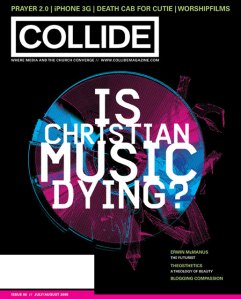
An Article in COLLIDE MAGAZINE!

I recently submitted an article to COLLIDE MAGAZINE, and it is going to appear in the July/August issue. This issue should hit mailboxes on or around July 15. Below is a snapshot of the cover, so be on the lookout for it! I am very excited about this article! I have always loved to write, I see this as just another ministry opportunity.

The article is titled “Theosthetics: A Theology of Beauty” (It’s on the bottom right hand corner).