Part 1: Interview with Dr. John Hammett on ‘The Importance Membership in a Local Church’

This is question one in a five part interview series with Dr. John Hammett on the Importance of Church Membership. Dr. Hammett (Ph.D., The Southern Baptist Theological Seminary) currently serves as Professor of Systematic Theology and the Associate Dean of Theological Studies at Southeastern Baptist Theological Seminary in Wake Forest, NC.

Previous posts in this series: Introduction

Dr. Hammett, Is local church membership really that important, is it even biblical?

I think it is, and understand that some may see church membership somewhat negatively, as a worthless formality that reeks of institutionalism. One might think, “what matters is your heart relationship with Jesus. Love him, serve him, follow him, and don’t worry about formalities.” I would say you’re separating what God has joined together.

1. The call to come to Christ is also a call to be joined to his people.

Look at I Peter 2:4-5:

As you come to him, the living Stone—rejected by men but chosen by God and precious to him—you also, like living stones, are being built into a spiritual house to be a holy priesthood, offering spiritual sacrifices acceptable to God through Jesus Christ.

Look at the order there. As you come to Christ he sticks you to other believers. God doesn’t call his people to be Lone Rangers, or even to casual association with other believers. You are to be like stones that are built together into a house. That means connection, mortar, being stuck together. Think of the people in your church family —these are the people you’re stuck to and stuck with. Now I can understand some hesitancy about that. There’s a saying that I think must have been written by a longtime church member:

“To live above with saints we love, O that will be glory! To live below with saints we know; well, that’s another story!”

It can be tough, but that’s part of the call. All those called to Jesus are called to join themselves to his people. You may say, okay, I’ll come, I’ll be involved with the body. But I’m just not a joiner. Surely, the New Testament churches didn’t have membership rolls and such. Do we have to get all formal and jump through hoops and sign on the dotted line?

2. The call to follow Christ is also a call to openly identify with a local church.

I’m not sure if they had a written list of members, but they did know who was part of their local body. In I Corinthians 5, Paul is instructing the church there about how they should handle the sad case of a man who was living in immorality. He told them they had to hold this man accountable. He specifically says that it is different than someone living that way who was outside the body.

I have written you in my letter not to associate with sexually immoral people—not at all meaning the people of this world who are immoral, or the greedy and swindlers, or idolaters. In that case you would have to leave this world. But now I am writing you that you must not associate with anyone who calls himself a brother but is sexually immoral or greedy, an idolater or a slanderer, a drunkard or a swindler. With such a man do not even eat. (9-11)

They knew who their members were. They had to, because they were accountable; that’s one of the blessings of membership. They had some expectations for members in terms of living a life that would not bring reproach upon the cause of Christ and maybe one reason why some people hesitate to join is they don’t want to be identified and responsible and accountable. They’d rather be a free agent. But that’s not your calling as a follower of Christ; Christ calls you to membership in his body.

As to the importance of actually going through an open, public process, let me offer a comparison. If you are a father you may have a daughter who is falling in love with a young man. You approve of him, you see God’s hand in their relationship, and rejoice in it. But would you say, “Honey, what matters is that you and your young man love each other and are committed to each other, and see God’s leading you together. You can just privately make that commitment to love and stick with each other, and we can just skip this wedding thing. I mean the wedding dress and the reception and all that stuff costs a bundle and is not really necessary. It’s just a formality.” Do you think you could get away with that? No, the wedding is the public declaration and open commitment of two people. In the same way, all those who love Jesus should declare it openly by publicly and formally committing themselves to a local expression of Christ’s body.

Furthermore, I believe that commitment to a body of believers is a command, you can’t be fully faithful to Christ and not be a church member. Further, I don’t know how someone could live out the one-another commands of the NT (over 30) or use their spiritual gifts for the common good (I Corinthians 12:7), or grow to maturity (Ephesians 4:16) without the body.

The next question, what are the requirements one must meet for local church membership?

Introduction: Interview with Dr. John Hammett on ‘The Importance Membership in a Local Church’

Over the next week I will be posting a five part interview with Dr. John S. Hammett on the importance of local church membership. I am excited about this interview series not only because the topic is extremely important to the Church, but also because God has used Dr. Hammett notably in my own theological formation.

While working on my master’s degree I had the privilege of sitting under Professor Hammett for several lecture courses and worked with him in one independent study course. His love for the local church was contagious and propelled me to see the importance of ecclesiology in a very deep way. John Hammett is a seasoned, humble, and respectable scholar who loves Christ’s church dearly.

Dr. Hammett earned degrees at Duke University (B.A), Trinity Evangelical Divinity School (M.Div.), Southeastern Baptist Theological Seminary (D. Min.), and The Southern Baptist Theological Seminary (Ph.D.). Dr. Hammett is currently serving as Professor of Systematic Theology and the Associate Dean of Theological Studies at Southeastern Baptist Theological Seminary in Wake Forest, NC.

Hammett’s book Biblical Foundations for Baptist Churches has been instrumental in the formation of my own ecclesiology, and naturally I highly recommend it. Hammett also wrote an excellent chapter on “The Doctrine of Humanity” in A Theology for the Church. Dr. Hammett has contributed too many other books, magazines, scholarly journals, and online resources on Theology, Ecclesiology, and Missiology. (Here are a few from 9Marks Ministries) Simply put, he has given much thought to the importance of the local church.

The interview series will be organized under five questions:

  1. Is local church membership really that important, is it even biblical?
  2. In your opinion, what are the requirements one must meet for local church membership?
  3. What are the privileges of being a member of a local church?
  4. What are the responsibilities of being a member of a local church?
  5. What, if any, are valid reasons for parting ways with a local church?

Here are some introductory thoughts from Hammett:

“Church membership is something that can be misunderstood. It’s not the same thing as the gospel, and certainly doesn’t guarantee someone’s place in heaven. But consider this – On a typical Sunday morning, of the more than 16 million members of Southern Baptist churches across the country, more than 10 million will not be present in a local church, that’s less than 40%. Where are they? Some are sick or on vacation, but many simply choose not to come, and have made that choice consistently for years. Somewhere along the line they joined a church, but their life shows no evidence that they know Christ. My fear is that they think somehow their church membership guarantees them access into heaven, but being a church member doesn’t necessarily mean you’re a genuine follower of Jesus. It should, but in many churches it doesn’t.

Not only can church membership be misunderstood, it can also become meaningless. Churches where more than 60% of the members never even come and whose lives shows no sign of Christ’s presence make membership a meaningless mockery and expose such churches to the charge that they are full of hypocrites. All you can say is, “you’re right.” Church membership doesn’t guarantee that someone will live a Christ-honoring life. So some churches have deemphasized church membership. It doesn’t save you, and doesn’t make someone a better person, so what’s the value? While I want to keep the main thing the main thing, there can also be secondary things that have significant value. I think church membership is one of those secondary things.”

I look forward to posting Dr. Hammett’s thoughts on the importance of church membership over the next few weeks.

Idolatry in “Christian Worship”?

Worship leader and author Bob Kauflin shares some good thoughts on the prevalent, yet pervasive, idols Christians sometimes bow to – even as we gather for musical worship on Sunday mornings. Have you ever thought about the potential idols that fight for our adoration even in Christian worship settings? Remember that “idolatry is attributing ultimate value, authority, or supremacy to any object other than God.” Give some thought to this eight part series:

  1. Introduction: Idolatry on Sunday Mornings
  2. The Idols of Music, Tradition, and Creativity in Worship
  3. The Idol of Experience in Worship
  4. The Idols of Biblical Knowledge and Ignorance in Worship
  5. The Idol of Musical Excellence in Worship
  6. The Idol of Results in Worship
  7. The Idol of Reputation in Worship
  8. The Idol of Relevance in Worship

Bob serves as the Director of Worship Development for Sovereign Grace Ministries.

Faith and Repentance: Our Response to the Gospel

Introduction

When it comes to evangelism the aim of understanding the context (creation, rebellion, redemption, restoration) and content (1 Corinthians 15:1-5, etc.) of the Gospel is so that we can explain it to someone clearly, that they may see their need for Christ and be “drawn to the well.” People come to Christ when the Holy Spirit opens their eyes to see their need for Him. But once they see their need for Christ, they must do something, the must respond. Consider this observation about the nature of Jesus ministry[1] among the people who followed him.

In the first part of Jesus’ ministry he is training people so that they would know exactly who he is. Jesus does this through his teaching and miracles, his actions, and his ministry. During this time Jesus is showing them who he is. Now, in the narrative there is a sharp transition point for the people whom are following Him. Notice that there is an ‘outer circle’ of followers, seekers, who are learning from and about Jesus. But at some point, Jesus calls for a response, he calls for belief. It is here that Jesus asks them the ultimate question, “who do you say that I am?” When someone professes faith, they are brought into the ‘inner circle’ of Jesus’ followers, the Church![2]

See, in explaining the context and content of the Gospel to someone – you are explaining to them who Jesus actually is. These biblical truths, these realities, these contexts for understanding our world should draw people to Jesus, the living water. At this point a response is required. Once that person is confronted with the person of Jesus Christ and his loving grace, if God wills, they will cry out ‘what are we to do to have this salvation?’

According to the Bible, our response to the gospel involves turning to Christ, which entails turning away from sin. If we repent of our sin and place out faith in Christ, we will be saved! So faith and repentance is the proper response to the gospel. Listen to Jesus’ first words as recorded in Mark’s Gospel:

“The time is fulfilled, and the kingdom of God is at hand; repent and believe in the gospel.”[3]

Understand that at the beginning of Jesus’ ministry he proclaimed that the time of fulfillment had come. As you know, prior to Jesus, John the Baptist had been preaching to Israel that her Messiah was coming and that Israel was to repent of her failure to keep God’s covenant.

At the beginning of Jesus’ ministry, the “good news” was simply that the kingdom was at hand. It was still unclear as to how exactly it would be established. However, the good news that the kingdom was beginning in Jesus’ own ministry was a promise that the kingdom would be established. And it was. Jesus established His kingdom through His death for sin and His resurrection. As proclaimed in the Gospel – the proper response to the coming of the kingdom was repentance and faith in this good news. This response exemplifies God’s people: faith and repentance as we trust him and his word.[4] But how are faith and repentance related?

Faith and Repentance are “Two Sides of One Coin”

“Protestants have long affirmed that it is only by faith in the Gospel that we are saved. The Protestant cry ‘Sola Fide’ (faith alone) summarizes our understanding of what the Bible teaches about how the benefits of the Gospel come to us personally. It stands in opposition to any doctrine, but particularly the Roman Catholic doctrine, that salvation comes through faith in the Gospel and our works of obedience. While Roman Catholics believe that faith plus works result in justification before God, we Protestants believe that faith results in justification and works.”[5]

With that said, it is easy to misunderstand the passages discussed above which all call for faith and repentance. As we will see below, faith and repentance are distinct, but they are inseparable. A person cannot trust in Jesus apart from turning from their sin. There are two sides to the coin of conversion, two distinct yet inseparable aspects: faith and repentance. As the reformer John Calvin put it, “from the tree of faith comes the fruit of repentance, the two are interdependent responses, each incomplete without the other.”[6] John Murray agrees, “it is impossible to disentangle faith from repentance. Saving faith is permeated with repentance and repentance is permeated with faith.”[7]

Faith

Faith is a word that has often been misused, even in Christian literature. For instance, if you were to ask someone on the street what they thought ‘faith’ was you might receive an answer similar to the one Greg Gilbert posits: “…while you might get some respectful sounding words, the heart of the matter will most likely be that faith is belief in the ridiculous against all evidence.”[8] A false understanding of faith “believes that faith is holding to some ridiculous idea against all evidence.”[9] Many Christians have subtly made this mistake and misunderstand the biblical idea faith altogether. This misunderstanding leads to two serious errors.

  1. First, they wrongly believe that trusting in Christ is some sort of irrational commitment against reason, historical evidence, and even common sense. Many Christian’s find false safety in this understanding of ‘faith’ because they feel justified in not deal with any objections to Christianity. But this undermines the very historical nature of the Gospel.
  2. Second, what many Christians don’t realize it that thinking of faith as “believing against all the evidence” places the focus on themselves rather than the object of their faith. Therefore one begins to focus on the degree of confidence and commitment they have to the faith rather than focusing on the object of that faith, namely, Christ himself. “This is what leads so many Christians to constantly struggle with doubting their salvation. When we constantly examine the strength of ‘our faith’ we will only end up despairing as we see how small our trust really is.”[10]

These two mistakes are incompatible with true gospel faith. Undermining these two mistakes are the same premises that all other religions are built on. When one examines all other religions, and the teachings of their founders, it becomes apparent that they teach a way to salvation. This is the major distinction between ‘religion’ and the gospel of Jesus Christ.[11] Religion is “salvation through human effort” while the Gospel is salvation through grace. When compared to religion, Jesus is the only one who actually claimed to be “the way of salvation himself.”[12] This is what the Apostle Paul is referring to when he proclaims that we are justified by faith.[13]

Other religions set up some type of law or ‘way’ that must be upheld as the means of salvation. The Christian realizes that they cannot fulfill the perfect law of God, and must understand that Christ did. Christ did what we could not do, and graciously offers us pardon. Faith is the means by which we receive salvation. Think about it, salvation by grace removes all boasting in ourselves. Allow me to re-word what British Theologian Richard Hooker penned in 1593:

“God saves the believing man, not for the worthiness of his faith, but because of the worthiness of Christ, who he believes in.”[14]

The Christian life is meant to be a life of constant examination of God’s goodness revealed in the Gospel of Jesus Christ. This good news compels us to trust God more and more because we see the sufficiency of Christ in comparison to our own sinfulness. So, foundational to saving faith is knowledge of the gospel of Jesus Christ. It also includes acknowledgement of the truths contained in the gospel.

But faith remains incomplete without trust; we need to entrust ourselves to Jesus.[15] Having faith in Christ, which seals our union with him through the Holy Spirit, is the means by which God accounts Christ’s righteousness as our own,[16] this is “salvation through faith in Christ.”[17] To demonstrate this truth the writers of Scripture often use two things to explain what faith is by way of contrast.

  1. Faith is consistently contrasted with works. The Scriptures say that “for by grace you have been saved through faith. And this is not your own doing; it is the gift of God, not a result of works, so that no one may boast.”[18] We also read that “we hold that one is justified by faith apart from works of the law.”[19] Notice that Paul contrasts faith and works in both of these passages. We are saved by faith because of God’s grace and not our works. We are saved, not as a result of our works, but through faith in Jesus Christ. In fact, we are justified apart from works of the law.
  2. Faith is consistently contrasted with sight. Again, we read in the Bible that “we walk by faith, not by sight.”[20] We also know that “faith is the assurance of things hoped for, the conviction of things not seen.”[21] Paul explains that the Christian life is a walk of faith not sight. He does not mean, as we discussed above, that being a Christian means believing without evidence that God is real and Christ really did die and rise from the dead. He means that we trust God to do what he has promised to do. Throughout history, trust in the promises of God has always been how people have been saved.

Faith is total reliance on/in Jesus Christ – a real person. Faith as reliance should be understood as “a rock-solid, truth-grounded-promise-founded trust in the risen Jesus to save you from your sin.”[22] Notice who the faith is in, Jesus and not oneself.

Repentance

But remember, there are two sides to the coin of ‘gospel response’ – the two distinct yet inseparable aspects of faith and repentance. Throughout the Bible God calls people to turn/return to him in order to be saved from their own destruction and his own wrath.[23] In the pages of the New Testament we see Christ preach so that people would turn to God in repentance[24], we also see Paul summarize the objective of preaching as follows:

“That they [all peoples] should repent and turn to God, performing deeds in keeping with their repentance… testifying both to Jews and to Greeks of repentance toward God and of faith in our Lord Jesus Christ”[25]

In Biblical language ‘to repent” involves a total turn, a radical alteration within the core of ones being. And the turning that we are called to do in order to be saved is fundamentally a turning to Christ as our only hope. Turning to Christ requires real recognition of sin and a need for salvation, it’s a heart issue. To use the words of Anthony Hoekema:

“Repentance not only means a change of conduct but deals primarily with the springs of our action, and with the source of our motives.”[26]

Turning to God necessarily implies our turning away from sin. The whole Bible clearly teaches that to repent is to “acknowledge [God’s] name and turn from [our] sins.”[27] It is vitally important to note that repentance is a work of God in us. God enables humans to see their sin and repent. When we are saved by grace we are no longer enslaved to sin. Though we still struggle with it[28], God has given us the gift of repentance[29], and we have been freed from sin’s dominating power.

Repentance really has two levels. On the surface, repentance involves agreeing with God that we sin. This is the most obvious and common type of repentance. But, on another level, true repentance involves agreeing with God that even our good deeds are sinful because we attempt to save ourselves, or earn favor with God through them. True repentance agrees with God that our motives, actions, thoughts, and desires are sinful to their very core.

Derek Radney rightly notes that “many Christians have been taught that true repentance is turning from a sin and never going back. Therefore, many Christians end up concluding that they have never really repented sincerely since they continue to struggle in certain areas. Others conclude, and this is much more dangerous, that they were sincere and have not since sinned in any serious way. This notion of repentance is flawed because it makes the same mistake self-centered mistake that many people make concerning sin.” Again, this flawed understanding places the focus on the self and on our sincerity. We must remember that true repentance does not result in perfection in this life. True repentance is agreeing with God that we are sinful and utterly helpless, in need of and dependant on a savior. For the Christian this should result in a hatred for sin and also prevent us from living at peace with our sin.

Faith and Repentance throughout Life

When Paul asked his readers not to be conformed to the pattern of the world but be transformed by the renewing of their minds, he is holding before them a lifelong challenge.[30] There is indeed an initial faith and repentance that begins a Christian’s pilgrimage, but these elements should also characterize their entire journey. We never get beyond believing in and responding to the gospel. The gospel is not only for conversion. Sanctification is the continual application of the gospel to every area of our lives.

It is important that Christians make a practice of ‘faith and repentance’ as to keep from falling into the empty traps of religion and irreligion. See, religion stresses truth without grace; it says that we must obey to be saved. On the other hand, irreligion stresses grace without truth, it says that we are all accepted by God and we must decide what’s true for us. But the gospel of Jesus Christ is totally different. As Tim Keller has so aptly put it:

In the gospel we are free to see that we are more sinful than we ever dared to believe, while at the same time we are more accepted than we ever dared to hope.[31]

When Christ is seen as our only hope, and his free grace enables our forgiveness, we are propelled into a life of faith and repentance. When we sin, and all of us will – we don’t loose hope like the religious because our hope is in Christ. In contrast to the irreligious we don’t ignore our sin but are able to openly face it because Christ defeated it on the cross. This kind of ‘gospel mentality’ should draw people “to the well”, to Christ, because it resonates with the reality of the human heart.

Reflection Questions

1. I have often heard people say “I would share the gospel more if I could get my own life in order first.” What is the assumption behind that statement? How does the idea of a ‘life of faith and repentance’ defeat that claim?

2. What do most people around you place their faith in? Come up with a related scenario and walk us through how you might share the gospel with that person (who has placed their faith in something other than Christ)?

3. Do you think most people understand their need for repentance? If not, why? How can one be clearer when talking about sin and showing people their need for repentance and salvation?

Continue reading “Faith and Repentance: Our Response to the Gospel”

Is Your Church Missional?

Jesus said, “As the Father has sent Me, I am sending you”…As you go, “make disciples of all nations, baptize them and teach them to observe all that I have commanded you.” This is what Jesus expects of his church – in every context of life. The command is simple, but how to do what Jesus has commanded can be a little more complicated depending on your context. For example:

Try and imagine what it would be like to enter into a foreign culture and attempt to communicate the gospel…

I think we can learn much from a missionary named Lesslie Newbigin here. He spent much his life ministering in the pagan society of India. When he returned home to Brittan after 30 years of service he realized that the culture of his own country had changed drastically since he left – it was now primarily a non-Christian society. But he realized that the church in Brittan had not adapted to its new situation. This caused Newbigin to essentially ask himself, how would a missionary approach ministry in this cultural climate?…Good question right?

What about your church? What does it’s posture, it’s behavior, it’s practices, and activities communicate to the community it’s in? I think all of us want to understand the culture and community we are ministering in so that we can communicate the gospel with absolute clarity. To do this we need to ask ourselves the hard but needed questions. Who are we reaching? Are we primarily reaching people who are like us?

  • Are we primarily reaching people who have a church background?
  • Are we primarily reaching people who are already believers?
  • Are we primarily reaching people who understand Christian subculture and taboos?

Sure we need to reach these people. But, what about the many people who live and work around you who are not like you.

  • What about the people who don’t have a church background?
  • What about the people who are unfamiliar with Christian beliefs?
  • What about the people who don’t understand church subculture and behavioral taboos?

Don’t we believe that the gospel is a message for all people? See, in the recent past there was little difference between the language and morality inside and outside of the Church, because our culture was largely Christianized. So it was easy for someone to enter into, understand, and adjust to the church culture.

But this is no longer the case. Our world, our culture, our communities have changed in the past 10-20-30 years, and will continue to change. This calls us to consider how we seek to proclaim and reflect the unchanging Gospel of Jesus Christ to a culture that increasingly non-Christian. We may need to ask questions such as:

  • Where am I going to live to reach people?
  • How are we attempting to be a faithful presence where God has placed us?
  • What types of ministry should we be investing our time and energy in?
  • If our church family disappeared from our community, would they miss us?
  • What long term relationships should we focus on and cultivate?
  • What do we need to do to understand our culture, the dominant religions, and popular worldview?
  • How can we think in a Christian way about the things people are facing in our culture and communities?
  • How does God’s Word affirm some of the things we see in secular cultural?
  • How does the Gospel transform some of the things we see in secular culture?

See, being a missional church means that we must think strategically while taking the message into our communities, neighborhoods, and workplaces. Consider the ministry patterns of the New Testament. It seems that these Christians taught primarily through dialogue, sayings, and stories. Sure, they taught in the synagogues, but they more often taught in homes, along the road, and while in fellowship with neighbors. Much of their evangelism and discipleing was informal, but intentional. This kind of ministry requires committed relationships, quality time, and gospel intentionality. Think about it.

What if the primary way people came to faith in Jesus Christ was through the day to day activities of the church scattered? What if we frequently heard of people who came to faith in Jesus while they encountered our church as a network of relationships rather than a building one enters? This would require a missional mindset. It would mean that we need to think as missionaries in order to intelligently and respectfully engage others for the sake of the gospel.

Many of our churches have always been committed to missions – globally and locally. Our challenge to be missional takes those strategies and places them in the hands of every church member and asks them to be a missionary where they are day to day. See, being missional is primarily a way of thinking about the church and how it relates to the world.

A missional church understands that the church does not just go on mission, or just send people out to do missions. Rather, the church is the mission of God into the world, to proclaim and reflect the gospel of Christ.

A missional church seeks to appropriately engage culture with understanding – by permeating it with equipped worshipers who’s lives are defined by the mission in all that they do. Jesus said, “As the Father has sent Me, I am sending you”…Church…As you go, make disciples, baptize, teach them to observe what Jesus has commanded.” Have a missional mentality.

C.S. Lewis on “Making a Decision for Salvation”

On May 7th of 1963 C.S. Lewis was interviewed by Sherwood E. Wirt of the Billy Graham Evangelistic Association. I found this particular part of the interview interesting.

Wirt: In your book Surprised by Joy you remark that you were brought into the Faith kicking and struggling and resentful, with eyes darting in every direction looking for an escape. You suggest that you were compelled, as it were, to become a Christian. Do you feel that you made a decision at the time of your conversion?

Lewis: I would not put it that way. What I wrote in Surprised by Joy was that ‘before God closed in on me, I was in fact offered what now appears a moment of wholly free choice.’ But I feel my decision was not so important. I was the object rather than the subject in this affair. I was decided upon. I was glad afterwards at the way it came out, but at the moment what I heard was God saying, ‘Put down your gun and we’ll talk’.

Wirt: That sounds to me as if you came to a very definite point of decision.

Lewis: Well, I would say that the most deeply compelled action is also the freest action. By that I mean, no part of you is outside the action. It is a paradox. I expressed it in Surprised by Joy by saying that I chose, yet it really did not seem possible to do the opposite.

You can read the whole interview here.

“The Glory of God in Jesus” a Book Study in The Epistle to the Hebrews

Starting next week I will begin teaching a book study through the book of Hebrews at Calvary West on Wednesday Nights from 6:30-8:00. We will not only move through the text of Hebrews, but we will also look at principles for reading, understanding, and applying God’s word (hermeneutics).

I have often been moved to worship as I have studied this wonderful letter. This written sermon is one of the most elegant literary works in the New Testament. The author brilliantly weaves a tapestry of “texts and themes” from the Old Testament to show how Christ is the definitive revelation of God. Again and again he shows us how all things point to the supremacy of Jesus!

Here is the schedule for the course:

January 19th: Introduction: God’s Final Word Spoken in Jesus (1:1-4)
January 26th: The Position of Jesus in Relation to Angels (1:5-2:18)
February 2nd: Focus on Jesus, Warning against Unbelief and Promise of Rest (3:1-4:13)
February 9th: Since We Have Jesus, Let Us Hold Fast (4:14-16)
February 16th: Jesus the Great High Priest, Part 1 (5:1-6:20)
February 23rd: Jesus the Great High Priest, Part 2 (7:1-28)
March 2nd: The Superior Offering of Jesus, Part 1 (8:1-13)
March 9th: The Superior Offering of Jesus, Part 2 (9:1-28)
March 16th: The Superior Offering of Jesus, Part 3 (10:1-18)
March 23rd: Since We Have Jesus, Let Us Draw Near (10:19-25)
March 30th: A Call to Preference and Faith, Part 1 (10:26-39)
April 6th: A Call to Preference and Faith, Part 2 (11:1-40)
April 13th: Conclusion: A Call to Preference and Faith, Part 3 (12:1-13:25)

If you plan on coming I encourage you to begin reading through Hebrews. Also, take some time to read through this Introduction to Hebrews that I have provided below:

An Introduction to Hebrews by Matt Capps

If you would like extra material to help with further study I would encourage you to consider purchasing the following Bible Study helps:

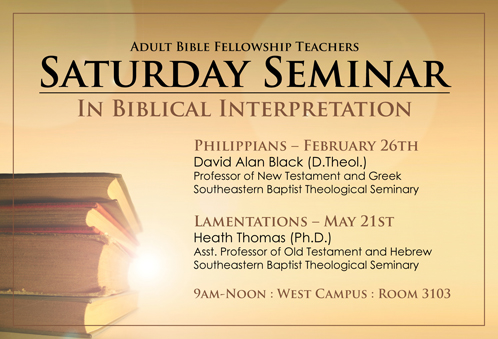
Dr. David Alan Black and Dr. Heath Thomas at Calvary Baptist Church

Sign Up Here

If you are a Bible Fellowship teacher, part of a Bible Fellowship teaching team, or even thinking about teaching, you will not want to miss this training opportunity to learn from two world class seminary professors! I am looking forward to having these two professors come and open God’s word with us.

Dr. David Black is Professor of New Testament and Greek at Southeastern Baptist Theological Seminary in Wake Forest, NC. He holds the D.Theol. in New Testament from the University of Basel (Switzerland) and has done additional studies in Germany and Israel. Dr. Black is considered a leading authority on linguistics and New Testament Interpretation. He has written over 100 articles and authored or edited over 20 books. Dr. Black is well known for his passion in teaching (watch here).

Dr. Heath Thomas is Assistant Professor of Old Testament and Hebrew at Southeastern Baptist Theological Seminary in Wake Forest, NC. He earned a Ph.D. in Old Testament from the University of Gloucestershire in Cheltenham (United Kingdom) and has also done studies at Oxford University. Dr. Heath Thomas has recently published a commentary on The Message and Meaning of the Book of Lamentations.

Coming soon will be an online registration form…


I found this post by Dr. Black on his blog:

I’ve been asked to do a 3-hour teachers’ workshop on Saturday, February 26, at Calvary Baptist Church in Winston-Salem, NC. What fun that will be! My assignment is to walk the teachers through the book of Philippians, which they will be teaching in their classes beginning in March. Exegeting a New Testament epistle is like working on a giant jigsaw puzzle of an ancient walled city in Europe. Just when you think you’ve figured out how to put together the walls, the ramparts, the towers, and the homes you encounter a blue, cloudless sky. The cry, “I got it”, is the final act of triumph. I’ll never forget the day I completed my essay on the discourse structure of Philippians (later published in Novum Testamentum). It was one of those “ah-ha!” moments the likes of which I shall never forget. I suspect that those who believe that “joy” is the theme of this New Testament book will be sorely disappointed with my essay. But as I read the epistle, I was forced to conclude that joy is at best the byproduct of something much more important.

I have said that this invitation is from a local church that is preparing its teachers to teach well and accurately. I cannot think of a better way to integrate seminary and church. Nor can I think of a single faculty member at SEBTS who would not be willing to place his or her expertise in the service of the church in such fashion.

We look forward to having both of you here! You can read an interview that Dr. Black did with Dr. Thomas here.

D. Martyn Lloyd Jones on “Seeking Happiness”

This past Sunday Will Toburen read this wonderful quote from D. Martyn Lloyd Jones in his sermon while commenting on Matthew 5:6. I wanted to share it here:

“There are large numbers of people in the Christian Church who seem to spend the whole of their life seeking something which they can never find, seeking for some kind of happiness and blessedness.  They go around from meeting to meeting, and convention to convention, always hoping they are going to get this wonderful thing, this experience that is going to fill them with joy, and flood them with some ecstasy.  They see that other people have had it, but they themselves do not seem to get it…Now that is not surprising.  We are not meant to hunger and thirst after experiences; we are not meant to hunger and thirst after blessedness.  If we want to be truly happy and blessed we must hunger and thirst after righteousness.  We must not put blessedness or happiness or experience in the first place.”

From Studies in the Sermon on the Mount, page 64.

As believers in Christ let us be thankful that He is our righteousness, and we are credited His perfect righteousness when we repent of our sinfulness and trust in Him as our only hope. With His righteousness comes the blessedness and happiness that humanity longs for.

A Christmas Devotional from Luke 2:1-20

Luke 2:1-20

In those days Caesar Augustus issued a decree that a census should be taken of the entire Roman world. (This was the first census that took place while Quirinius was governor of Syria.) And everyone went to their own town to register.

In those days it would appear that Augustus was the sovereign ruler of the entire known inhabited world. Imagine the power that one like that had – we are told that many under his rule would have viewed him as a divine king. Understandable, He established a Roman Empire that reigned throughout the world.

But here, for Joseph, Mary, and Israel as a whole, the alien intrusion and decree of a census was a reminder that they were a conquered people. Since Augustus had pronounced a census, all people travelled from here and there to fulfill his burdensome desire.

So Joseph also went up from the town of Nazareth in Galilee to Judea, to Bethlehem the town of David, because he belonged to the house and line of [King] David. He went there to register with Mary, who was pledged to be married to him and was expecting a child.

While they were there, the time came for the baby to be born, and she gave birth to her firstborn, a son. She wrapped him in cloths and placed him in a manger, because there was no guest room available for them.

Joseph and Mary arrive in Bethlehem before the delivery of Mary’s baby. While in Bethlehem they had trouble, in fact, they could not find lodging. Perhaps the village was over crowded with travelers for the census. But when the time finally came for Mary to give birth they had to find shelter. So they were directed to an animal stall where they could use a feeding trough to place their child in. Odd, unlikely – Never before has a King had such a lowly beginning, born in a animal stable, placed in a feeding trough, in an obscure village.

And there were shepherds living out in the fields nearby, keeping watch over their flocks at night. An angel of the Lord appeared to them, and the glory of the Lord shone around them, and they were terrified. But the angel said to them, “Do not be afraid. I bring you good news that will cause great joy for all the people. Today in the town of David a Savior has been born to you; he is the Messiah, the Lord. This will be a sign to you: You will find a baby wrapped in cloths and lying in a manger.”

Suddenly a great company of the heavenly host appeared with the angel, praising God and saying,

“Glory to God in the highest heaven,
and on earth peace to those on whom his favor rests.”

When the angels had left them and gone into heaven, the shepherds said to one another, “Let’s go to Bethlehem and see this thing that has happened, which the Lord has told us about.”

So they hurried off and found Mary and Joseph, and the baby, who was lying in the manger. When they had seen him, they spread the word concerning what had been told them about this child, and all who heard it were amazed at what the shepherds said to them. But Mary treasured up all these things and pondered them in her heart. The shepherds returned, glorifying and praising God for all the things they had heard and seen, which were just as they had been told.

In the narrative we move from an event, to a response. The narrative begins with the world ruler announcing a degree from his high and lofty throne. It is interesting how God works – on one level it was a man’s schemes (Augustus) who brought Joseph and Mary to Bethlehem – but it was God working though Augustus, Joseph, and Mary who orchestrated the whole event of Christ’s birth in order to fulfill what had been spoken of in the Prophets.

As we reach the point in the story where we see people responding to the event of Christ’s birth, who does God choose to reveal this great news to? God announces this glorious message to poor shepherds – to peasants, the outcasts of society. Reflecting on the narrative of the Shepherds provides a good opportunity for us to stop and consider what God has done in Christ.

1. In Christ we have been moved from ‘darkness’ into ‘light.’

Just as the Shepherds had moved from the dark coldness of night into the brilliant light of God’s glory (2:8-9), so to do we get to experience the warm and loving presence of God’s Spirit in our hearts by the grace of Jesus Christ our King when we repent of our sin and place our faith in Him.

Think about it, God’s glory was manifest around them. An angel spoke directly to them. They were surrounded by thousands of angels proclaiming that “peace on earth has come to those in whom God is pleased.” This is the meeting place of heaven with earth, of divine with man, here with the outcasts of society.

See, the good news comes to peasants, to outsiders, to the lowly. These are to ones who are lifted up to see the glory of God in his Son Jesus – our Savior, Messiah, and Lord. The wealth of this angelic pronouncement stands in stark contrast to the poverty of the shepherds.

2. In Christ we can move from ‘great fear’ to ‘great joy.’

In the narrative, the Shepherds trade their “great fear” in for “great joy” (2:9-10). The great joy is a response the good news that another ruler has been born, one who is loving and just, one whose dominion and power will be everlasting. And this Kingdom did not come in power through military force, through fearful conquering. Christ’s Kingdom came in power through loving sacrifice.

According to the angelic messengers, this is good news “for all the people”, peace has come on earth in Jesus the Messiah (2:10, 14). Yet, we all understand that this world is broken and confused; we understand that all of us are wrecked sinners. We are all spiritual peasants with nothing worthy to offer a Holy God. So how can this be good news for all people?

As we continue to read the Scriptures we find this King who was born in a stable growing up and offering His own life as a ransom for peasants like you and I. When we repent of our sin and trust in Jesus the King we will be saved. When this happens we have no reason to fear any longer, there is no more condemnation! See, He is a good King who gives us what we do not deserve out of His own good pleasure. His salvation moves us from the darkness of sin into the glorious light of his righteousness! His salvation moves us from being outcast peasants in fear to experiencing the riches of joy in fellowship with God!

This season is not only a reminder of Christ’s birth, but a call to look forward when He will come again. One day our King will return and all things will be made new. We will experience His glory and presence free from the poverty of our sinful natures, free from the brokenness of this world. I don’t know about you but I long for that day. And Christ’s birth announcement is a proclamation that our God reins, that His kingdom has been established. Those of us who have placed our trust in this King can proclaim with the Shepherds, with the Angels, that there is a rich wholeness in His salvation:

“Glory to God in the highest heaven,
and on earth peace to those on whom his favor rests.”

Merry Christmas!