The Seven Deadly Sins

tgpblog_851x315_sds

The Winter 2015 adult and student editions of The Gospel Project examined the truth of human sin and the beauty of God’s salvation. In conjunction with the studies, we launched a blog series on the Seven Daily Sins. Here is a list of the blog posts from the completed series.

Desiring God also released a free eBook titled Killjoys: The Seven Deadly Sins, you can download it here.

full_killjoysOur hearts were designed to enjoy a full and forever happiness, not the pitiful temporary pleasures for which we’re too prone to settle. Pride, envy, anger, sloth, greed, gluttony, and lust are woefully inadequate substitutes for the wonder, beauty, and affection of God. They will rob you, not ravish you. They will numb you, not heal you. They will slaughter you, not save you.

Killjoys was written to lead you deeper in love with our God and further into war against your sin. The truths, warnings, and promises in these pages are meant to chart a life-giving path to greater holiness and greater joy.

Balancing Ministry and Family

Southeastern Baptist Theological Seminary recently hosted a discussion between Drs. John Ewart, David Horner, and Jamie Dew about their experiences on how to balance time between work and family being a pastor. This is an important conversation that speaks into the intersection of the calling of pastoral ministry, family life, and church expectations.

The Cross of Christ and Human Pride

tgpblog_851x315_sds

This post first appeared at The Gospel Project blog.

We Are All Prideful, Aren’t We?

We all struggle with pride. It is a perpetual nagging temptation. Pride is what causes us to connect every experience and every conversation with ourselves. In a sense, pride is the sin beneath every other sin because at its core, pride is self-worship. What makes pride so dangerous is that it can be subtle, perverse, and sometimes undetectable.

Certainly there are people whose pride exudes from them as if it were a badge of honor. In some cases, this happens unknowingly. Pride has very effective ways of blinding self-awareness. And there are others who proclaim their humility by complaining about (or condemning) prideful people. How prideful! Even those who seem to be the least prideful of people—people quietly paralyzed by low self-esteem, anxiety, and worry—can actually be full of pride. To echo the words of the apostle Paul in Romans 7:24, what wretched men we are!

What Can We Do About Our Pride?

Feel exposed yet? Good. As long as you know that you are proud, you are safe from the most subtle form of pride. The first step of fighting pride is to realize that you are proud. And since pride and humility are direct opposites (Prov. 16:19; 29:23), shouldn’t we aim for humility? Yes, but this is not as simple as it seems. As C.S. Lewis once put it, “A man is never so proud as when striking an attitude of humility” (Christian Reflections). In other words, it is possible to adopt an outward demeanor of humility while burning with pride on the inside.

In order to develop true humility we need to take the focus off of ourselves entirely because true humility means we stop connecting every experience and every conversation with ourselves. To put it another way, Tim Keller says that the “… essence of humility is not thinking more of myself or thinking less of myself, it is thinking of myself less” (The Freedom of Self-Forgetfulness). And the only way to take the focus off ourselves is to be totally enraptured by something else.

How Can the Cross Deal with Our Pride?

To break our pride is to fix our eyes on God and bask in His beauty and splendor (Ps. 27:4). As long as someone is proud, they cannot know or love God (Ps. 10:4). True humility is the necessary condition of not only seeing God but also accepting His grace in Christ Jesus. No one stands before God looking down through their nose. Certainly, no Christian stands at the foot of the cross with their chest puffed out.

Before God we all, like Abraham, realize that we are mere “dust and ashes” (Gen. 18:27). We have nothing to be proud of. This gives us the deep humility we need. Yet, on the other hand, we also realize that in Christ God accepts us and loves us on the basis of His perfect life and sacrificial death. These truths crucify any reason for pride, as if we had one in the first place.

Hope for the Humble

Seeing that we can only boast in Christ—and in Christ alone—gives us hope (2 Cor. 10:17; Gal. 6:14). The Bible is clear: God opposes the proud and gives grace to the humble (Prov. 3:34; Jas. 4:6). So, one of the best ways to fight pride is to reflect continually on one’s true position before God, namely, as a dependent child (Matt. 5:3-5; 18:1-4). We are dependent on Christ and on what He has done on our behalf (Matt. 20:28; Rom. 5:7,10). The good news is that Christ’s work is perfect and complete, lacking nothing. Even better, we have a Father who loves us dearly.

See, proud people rely on themselves, and seek their own glory. Humble people realize they are reliant on God, and in response to His love, they seek to live for His glory. Pride gives us the deadly illusion that we are competent to run our lives, attain our sense of worth, and find purpose or meaning on our own. However, pride ends in a fall (Prov. 29:23). On the other hand, “The poor in spirit are blessed, for the kingdom of heaven is theirs” (Matt. 5:3).

“Gather” by Philip Nation

This past Sunday at The Fellowship we started a sermon series exploring our vision as a church: “We will do whatever it takes to make disciples of Jesus Christ who gather, grow, and go.” This sermon on gathering is by Philip Nation.

Fifteen Trends for Churches for 2015

happy-new-year-2015-image-3d-HD-wallpaper
Over the weekend Thom Rainer presented 15 trends for the church for 2015. They are presented in reverse order of their potential magnitude. His predictions are below:

15. A rapid increase in bi-vocational church staff. We have noted the growing trend of bi-vocational pastors. We will see in 2015 an accelerated trend of other church staff becoming bi-vocational.

14. The tipping point of churches eliminating Sunday evening worship services. We see the number of U. S. churches offering a Sunday evening service to dip below 5 percent of all churches in America. In other words, this service will become almost extinct.

13. More emphasis on congregational singing. In many of our churches, both traditional and contemporary, you can hardly hear the congregation sing. There will be an increased emphasis on intentionally bringing the congregants into worship through singing.

12. Growth of verbal incarnational evangelism. Incarnational evangelism is simply defined as presenting the good news through our Christ-like lifestyle to non-believers. There will be an increased emphasis to share the gospel verbally as well as demonstrating a gospel witness through our lifestyle.

11. The waning and reconfiguration of denominational structures. This trend is already taking place, but it will accelerate in 2015. Denominational structures will continue to get smaller and more streamlined, and churches will not be able to expect the same type of resources they have received in the past.

10. Congregations growing in favor in their respective communities. Churches are transitioning from being an island in the midst of their communities to being a real and positive presence. As church members seek to serve their communities in a plethora of ways, the communities will see these churches more as valued partners.

9. Continued flow of people from smaller churches to larger churches. There will be a continued increase in the number of attendees in churches with an average worship attendance of 1,000 and larger. Churches with an attendance of 400 to 999 will be collectively stable in attendance. And the number of people attending church in congregations with an attendance under 400 will decline.

8. More partnerships between denominations and churches. Of course, not all churches belong to a denomination. For those that do, denominational entities typically created the resource or mission opportunity and churches would follow their lead. In 2015 we will see more “bottom up” partnerships, meaning that churches lead the partnerships, but denominations participate in them. That is particularly true for seminaries. That issue is thus a separate trend, noted in the number 7.

7. More focus on theological education in local churches. I am not among the pundits who believe that seminaries will become extinct. They still have a vital role for training ministers. I do see, however, a continued shift for more theological education taking place in local congregations. The successful seminaries in the upcoming years will seek to partner with churches rather than compete with them.

6. The tipping point for a plurality of teaching pastors. In the recent past, churches that had more than one regular preacher or teaching pastor were an anomaly, and they were usually very large churches. In 2015 multiple teaching pastors will become normative, and they will be pervasive in smaller churches as well.

5. Continued increased in the number of multi-site churches. Two years ago, the multi-site movement in America reached a tipping point. Their growth will continue unabated in 2015.

4. The beginnings of prayer movement in our churches. I am seeing the growth of more and more organizations dedicated to prayer in the local church. I am observing this passion become a greater emphasis with pastors, particularly Millennial pastors.

3. The tipping point for small groups. The evidence for the efficacy of small groups in the local church is too overwhelming to be ignored. I see a new movement of “groups” taking place that will be similar in growth as the Sunday school movement was in the late 19th century through the first half of the 20th century.

2. Increased difficulty in matching prospective pastors with churches with pastoral vacancies.This trend is growing and frustrating to both pastors and those in churches seeking pastors. It is particularly frustrating for those churches that use the pastoral search committee model. I will not be surprised to see that model begin to change in 2015.

1. Smaller worship gatherings. The era of the large worship gathering is waning. Churches that are growing will likely do so through multiple services, multiple venues, and multiple sites. This trend will accelerate through the growing influence of Gen X and the Millennials.

“God With Us!” Charles Spurgeon on Isaiah 7:14-15

In 1854, Charles Spurgeon preached a Christmas Eve sermon on Isaiah 7:14-15. A portion of that sermon has been turned into this video. You can read the whole sermon here.

A Time To Speak

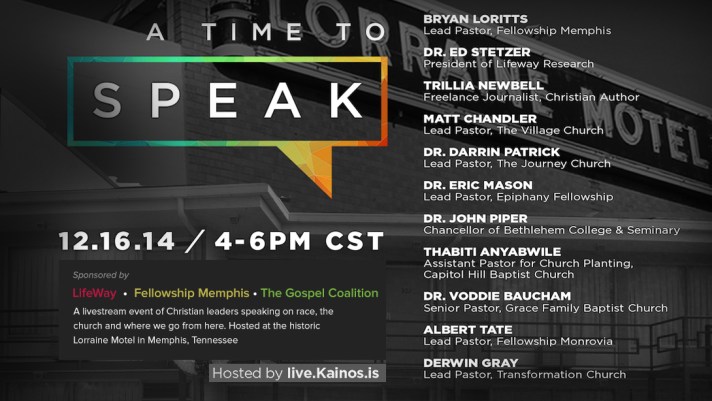
a-time-to-speak

Today, December 16th, a panel of Christian leaders will gather at the Lorraine Motel in Memphis, Tennessee to discuss race, the church, and what we can do from here. The Lorraine Motel is a significant location for this event. On April 4, 1968, Dr. Martin Luther King, Jr. was killed at the Lorraine Motel. Today, it is the National Civil Rights Museum in the United States and will be the host for this event.

Here’s a brief explanation from the event’s organizer, Pastor Bryan Loritts:

“We want to boldy declare there is hope…The grand jury’s decision not to indict the officers involved in the deaths of Eric Garner and Michael Brown has left many in our nation angry, saddened and hopeless…The fact that such heart-wrenching decisions have taken place some 50 years after the civil rights movement have left the children of those who marched in such places as Birmingham and Selma wondering if justice has not only been delayed, but has she finally and permanently been denied.”

A number of well-known Christian leaders will aim to bring their wisdom and love for the gospel in this discussion panel. As Ed Stetzer has said, “We want to listen well, dialogue on the issues, and point to Jesus.” Here are the pastors and leaders slated to take part in this discussion:

  • Bryan Loritts, pastor of Fellowship Memphis
  • Trillia Newbell, writer and author
  • Matt Chandler, pastor of The Village Church in Dallas-Fort Worth
  • Darrin Patrick, pastor of The Journey Church in St. Louis
  • Eric Mason, pastor of Epiphany Fellowship in Philadelphia
  • John Piper, chancellor of Bethlehem College and Seminary
  • Thabiti Anyabwile, assistant pastor for church planting at Capitol Hill Baptist Church in Washington, D.C.
  • Voddie Baucham, pastor of Grace Family Baptist Church in Spring, Texas
  • Albert Tate, pastor of Fellowship Monrovia in Monrovia, California
  • Derwin Gray, pastor of Transformation Church in Indian Land, South Carolina

The event is not open to the public, due to our location and our limited time there, but anyone can watch online on Tuesday afternoon from 4pm to 6pm CT (5pm to 7pm ET). It is expected to be widely viewed and discussed – so join in. The discussion will be honest and Christlike, and the hope of the panelists is that the viewers will benefit from their time together.

Click here to visit the website. 

The Resurrection and the Life (John 11:1-44)

This is the sermon I preached at The Fellowship at Two Rivers on 12/14/2014.

The Kingdom of God: A Blog Series

blogheader_godskingdom_620x349

This fall, The Gospel Project for Adults and Students have been on a journey through the story line of Scripture once again, this time looking at the theme of God’s kingdom. With every study we run a corresponding blog series as an additional resource for churches and groups using The Gospel Project. Here are the posts focused on the kingdom of God, and its implications for everyday life.

Every week, we pray for people studying the Bible and using The Gospel Project. This fall, we are praying God reveals the hidden idols of our hearts, magnifies the greatness of King Jesus, and transforms us into heralds of the returning King. May God make us a people who live under the lordship of Christ and speak of His excellency to those around us who have not yet bent the knee. The King has a mission, and we are His messengers.

The Long Awaited King

blogheader_godskingdom_851x315

We All Long for a True King

Most of us have not experienced what it is like to live in a kingdom, under the true reign of a king. We are familiar with kingdom language. Michael Jackson once reigned as the “king of pop.” Budweiser notoriously declares in their advertisements that they are “the king of beers.” Even LeBron James refers to himself as “King James” and supposedly rules the hardwood. But in reality, this language is devoid of any lasting meaning, missing the essence of true kingship.

Why does this matter? In every society, there is the structure for leadership, a particular person or a body of people to reign over its citizens. Human society needs the structure of justice to deliver its people from the cruelty of the sinful acts of men. Human civilization needs to provide protection over its people to promote what is good and guard peace in the land. We all want someone to look to, to lead the way, to make the difficult calls in order to seek our welfare. However, as history has shown, we have never seen that perfect king-like leader. We have never experienced the perfect and pure rule of a king. Even our best leaders are flawed, and our worst leaders can be tyrants.

However, while the human experience leaves us longing for the perfect rule of a perfect king, the Bible provides us with a more meaningful, hope-filled understanding of true kingdom reign. In the Bible, kings are to reign over every domain of life in their land; they are to have real authority to be used for the good of the people. And while God rules sovereignly over the universe, in the Bible, kings are called to mediate God’s justice to the people. In other words, the kings of earth are to rule as God’s vice-regents, His under-kings. Nevertheless, even the promising kings of the Old Testament left the people longing for a greater king.

The Kings of the Bible

While Adam did not have the title of king, he was called to rule as a king on the earth. Before the fall in Genesis 3, Adam and Eve were appointed by God to rule as His vice-regents to govern the earth and everything in it on His behalf. They were not only called to represent God’s sovereign rule by subduing creation but also to spread His dominion throughout the earth (Gen. 1:26-28). Eden was established as God’s kingdom on earth – the place where God’s people would dwell in God’s place, under God’s rule. However, in Genesis 3 we see that Adam attempted to dethrone God and forfeit his under-king status by siding with the enemy. And Eden was lost.

Later on, once God had established Israel as His covenant people and brought them to the promised land, He appointed judges as rulers over them. In a sense, the judges represented God’s rule in the lives of God’s people by delivering them from the folly of their sin (Judg. 2:14-23). The judges came, they delivered, but with no lasting blessing or security. There was some relief but no lasting solution. The people of Israel then cried out for a king to bring security and to lead them in faithfulness to God. And partially, they received what they asked for.

The reigns of Saul, David, and Solomon gave Israel a glimpse of hope. With each new king, Israel yearned anew. However, with great hope came also great disappointment. Saul turns out to be corrupt and downright crazy (1 Sam. 15). While David was a man after God’s own heart, his adultery with Bathsheba and his crime of murder revealed that he was not the perfect king (2 Sam.11). David’s son Solomon may have ruled in wisdom and with great riches, but while Solomon’s reign began with such hope, it ended in horror (1 Kings 11:1-4).

As the king went, so did the people. One of the lessons we learn from the Old Testament is that unless there is a good king, no aspect of life will be as it should be. The Old Testament leaves us longing. Along with the people of Israel we cry out, “There must be someone better than this!” There must be someone better than these men.

The True and Greater King

“Kingdom” is one of the primary themes of the Bible’s storyline, and this storyline finds its climax in the person and work of Jesus Christ. Our hopes for a greater king are fulfilled in the coming of Jesus Christ.

In the Gospel accounts alone, there are more than one hundred references to the kingdom of God (or “kingdom of heaven,” as in Matthew). In John, Jesus speaks of the kingdom of God as His kingdom (3:3,5; 18:36). Moreover, the New Testament writers indicate that the kingdom of Christ is the same thing as the kingdom of God (Eph. 5:5; Rev. 11:15; 12:10). According to Jesus, He is the true King for whom all of humanity has longed.

Jesus is the perfect King who rules with justice. Jesus not only seeks but is able to bring lasting welfare for the people. So, even with their flaws, the good aspects of the Old Testament kings give us a glimpse of what was to come. In other words, all of the biblical accounts of earlier kings cast King Jesus’ shadow. Jesus is the last Adam who will reign and exercise dominion over the restored Eden (Rev. 22:1-5). Jesus is the true Judge and King who reigns in His unshakable kingdom (Heb. 12:22-24,28). Jesus is both the son of David and the Son of God, the king from the line of David whose throne and dominion is everlasting (Luke 1:32-33).

With the coming of Jesus, the kingdom is present (Luke 17:20-22; Rev. 1:9). Yet, the kingdom is also future (Rev. 11:15). As Christians, we know that the full reality of His rule awaits His second coming (Matt. 13:30,39,47-50; 25:1-13; 2 Tim. 4:1). We also know that in Him, all of our hopes are fulfilled. Jesus is the true and greater King we have all been waiting for. Therefore, let us bow before the true King. He is worthy of our adoration and allegiance. Jesus’ rule extends to every aspect of our lives and therefore we serve him as under-kings in every realm of life (e.g., work, school, parenting, household chores, recreation, etc.).

And let us longingly wait for His return, when all things will be as they should. Eden may have been lost by the failures of the first king Adam, and no other human king has been able to restore it. But one day, Jesus will return, and with His return, His kingdom will be consummated and a greater Eden be restored.